

AI CERTs
4 months ago
Automated Trading Risk Exposed in Crypto Flash Crash
Crypto markets learned a painful lesson in October 2025. Within one frenzied hour prices collapsed and rebounded, shocking traders and regulators. The episode spotlighted Automated Trading Risk at unprecedented scale. Moreover, it exposed how leverage, thin liquidity, and synchronized algorithms can accelerate chaos. Analysts compared the collapse to earlier flash crashes across Stocks and currencies. However, the crypto event dwarfed previous records with $19 billion in forced liquidations. Approximately 1.6 million accounts were wiped inside minutes, according to CoinGlass. Consequently, global Finance watchdogs prioritized new rules for algorithmic systems. This article examines the mechanics, data, and policy fallout behind the shock. It also outlines practical steps professionals can take to navigate rising Volatility. Finally, we explore skills and certifications that help Agents build safer trading infrastructures.
Crypto Flash Crash Recap
Observers trace the trigger to a macro policy tweet on 10 October 2025. Immediately, Bitcoin plunged 14 percent while altcoins dived deeper. Meanwhile, liquidity across major venues evaporated as market-making algorithms withdrew quotes.
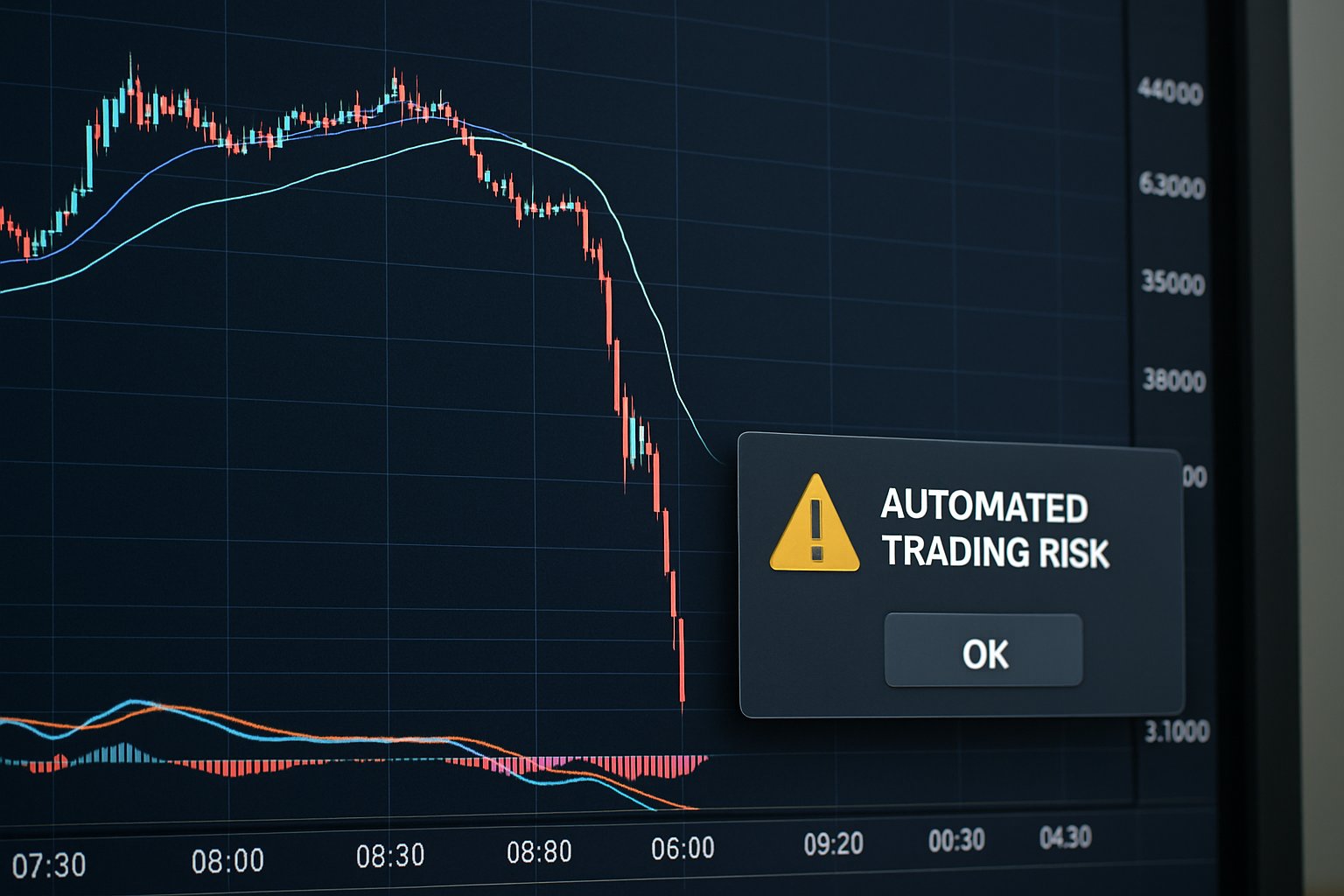
Consequently, liquidation engines fired simultaneously, creating a downward spiral. CoinGlass logged $19.3 billion in forced closures, the largest single-day tally on record. This moment illustrated Automated Trading Risk interacting with extreme leverage and fragile collateral rules.
These events reveal systemic fragility. However, deeper analysis of algorithmic feedback loops clarifies why losses snowballed.
Algorithmic Feedback Loop Dynamics
Algorithms respond within microseconds to price moves and risk flags. In contrast, human intervention requires longer reaction time.
Moreover, common data feeds and shared machine-learning models create herding. When one node de-risks, correlated Agents follow, draining order books.
Therefore, Automated Trading Risk scales non-linearly; once spreads widen, each succeeding liquidation magnifies the gap.
Loops like these convert shocks into self-reinforcing crashes. Consequently, leverage becomes the next accelerant.
Leverage And Liquidations Explained
Open interest exceeded $100 billion before the crash, according to exchange reports. Moreover, cross-margin products let traders collateralize multiple positions with a single volatile asset.
- Bitcoin fell 14% intraday, while some tokens lost over 30%, amplifying Volatility.
- Forced liquidations hit $19.3 billion, according to CoinGlass data.
- About 1.6 million accounts closed, illustrating the human impact of Automated Trading Risk.
- Open interest across crypto derivatives topped $100 billion before the crash, regulators in Finance noted.
Such structural leverage converted an ordinary price dip into a forced selling cascade. Automated Trading Risk, therefore, met leverage head-on, producing a liquidation tsunami.
This cascade highlights leverage as a flash-crash accelerant. Nevertheless, regulatory scrutiny has intensified in response.
Regulatory Alarm Bells Ring
Subsequently, the SEC cited the flash crash in December 2025 testimony. IMF and FSB teams likewise accelerated consultations on AI in Finance.
Nevertheless, regulators admitted data gaps hinder precise attribution. They urged exchanges to share granular order-book logs for future Stocks like products.
Automated Trading Risk appeared in every briefing as a top systemic threat.
Regulators now draft stricter safeguards. Meanwhile, industry actors debate implementation costs.
Persistent Risk Management Gaps
Many venues lacked centralized kill-switches for liquidation engines. Furthermore, oracle prices diverged between platforms, triggering unnecessary liquidations.
Market-makers such as Wintermute withdrew liquidity when internal thresholds tripped. Consequently, depth evaporated exactly when traders needed it.
These shortcomings compounded Automated Trading Risk and fed the spiral.
Operational weaknesses remain conspicuous. However, proposed safeguards could narrow outstanding gaps.
Proposed Market Safeguard Measures
Industry groups propose dynamic circuit breakers calibrated for crypto Volatility. Moreover, stress-test regimes may adjust margin in real time.
Regulators are exploring standardized price oracles and capital penalties for unsafe leverage. In contrast, some exchanges pledge compensation pools financed by trading fees.
Adopting these tools could reduce Automated Trading Risk before the next shock. Nevertheless, implementation costs remain a hurdle for smaller Agents.
Safeguards promise stronger resilience. Consequently, professionals need updated competencies to apply them effectively.
Essential Skills For Professionals
Professionals managing digital assets must deepen cross-domain understanding. Moreover, expertise in AI model governance, risk analytics, and market microstructure is critical.
Practitioners can validate competencies through the AI Engineer certification. The program covers algorithm auditing, data pipeline integrity, and regulatory compliance.
Completing such programs helps Agents navigate Automated Trading Risk with confidence while steering portfolios through extreme Volatility and shifting Stocks correlations.
Upskilling builds institutional resilience. Therefore, readers should evaluate relevant training pathways now.
Crypto flash crashes offer stark reminders. Automated Trading Risk grows alongside market complexity. Moreover, correlated algorithms, excessive leverage, and fragmented liquidity can still collide disastrously. Regulators worldwide are drafting circuit breakers, stronger margin rules, and transparent data mandates. Meanwhile, industry players refine real-time monitoring and shared oracles to tame Volatility. Professionals who cultivate robust skills, adopt disciplined risk controls, and pursue certifications will guide Finance toward safer innovation. Act today by reviewing the AI Engineer credential and preparing teams to withstand the next high-speed turmoil.
Disclaimer: Some content may be AI-generated or assisted and is provided ‘as is’ for informational purposes only, without warranties of accuracy or completeness, and does not imply endorsement or affiliation.


