

AI CERTS
2 hours ago
XPENG’s Physical AI Push: VLA 2.0, Robotaxis, and Beyond
Industry professionals will gain concrete statistics, launch milestones, and critical risk assessments. Meanwhile, opportunities for upskilling through specialized certifications also surface. Therefore, read on to understand how the automaker positions itself within the global Intelligent Driving race. In contrast, skeptics warn that aggressive timelines may collide with regulatory and manufacturing realities. Nevertheless, XPENG insists its data advantage and Turing chip will accelerate deployment.
XPENG Ecosystem Overview Today
The automaker delivered 429,445 vehicles in 2025, marking 125.9% annual growth. Moreover, the firm reorganized internal units to align cars, robots, and aerial vehicles under one leadership. Consequently, the Beijing R&D hub now steers cross-domain engineering. Investors heard this narrative during the FY-2025 call, where CEO He Xiaopeng cited a historic inflection point. Subsequently, Morgan Stanley reiterated an Overweight rating, calling the strategy "a bold leap forward".
Physical AI Defined Clearly
XPENG uses the term Physical AI to describe systems that perceive images, understand language, and output real-world actions. Unlike pure digital assistants, these models must coordinate sensors, compute, and mechanical components safely. Consequently, software updates interact directly with steering racks, robotic joints, or propellers. Therefore, the company argues vertical integration is non-negotiable.
The ecosystem spans VLA 2.0, the Turing chip, Ultra vehicle trims, IRON humanoids, and ARIDGE eVTOL craft. Additionally, a dedicated robotaxi business unit now oversees Level-4 service preparation. Meanwhile, Volkswagen partners on first external deployments of the AI stack. These developments underscore the firm's ambition and set the technical context for later sections.
VLA 2.0 Model Architecture
Intelligent Driving Data Scale
VLA 2.0 anchors the automaker's Intelligent Driving strategy. Moreover, the cloud variant holds about 72 billion parameters trained on 100 million driving clips. Consequently, XPENG equates that dataset to 65,000 human driving years. Inference cycles refresh every five days, according to company materials. Nevertheless, independent labs have not yet validated those claims.
On-vehicle, distilled models run on 2,250 TOPS using one to four Turing chips. Therefore, the company says Ultra trims can execute complex lane-change reasoning without LiDAR. In contrast, robotaxi prototypes allocate up to 3,000 TOPS for redundancy. These hardware capabilities enable continuous improvement via over-the-air updates.
- Cloud model: 72B parameters, 30,000 GPUs, five-day iteration cadence.
- On-vehicle compute: Up to 3,000 TOPS, pure-vision sensors, quarterly hardware refresh.
These figures illustrate the automaker's scale advantage. However, validation will determine whether the numbers translate into safer roads.
Let us next examine the commercialization roadmap and associated risks.
Robotaxi Roadmap And Risks
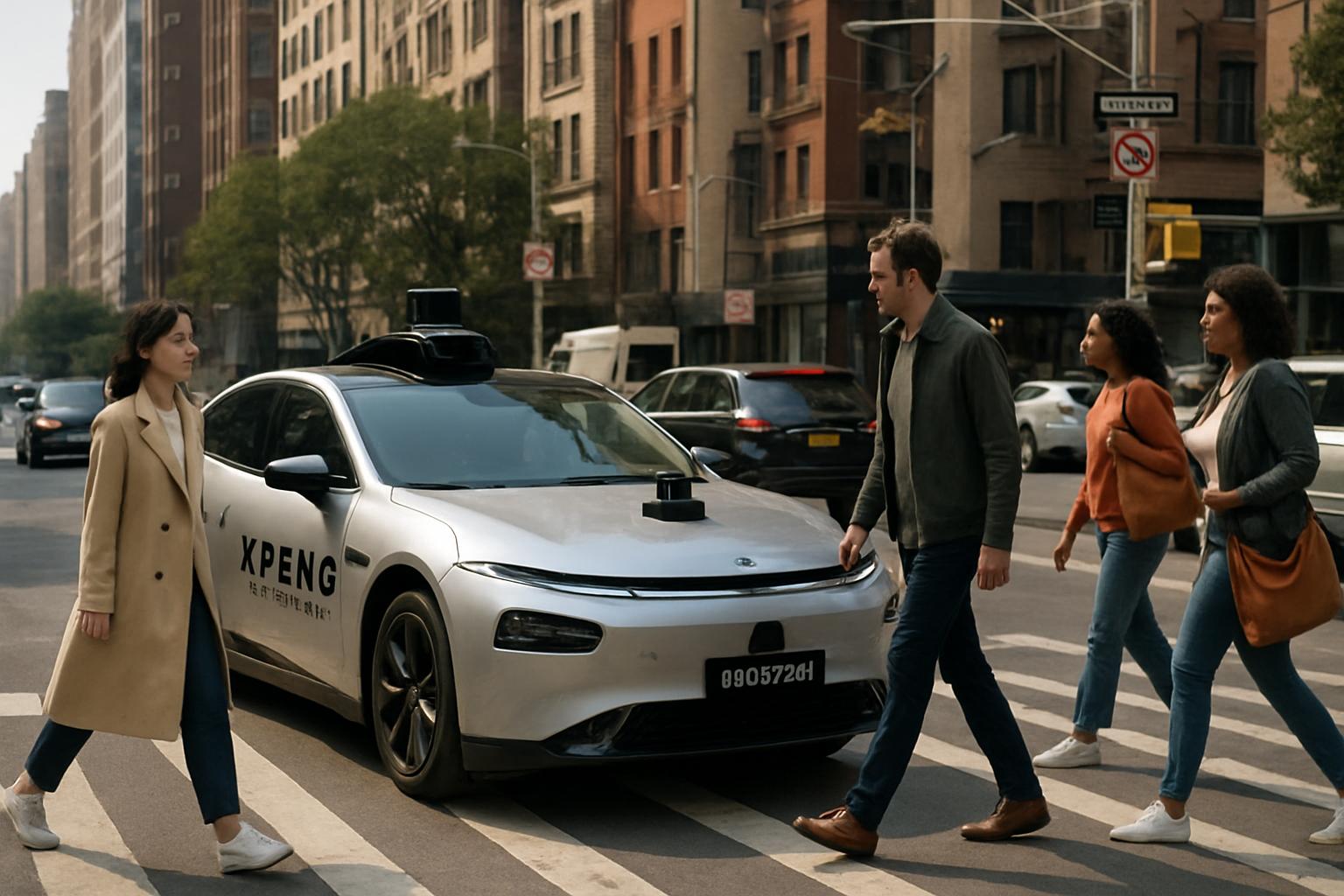
XPENG targets pilot robotaxi rides in the second half of 2026. Additionally, three vehicle variants—five, six, and seven seats—will share the core VLA 2.0 platform. Consequently, hardware will omit LiDAR to cut cost and rely on enhanced camera perception. Regulators must still approve Level-4 services, and the firm has yet to disclose specific city permits.
Moreover, safety validation will involve disengagement reporting and public road miles. Independent statistics remain scarce, raising questions about timeline realism. Nevertheless, the company insists data breadth will shorten the regulatory review cycle. Volkswagen's involvement may also reassure European regulators.
Robotaxi deployment promises new revenue streams. However, unresolved safety metrics could delay commercialization.
We now shift to the automaker's parallel ventures in humanoid robots and aerial mobility.
Humanoid And Aerial Plans
IRON, the second-generation humanoid, debuted at AI Day with dexterous manipulation demos. Furthermore, the company stated mass production may start by late 2026. Subsequently, Baosteel agreed to trial the robot in industrial inspection scenarios. In parallel, ARIDGE eVTOL prototypes completed several tethered flight tests. Consequently, XPENG markets a unified Physical AI stack for ground and air domains.
However, aerospace certification timelines traditionally dwarf automotive approval cycles. Manufacturing carbon-composite airframes at scale also poses supply-chain challenges. Therefore, analysts caution against assuming immediate revenue from flying cars.
These ambitious products extend the brand narrative. Nevertheless, execution risk remains significant given historical industry hurdles.
Next, we evaluate broader market ramifications and competitive positioning.
Global Market Impact Assessment
The automaker now competes directly with Tesla, NIO, Li Auto, and chip vendors like Nvidia. Moreover, Volkswagen's adoption of VLA 2.0 signals potential licensing revenue beyond vehicle sales. Consequently, Physical AI could emerge as the automaker's distinguishing export if geopolitical barriers remain manageable. Intelligent Driving alliances may also deepen as OEMs search for scalable Level-4 solutions.
Financially, the automaker posted triple-digit delivery growth yet still invests heavily in data centers and silicon. In contrast, competitors rely on third-party chips, limiting optimization options. Therefore, the company argues its Physical AI stack provides cost leverage over time. Nevertheless, sustained capital expenditure could pressure margins before licensing fees materialize.
- Pros: Vertical integration, scalable data, diversified revenue paths.
- Cons: Regulatory uncertainty, manufacturing complexity, high capital burn.
These factors will influence investor sentiment through 2026. Meanwhile, professionals should monitor third-party safety audits for tangible proof.
The following conclusion synthesizes actionable insights and upskilling opportunities.
XPENG's Physical AI initiative links chips, models, and machines into one controlled loop. VLA 2.0 fuels Intelligent Driving today while laying groundwork for robotaxi, humanoid, and aerial services tomorrow. Moreover, cloud scale, in-house silicon, and strategic partners like Volkswagen underpin the commercialization roadmap. Nevertheless, regulation, safety validation, and manufacturing scale could delay revenue realization. Consequently, professionals should track pilot metrics, audit reports, and market adoption curves carefully.
Meanwhile, those seeking leadership roles in robotics can formalize skills through the AI-Robotics™ certification. Therefore, mastering Physical AI concepts now positions talent for the next wave of mobility innovation. In contrast, ignoring Physical AI advancements risks falling behind faster-moving global competitors.


