

AI CERTS
18 hours ago ATP
Shen Xu’s Global Recognition Award Highlights Why AI Training Is Essential for the Future of Intelligent Decision-Making
Artificial intelligence is rapidly evolving from a tool that automates repetitive tasks into a technology that actively supports strategic decision-making. Across industries, AI is influencing business operations, economic planning, customer engagement, healthcare, finance, and public administration. As organizations place greater trust in AI-powered systems, the ability to understand, govern, and deploy these technologies responsibly has become a business priority rather than a technical advantage.
This shift is reflected in the recent recognition of researcher Shen Xu, who received the 2026 Global Recognition Award for advancing AI-mediated decision systems and economic coordination frameworks. The award acknowledges contributions that explore how AI can reshape decision-making processes and improve coordination across increasingly complex economic systems. It also reinforces an important message for organizations worldwide: AI innovation delivers the greatest value when professionals possess the knowledge and skills to implement it effectively.
Understanding the Significance of AI-Mediated Decision Systems
Modern AI systems are doing much more than generating text or analyzing datasets. They are becoming intelligent decision-support systems capable of processing massive amounts of information, identifying patterns, recommending actions, and assisting leaders in making faster and more informed decisions.

Shen Xu's work focuses on AI-mediated decision systems, a concept that examines how AI increasingly influences interactions between people, businesses, and digital platforms. Rather than simply supporting human decisions, these systems are gradually becoming active participants in business workflows, changing how organizations coordinate resources, evaluate opportunities, and respond to market changes. His research also explores how AI may reshape economic coordination as intelligent systems become embedded in everyday operations.
The recognition demonstrates that AI research is progressing beyond model development toward building practical frameworks that help organizations operate more intelligently and efficiently.
Why This Matters for Businesses Across Every Industry
Organizations are investing heavily in AI technologies to improve productivity, optimize supply chains, personalize customer experiences, detect fraud, automate operations, and strengthen strategic planning. However, technology alone cannot deliver these outcomes.
Many AI initiatives struggle because employees lack the expertise to interpret AI outputs, integrate AI into business processes, manage governance requirements, or evaluate ethical implications. As AI systems become more influential in operational and strategic decisions, businesses require professionals who understand both the technology and its practical applications.
Global discussions around responsible AI continue to emphasize that education and workforce development are essential for scaling trustworthy AI. Building organizational capability requires professionals who can combine technical understanding with governance, ethics, and business strategy.
The Growing Need for AI Training
Recognition of groundbreaking AI research highlights another reality: innovation creates demand for skilled professionals. Every advancement in AI introduces new tools, workflows, governance models, and business opportunities that require trained individuals to implement successfully.
AI training equips professionals to understand machine learning concepts, AI governance, prompt engineering, responsible AI practices, automation strategies, data-driven decision-making, and emerging enterprise applications. These skills help organizations reduce implementation risks while increasing confidence in AI adoption.
Instead of viewing AI as a replacement for human expertise, trained professionals learn how to collaborate with intelligent systems, validate AI recommendations, maintain transparency, and ensure AI aligns with organizational objectives. This combination of technical knowledge and strategic thinking enables businesses to generate measurable value from AI investments.
As AI becomes integrated into more decision-making environments, professionals who continuously build AI competencies will be better prepared to lead digital transformation initiatives and contribute to long-term organizational success.
Key Lessons Organizations Can Learn
The recognition of Shen Xu's work offers valuable lessons for business leaders and professionals navigating the AI era. First, AI is becoming a strategic decision partner rather than simply an automation tool. Second, organizations must invest not only in AI technologies but also in developing people who can implement them responsibly. Third, governance, transparency, and human oversight remain fundamental as AI systems become more sophisticated.
Perhaps the most important takeaway is that successful AI adoption depends on workforce readiness. Organizations that prioritize continuous learning are more likely to unlock AI's full potential while minimizing operational, ethical, and regulatory challenges. As global innovation accelerates, AI literacy is becoming an essential capability across leadership, technical, and business functions.
Preparing the Workforce for an AI-Driven Future
The pace of AI innovation shows no signs of slowing. Research into intelligent decision systems, autonomous agents, and AI-assisted economic coordination continues to shape how industries will operate in the years ahead. Businesses that prepare their workforce today will be better positioned to adapt to these changes and maintain a competitive advantage.
Building AI capability is not limited to data scientists or engineers. Executives, managers, analysts, marketers, HR professionals, cybersecurity teams, finance specialists, and operations leaders all benefit from understanding how AI can enhance their specific roles while supporting responsible business practices.
Conclusion
As AI research continues to redefine intelligent decision-making, organizations need skilled professionals who can transform innovation into measurable business outcomes. Becoming an Authorized Training Partner (ATP) with AI CERTs® enables training providers to deliver globally recognized AI certification programs that help individuals and organizations build practical AI expertise across multiple domains. Through comprehensive learning pathways, industry-aligned certifications, and workforce development opportunities, the AI CERTs Authorized Training Partner Program empowers organizations to prepare professionals for the evolving demands of an AI-driven economy.
AI CERTS
18 hours ago ATP
Capco’s OpenAI Governance Award Highlights Why AI Training Is the Foundation of Responsible Enterprise AI
Artificial intelligence is transforming the financial services industry at an unprecedented pace, but innovation alone is no longer enough. As organizations deploy AI across critical business functions, the ability to govern these systems responsibly has become just as important as building them. This shift was recently reinforced when Capco received OpenAI's AI Governance & Risk Excellence Award, recognizing its leadership in delivering secure, compliant, and enterprise-grade AI solutions for highly regulated industries.
The recognition reflects a growing industry reality that responsible AI has become a competitive advantage rather than just a regulatory requirement.
The achievement sends a clear message to organizations worldwide. The future belongs to businesses that can balance AI innovation with governance, transparency, and risk management. However, reaching that level of maturity requires more than investing in AI technologies. It demands continuous AI education and workforce development.
Responsible AI Is Becoming a Business Imperative

Financial institutions operate in one of the world's most regulated environments, where every AI-driven recommendation or automated decision carries significant business, legal, and customer implications. From fraud detection and credit risk assessment to customer service automation and compliance monitoring, AI systems must be accurate, explainable, secure, and aligned with regulatory expectations.
Capco's recognition demonstrates how organizations are successfully embedding governance into AI deployment rather than treating it as an afterthought. The company's expertise in helping enterprises scale AI while reducing operational risk and strengthening compliance illustrates the direction the industry is taking. Enterprise AI success today depends on governance frameworks that ensure AI systems remain trustworthy throughout their lifecycle.
AI Governance Requires Skilled Professionals, Not Just Technology
One of the biggest misconceptions surrounding enterprise AI is that governance can be solved entirely through software platforms or automated controls. In reality, governance begins with people who understand AI technologies, regulatory requirements, ethical considerations, and organizational risk.
Whether organizations are implementing generative AI, predictive analytics, intelligent automation, or AI-powered customer experiences, every project requires professionals capable of evaluating model performance, identifying bias, protecting sensitive information, ensuring transparency, and aligning AI initiatives with business objectives.
Without trained professionals, even the most advanced AI platforms can introduce compliance risks, inconsistent decision-making, and reputational damage. As AI adoption accelerates across industries, the shortage of professionals with practical AI governance knowledge continues to grow, making structured AI training more valuable than ever.
The Biggest Lesson Businesses Can Learn
Capco's achievement offers an important lesson for organizations planning their own AI transformation journeys. Successful AI adoption is not measured by how quickly an organization deploys AI tools but by how confidently it can scale them across business operations.
This confidence comes from building AI literacy across leadership teams, technical professionals, compliance specialists, risk managers, and operational staff. When employees understand how AI models work, where risks emerge, how governance frameworks operate, and how responsible AI principles are applied, organizations become better equipped to innovate while maintaining customer trust.
In many cases, AI initiatives fail not because the technology is inadequate, but because organizations lack the internal expertise needed to implement AI responsibly. Investing in workforce capabilities therefore becomes just as important as investing in AI infrastructure.
AI Training Bridges the Gap Between Innovation and Governance
As enterprises move from AI experimentation to enterprise-wide deployment, training has become the bridge between technological capability and responsible execution. Comprehensive AI education equips professionals with practical knowledge of AI fundamentals, governance frameworks, ethical AI practices, regulatory compliance, data management, prompt engineering, model evaluation, and real-world implementation strategies.
This knowledge enables organizations to create AI strategies that are sustainable, scalable, and aligned with evolving business requirements. More importantly, trained professionals become catalysts for responsible innovation, helping organizations maximize AI's potential while minimizing operational and regulatory risks.
The growing recognition of organizations leading in responsible AI governance reinforces a simple truth: successful AI transformation starts with knowledgeable people who understand both the opportunities and the responsibilities that AI brings.
Empower Organizations Through AI CERTs Authorized Training Partner
Organizations looking to build future-ready AI capabilities can benefit from partnering with the AI CERTs Authorized Training Partner (ATP) network. Through globally recognized AI certification programs, ATPs help businesses, educational institutions, and professionals develop practical AI skills across governance, leadership, cybersecurity, data, cloud, marketing, development, and many other domains. By delivering industry-aligned training that combines technical knowledge with responsible AI practices, Authorized Training Partners enable organizations to create a workforce capable of adopting AI confidently, ethically, and at scale.
Learn more about becoming an AI CERTs Authorized Training Partner here: AI CERTs Authorized Training Partner Program
AI CERTS
19 hours ago ATP
Industrial Automation Accelerates in 2026 as AI Humanoids and Smart Factories Rise Highlighting the Growing Need for AI Training
The manufacturing sector is entering a defining phase of digital transformation. Recent industry developments reveal that industrial automation is accelerating rapidly in 2026, fueled by AI-powered humanoid robots, autonomous mobile robots (AMRs), machine vision, and significant investments in manufacturing facilities. However, the biggest challenge is no longer access to AI technologies—it is ensuring that organizations and their workforce are prepared to implement them effectively.
This shift signals an important reality for manufacturers, system integrators, technology professionals, and business leaders. AI success will depend as much on skilled people as it does on advanced machines. As organizations invest heavily in intelligent automation, AI training is becoming the foundation that enables businesses to unlock the full value of these technologies.
Industrial Automation Is Entering a New Era
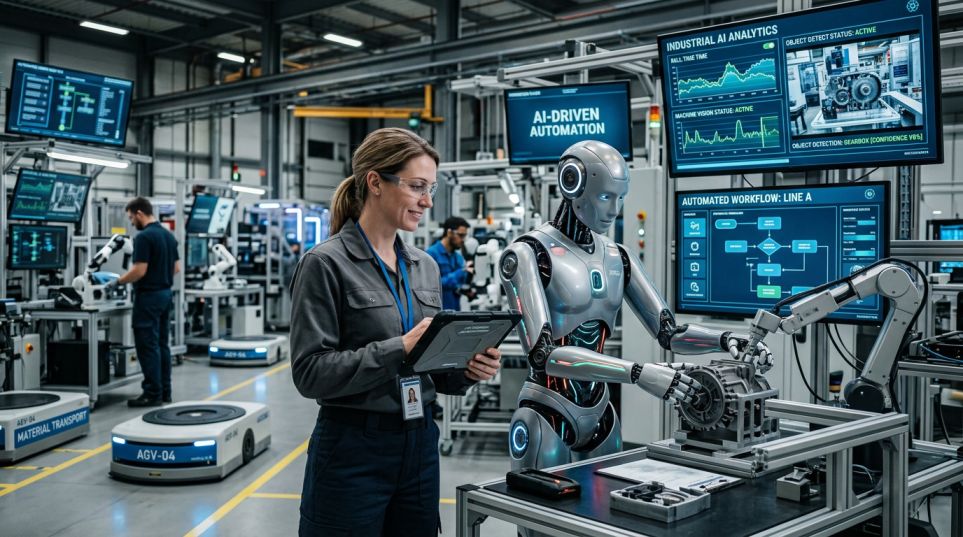
Across industries, AI is moving beyond software applications into physical environments. Manufacturers are integrating intelligent robots into production lines, while AMRs are transforming warehouse logistics and material handling. Facility upgrades are also becoming a strategic priority as organizations modernize factories to support connected machines, Industrial IoT, and AI-powered decision-making.
One notable development involves AI-enabled apparel manufacturing, where intelligent robotics is beginning to tackle production processes that have historically been difficult to automate due to the complexity of handling flexible fabrics. At the same time, automotive manufacturers are expanding the deployment of autonomous mobile robots to improve workplace safety and optimize internal logistics. These examples demonstrate that AI is no longer limited to repetitive industrial tasks but is evolving into a core driver of operational excellence across diverse manufacturing sectors.
The convergence of robotics, AI, advanced sensors, and modern manufacturing infrastructure is laying the groundwork for highly intelligent factories capable of making real-time operational decisions with minimal human intervention.
Technology Alone Cannot Deliver Business Value
While AI capabilities continue to evolve rapidly, organizations face a more practical challenge—operational readiness. Many manufacturers possess large volumes of production data but struggle with fragmented systems, inconsistent processes, weak cybersecurity, or insufficient governance structures. Without addressing these foundational issues, even the most sophisticated AI solutions may fail to deliver measurable business outcomes.
Successful AI adoption requires professionals who understand far more than automation hardware. Teams must know how AI models interact with industrial data, how machine learning improves predictive maintenance, how cybersecurity protects operational technology environments, and how AI-driven insights support better production decisions.
This is where workforce capability becomes a competitive differentiator.
Why AI Training Has Become a Business Imperative
As factories become increasingly intelligent, every department is affected. Operations managers must interpret AI-driven recommendations. Engineers need to understand machine learning applications. Plant supervisors must collaborate with AI-powered systems, while executives require strategic knowledge to make informed technology investments.
Organizations that invest in AI training gain more than technical knowledge. They develop teams capable of identifying automation opportunities, reducing implementation risks, improving collaboration between IT and operational technology, and accelerating digital transformation initiatives.
AI education also helps employees understand responsible AI deployment, data governance, model monitoring, and continuous improvement practices that are essential for long-term success.
Rather than viewing AI as a replacement for human expertise, leading manufacturers are using training to create professionals who can work alongside intelligent systems and maximize their potential.
Lessons Businesses Can Learn from the Latest Industry Developments
The latest developments in industrial automation highlight several important lessons for organizations planning their AI journey. The first is that infrastructure investments must be accompanied by investments in people. Smart factories cannot operate efficiently without skilled professionals capable of managing AI-powered systems.
The second lesson is that AI adoption should be approached strategically rather than experimentally. Businesses need structured roadmaps, governance frameworks, and cross-functional collaboration to achieve sustainable results.
Finally, organizations should recognize that AI capabilities will continue evolving. Continuous learning enables professionals to remain current with emerging technologies such as digital twins, autonomous robotics, predictive analytics, generative AI, and intelligent manufacturing systems. Companies that prioritize ongoing AI education will be better positioned to adapt as industrial innovation accelerates.
Preparing the Workforce for the Future of Manufacturing
Industrial automation is evolving from isolated automation projects into enterprise-wide AI ecosystems. As humanoid robots, intelligent machines, and connected factories become increasingly common, organizations need professionals who understand both the technology and the business strategy behind AI adoption.
This transformation creates significant opportunities for manufacturers, technology providers, consultants, engineers, and operational leaders willing to develop AI expertise. The organizations that combine advanced technology with a well-trained workforce will be best positioned to improve productivity, enhance safety, optimize costs, and remain competitive in an increasingly AI-driven industrial landscape.
Conclusion
As industrial automation continues to accelerate, businesses need more than cutting-edge technology—they need knowledgeable professionals who can deploy, manage, and scale AI solutions effectively. Becoming an AI CERTs Authorized Training Partner enables organizations to deliver globally recognized AI education, empower professionals with industry-relevant certifications, and build the skilled workforce required to support the next generation of intelligent manufacturing. By bridging the gap between innovation and practical expertise, Authorized Training Partners help organizations confidently navigate the future of AI-powered industry.
AI CERTS
19 hours ago ATP
Kazakhstan’s Renewable Energy and AI Infrastructure Partnership Highlights Why AI Training Is the Next Competitive Advantage
The future of clean energy is no longer defined by renewable power generation alone. It is increasingly driven by artificial intelligence, advanced data infrastructure, and a workforce capable of managing intelligent energy systems. This shift became evident with the recent collaboration between Kazakhstan and Masdar, as both partners expanded their cooperation to accelerate renewable energy projects while simultaneously supporting AI infrastructure development.
The initiative demonstrates that sustainable energy and artificial intelligence are becoming deeply interconnected, creating new opportunities for governments, enterprises, and professionals alike.
As organizations worldwide invest in digital transformation, projects like these reinforce one important reality: technology investments succeed only when supported by people who possess the right AI skills.
A New Model for Energy and Digital Infrastructure
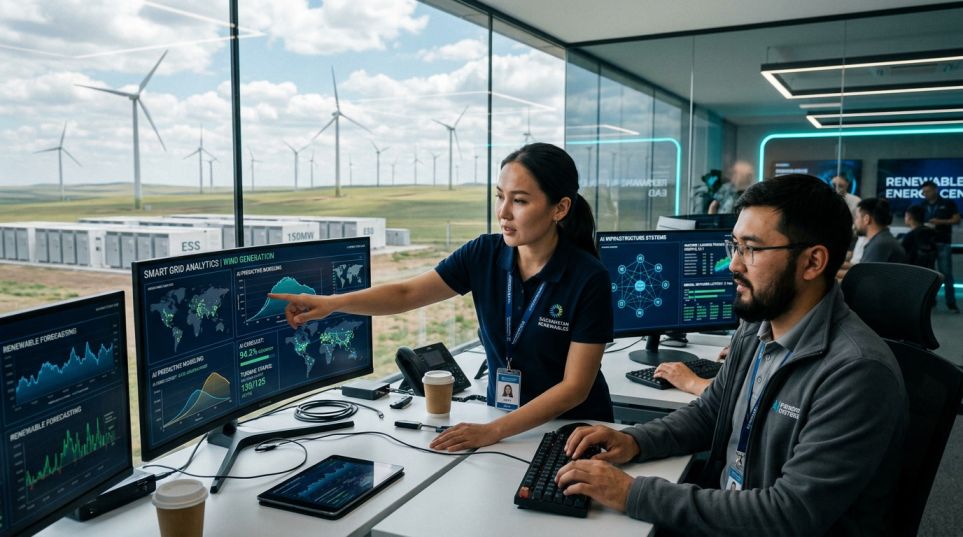
Kazakhstan and Masdar are strengthening their partnership by combining large-scale renewable energy projects with infrastructure designed to support AI-powered data centers. Alongside the construction of a 1 GW wind farm and a 600 MWh battery energy storage system, both organizations are advancing plans for round-the-clock renewable energy solutions capable of supplying reliable electricity for AI infrastructure. This reflects a broader strategy of building digital economies where sustainable power and artificial intelligence grow together rather than independently.
AI infrastructure requires enormous computing power, and computing power requires stable, sustainable electricity. Renewable energy projects equipped with intelligent forecasting, battery optimization, and grid management technologies are becoming essential components of national AI strategies. Countries investing in these integrated ecosystems are positioning themselves for long-term economic competitiveness.
Why Artificial Intelligence Is Essential for Renewable Energy
Renewable energy systems generate enormous volumes of operational data every second. Wind speeds fluctuate, solar production varies with weather conditions, and battery storage systems continuously adjust to changing demand. Managing these variables manually is nearly impossible at scale.
Artificial intelligence enables operators to forecast energy production, optimize battery performance, predict equipment failures before they occur, automate maintenance scheduling, and improve overall grid efficiency. AI models analyze historical and real-time information to make faster and more accurate operational decisions than traditional methods. As renewable infrastructure expands globally, intelligent automation becomes a necessity rather than an optional enhancement. Research continues to show AI's growing role in renewable forecasting, predictive maintenance, smart grids, and energy optimization.
This growing dependence on AI means organizations require professionals who understand not only AI technologies but also how they apply within industries such as energy, infrastructure, manufacturing, logistics, and sustainability.
The Biggest Investment Is Not Technology but Talent
Large-scale infrastructure announcements often highlight financial investments worth billions of dollars. However, the true long-term value comes from developing skilled professionals capable of designing, deploying, governing, and managing AI-driven systems.
Organizations implementing AI-powered renewable energy solutions need leaders who understand AI strategy, engineers who can build intelligent systems, analysts who can interpret operational insights, cybersecurity professionals who can protect digital infrastructure, and project managers who can oversee responsible AI implementation.
Without continuous AI training, businesses risk underutilizing expensive technologies, facing implementation delays, or struggling with governance and compliance challenges. Workforce readiness has become just as important as technological readiness.
The Kazakhstan-Masdar collaboration offers an important lesson for organizations worldwide. Building AI infrastructure is only one part of digital transformation. Developing AI-capable talent ensures those investments continue delivering measurable business value for years to come.
AI Training Bridges the Gap Between Innovation and Business Success
As industries embrace AI-enabled infrastructure, professionals across functions need practical AI knowledge rather than purely technical expertise. Business leaders must understand AI strategy and governance. Operations teams need to leverage AI for process optimization. Technology professionals require skills in deploying intelligent systems responsibly. Even non-technical professionals increasingly benefit from AI literacy as AI becomes embedded in everyday workflows.
Organizations that prioritize structured AI learning create stronger innovation cultures, accelerate technology adoption, improve decision-making, and increase operational efficiency. AI education also helps teams identify opportunities for automation while maintaining responsible and ethical AI practices.
Rather than viewing AI as a standalone technology initiative, forward-looking organizations are integrating AI training into workforce development strategies to remain competitive in rapidly evolving markets.
Preparing for an AI-Driven Future with an Authorized Training Partner
The Kazakhstan-Masdar partnership illustrates that the future belongs to organizations capable of combining sustainable infrastructure with intelligent technologies. As AI becomes central to energy, manufacturing, finance, healthcare, logistics, and countless other sectors, continuous AI education becomes an essential business investment.
Working with an AI CERTs Authorized Training Partner enables organizations to build AI-ready teams through globally recognized certification programs designed for professionals across industries and experience levels. By delivering structured learning, practical knowledge, and industry-aligned certifications, Authorized Training Partners help businesses develop the workforce needed to successfully implement AI initiatives, maximize technology investments, and confidently lead digital transformation in an increasingly AI-powered world.


