

AI CERTS
4 hours ago
Microsoft MAI-Image-2-Efficient Reshapes AI Models Pricing
Moreover, the launch underscores the vendor’s intention to build proprietary stacks while maintaining its high-profile OpenAI alliance. For leaders evaluating budget, performance, and governance, understanding model cost calculus has become essential before green-lighting AI Models deployments.
Pricing Disruption Explained Clearly
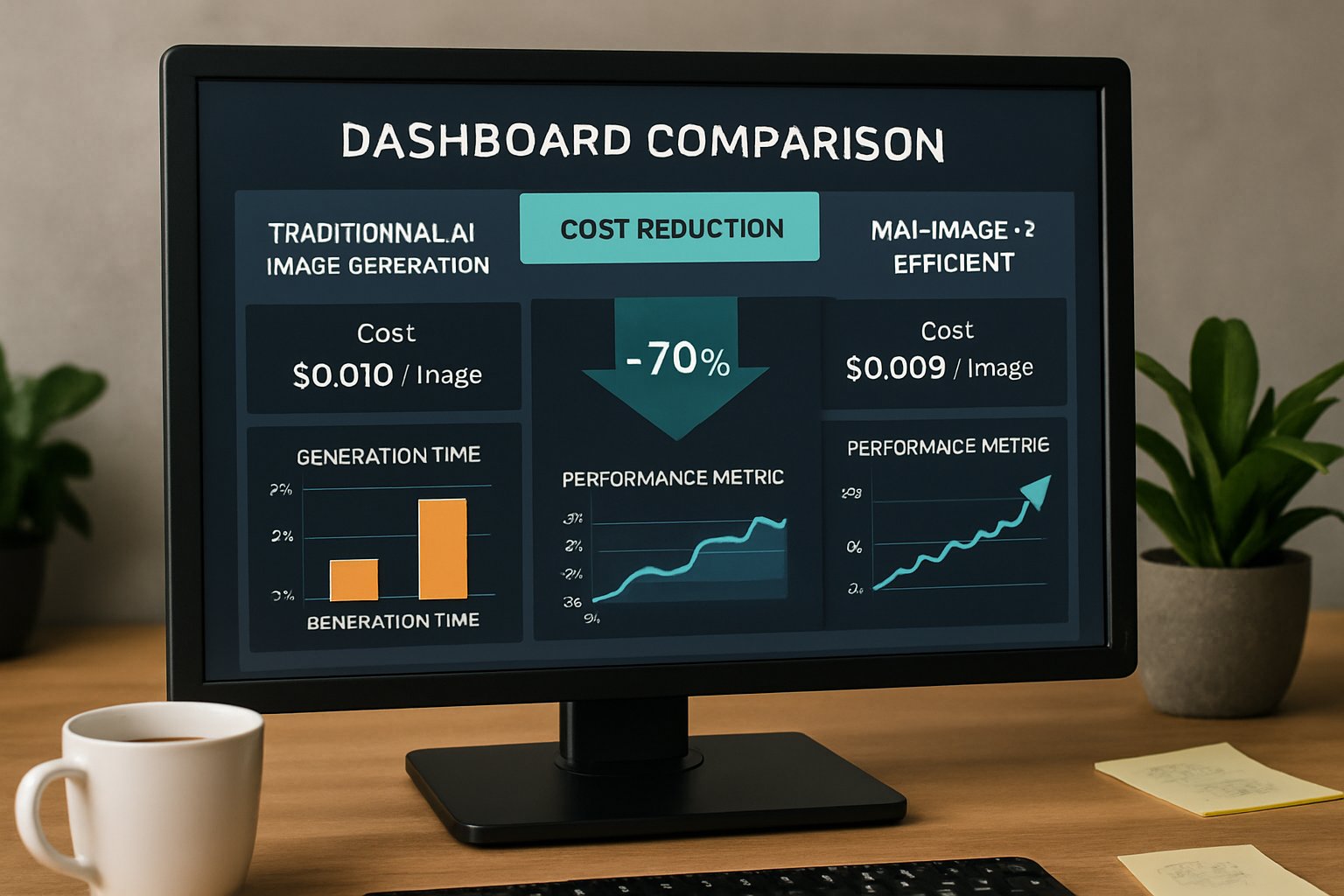
At the center of the announcement sits a dramatic price cut. The vendor now charges $19.50 for one million image output Tokens, compared with $33 under the flagship MAI-Image-2 tier. Input pricing remains unchanged at $5 per million prompts, easing migration fears. Consequently, generating a 1024×1024 picture falls to roughly $0.020, according to TokenCost’s calculator. Independent buyers should still compare competing AI Models tiers before retooling budgets. In contrast, rival Gemini image variants list at $25 per million image Tokens today. Moreover, the vendor positions the discount as permanent rather than promotional, signalling confidence in back-end Efficiency improvements.
These numbers illustrate a clear cost gap that favors bulk content producers. However, deeper technical shifts drive the savings, which the next section unpacks.
Architecture And Core Specs
Under the hood, the Efficient variant remains a diffusion-based engine with between 10 billion and 50 billion parameters. Moreover, the context window reaches 32 k, enabling lengthy style guides or brand narratives inside prompts. In contrast, many peer AI Models still cap at 8 k context Tokens, limiting creative control. Company engineers trimmed latency by rewriting scheduler kernels and compressing intermediate activations, producing the claimed four-times GPU Efficiency. Additionally, the model card lists training dates from January to March 2026, confirming rapid iteration. Safety filters mirror those in the flagship, covering violent, sexual, and trademarked prompts.
These architectural tweaks explain how cost cuts landed without obvious image degradation. Consequently, the focus now shifts to measured performance data.
Performance And Efficiency Gains
The vendor's public benchmark reports show 22 percent lower median latency versus MAI-Image-2. Furthermore, throughput per GPU quadrupled when normalised, delivering headline Efficiency. Nevertheless, vendor tests often favour house configurations. Independent groups like Arena.ai plan broader shoot-outs across leading AI Models within weeks. Consequently, early adopters should treat the percentages as directional, not definitive proof. In contrast, TokenCost’s synthetic latency sampling found a smaller 17 percent drop, yet corroborated reduced memory pressure. Moreover, Gemini 3.1 Flash trailed by an average 40 percent in the same vendor test.
Reduced wait times translate directly into higher creative iteration per hour. Subsequently, the discussion pivots to what those seconds saved mean in dollars.
Enterprise Cost Calculations Unpacked
Finance leaders rarely care about benchmarks alone. Ultimately, per-image economics decide whether procurement signs new contracts. TokenCost outlines three illustrative monthly scenarios:
- 100,000 images: estimated $2,000 output spend with MAI-Image-2-Efficient
- 500,000 images: estimated $10,000 output spend, 41 percent below flagship tier
- 1,000,000 images: estimated $19,500 output spend, aligning with marketing campaign peaks
Input Tokens add marginal overhead because prompt lengths remain short. Moreover, Azure Foundry bundles networking, compliance, and caching, which simplifies invoice forecasting. However, rivals like Stability AI still undercut on ultra-low resolution tiers. Therefore, buyers must consider creative quality targets, not list prices alone.
These comparisons show tangible budget swings across volumes. Meanwhile, the competitive view becomes crucial for holistic evaluation.
Competitive Landscape Right Now
Competitive pressure around generative imagery intensifies weekly. OpenAI’s DALL·E, Google’s Gemini Image, and Stability’s offerings each target distinct price-performance niches. However, MAI-Image-2-Efficient now occupies the pragmatic middle, balancing cost with brand-safe fidelity. Analysts argue that vendor lock-in, not pure pricing, often sways enterprise commitments. Consequently, organisations already invested in Azure may gravitate toward the vendor even when rival AI Models quote lower rates. Moreover, early leaderboards place the flagship MAI-Image-2 within the top five models for user preference. Nevertheless, rankings fluctuate rapidly as datasets expand and evaluation methods mature. Therefore, technology buyers should avoid treating AI Models charts as static truth.
These trends illustrate a fluid battlefield for creative tooling. Subsequently, the article addresses adoption risks.
Adoption Risks And Caveats
No rollout comes without wrinkles. Responsible-AI reviewers note lingering exposure to copyrighted personalities despite updated safety layers. Moreover, initial access remains limited to select US regions, delaying EU experiments. TokenCost also highlights that other AI Models still beat the model on extreme aspect ratios or real-time streaming. Consequently, teams must weigh feature completeness alongside headline performance. Nevertheless, vendor benchmarks have not been fully replicated by independent labs. In contrast, Stability AI already publishes p90 latency dashboards hourly. Therefore, cross-checking service-level agreements becomes critical before contract signature. Likewise, regional billing quirks on Foundry can surprise finance teams unless they scrutinise footnotes.
These caveats temper the hype, yet they do not erase the financial upside. Subsequently, strategic takeaways emerge for technology leaders.
Strategic Takeaways For Teams
Technical executives must translate buzz into operational value. Firstly, pilot workloads should benchmark latency, quality, and cost against internal tolerances. Secondly, negotiate volume-based discounts because AI Models consumption often grows unpredictably. Additionally, cultivate multi-provider capability to avoid single-vendor risk. Professionals can enhance their expertise with the AI Developer™ certification, ensuring teams understand deployment best practices.
These action points summarise a repeatable evaluation framework. However, leaders also need a concise recap, which the conclusion provides next.
MAI-Image-2-Efficient lowers image generation costs while maintaining acceptable quality benchmarks. Moreover, the variant demonstrates that relentless Efficiency gains continue across leading AI Models. Practical pricing of $19.50 per million output Tokens can unlock fresh creative pipelines for Azure-centric enterprises. Nevertheless, buyers should validate vendor claims, monitor regional availability, and run controlled pilots before committing budgets. In contrast, competitors will respond, driving further innovation and price compression.
Therefore, staying informed and upskilling remain critical. Explore the linked certification to deepen your production readiness and seize emerging opportunities in the expanding AI landscape. Consequently, organisations that move early could capture creative agility and cost advantages over slower peers.


