

AI CERTS
1 hour ago
CBSE Releases AI Handbooks for Classes 3–8- A Defining Shift That Signals India’s Urgent Need for AI Training
This isn’t just another curriculum update. It’s a signal that the future of education—and work—is being rewritten in real time.
A Curriculum That Starts Where the Future Begins
The newly introduced handbooks are part of CBSE’s broader push to integrate computational thinking and AI into the school ecosystem starting from the 2026–27 academic session. The initiative aligns with the vision of the National Education Policy (NEP) 2020 and aims to nurture “AI-ready learners” from an early age.
What makes this move particularly significant is its early entry point. By introducing AI concepts as early as Class 3, CBSE is shifting the focus from passive learning to active problem-solving. Students will now be encouraged to think logically, identify patterns, and understand how intelligent systems work skills that are no longer optional in a digital-first world.
The handbooks are designed not just for students but also for teachers, ensuring that educators are equipped with the right pedagogical tools to bring AI concepts into everyday classroom learning. This dual focus reflects a deeper understanding: AI education is only as effective as the people delivering it.
Beyond Coding: Building Thinkers, Not Just Technologists
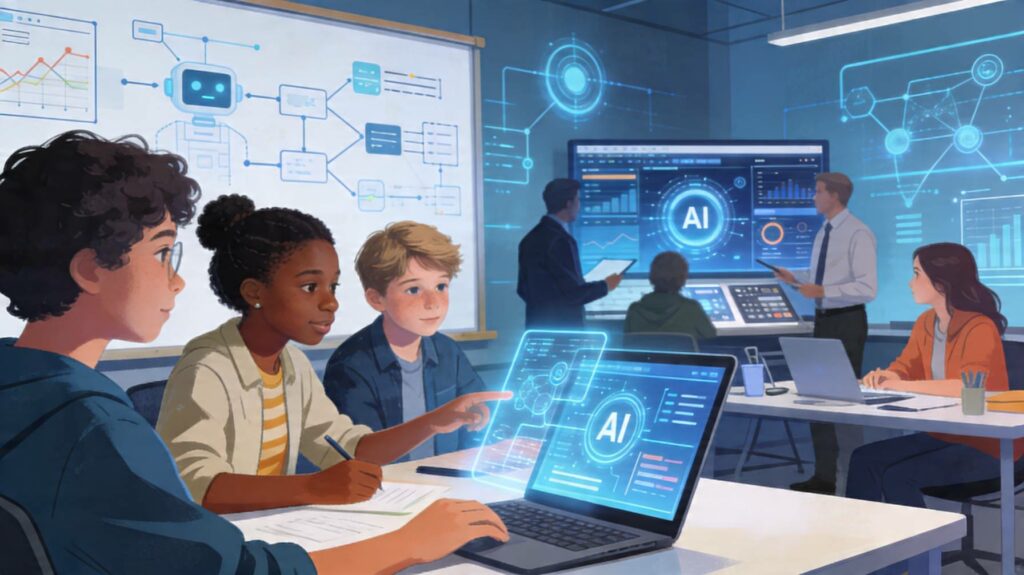
One of the most compelling aspects of this initiative is its emphasis on computational thinking rather than just coding. The curriculum is structured around seven key themes, including foundational AI concepts, interdisciplinary learning, real-world applications, and ethical use of AI.
This means students won’t just learn how to use technology they’ll learn how to question it, design it, and apply it responsibly. In a world increasingly shaped by algorithms, this distinction is critical.
The inclusion of ethics is particularly noteworthy. As AI systems influence everything from hiring decisions to healthcare, understanding responsible AI usage is becoming as important as technical proficiency. By embedding ethics into early education, CBSE is setting a precedent for holistic AI literacy.
Training the Trainers: A Nationwide Upskilling Push
To support this transition, CBSE is rolling out a comprehensive teacher training framework. Schools will organize district-level workshops, expert-led sessions, and regional orientation programs through Centres of Excellence. (www.ndtv.com)
This structured approach ensures that teachers are not left behind in the AI revolution. Instead, they become active participants in shaping how students engage with emerging technologies.
However, this also highlights a critical gap. While CBSE’s efforts are commendable, the scale of AI adoption requires a much broader ecosystem of trained professionals, educators, and institutions. The demand for AI skills is growing faster than traditional education systems can adapt.
The Bigger Picture: Why AI Training Can’t Wait
CBSE’s move reflects a larger global reality—AI is no longer a niche skill; it is becoming as fundamental as literacy and numeracy. Countries around the world are investing heavily in AI education, recognizing its impact on economic growth, innovation, and workforce readiness.
In India, this shift is particularly crucial. With a young population and a rapidly digitizing economy, the country stands at a pivotal moment. Early exposure to AI can empower students to become creators rather than consumers of technology.
But classroom learning alone is not enough.
The real challenge lies in bridging the gap between foundational education and industry-ready skills. This is where structured AI training programs and partnerships become essential. Schools may introduce the basics, but advanced learning, hands-on experience, and real-world applications require specialized training ecosystems.
Where ATP Fits Into the Future of AI Education
As AI becomes a core part of education, the need for scalable, high-quality training solutions is more urgent than ever. This is where initiatives like the AI CERTs Authorized Training Partner (ATP) program play a transformative role.
The ATP model enables training institutes, universities, and organizations to deliver globally recognized AI certifications, bridging the gap between academic learning and industry demands. It empowers educators and institutions to offer structured AI programs, ensuring learners gain practical, job-ready skills.
In the context of CBSE’s new handbooks, ATPs can act as a critical extension of the classroom. While schools introduce foundational concepts, ATPs can take learners deeper into AI applications, tools, and real-world problem-solving.
This synergy between formal education and professional training is what will ultimately define India’s success in the AI era.
A Defining Moment for India’s Education System
The release of AI handbooks for Classes 3 to 8 is more than an academic reform—it’s a strategic move that positions India at the forefront of future-ready education.
By starting early, focusing on both students and teachers, and emphasizing ethical and interdisciplinary learning, CBSE is laying the groundwork for a generation that understands not just how to use AI, but how to shape it.
Yet, this is only the beginning.
To truly harness the potential of this initiative, India must invest in continuous AI training, build robust learning ecosystems, and encourage collaboration between schools, training partners, and industry leaders.
Because in the age of AI, education is no longer just about knowledge—it’s about adaptability, innovation, and the ability to stay ahead of change.
FAQs
What are the CBSE AI handbooks for Classes 3 to 8?
The CBSE AI handbooks are structured learning resources designed to introduce students and teachers to computational thinking and artificial intelligence concepts. They provide guidance on integrating AI into classroom learning across subjects.
Why has CBSE introduced AI at such an early stage?
CBSE aims to build foundational skills like logical thinking, problem-solving, and digital literacy from a young age, ensuring students are prepared for a technology-driven future.
Will students need prior coding knowledge to learn AI?
No, the curriculum focuses on computational thinking and basic AI concepts rather than advanced coding, making it accessible to young learners without prior technical knowledge.
How are teachers being prepared for this change?
CBSE is conducting workshops, expert sessions, and regional training programs to equip teachers with the skills needed to effectively teach AI and computational thinking.
How can students go beyond school-level AI learning?
Students can explore advanced AI training through certification programs and partnerships like Authorized Training Partners, which offer practical, industry-relevant skills beyond the classroom.


