

AI CERTS
1 week ago
Taiwan Bets Big On AI Supply Chain
However, bottlenecks in substrates, memory, and power threaten delivery schedules. This article unpacks the money flows, technology pivots, and policy pressures shaping the next wave. Readers will also see how certifications, such as the AI Architect™, can future-proof professional skills.
Taiwan Ecosystem Investments Surge
AMD stole headlines on 21 May 2026 with a pledge exceeding $10 billion to local partners. Moreover, executives said the funds target advanced packaging lines and Helios rack builds. This injection cements Taiwan’s position as a preferred launchpad for next-gen accelerators. Consequently, competitors accelerated their own spending to avoid supplier lockouts.
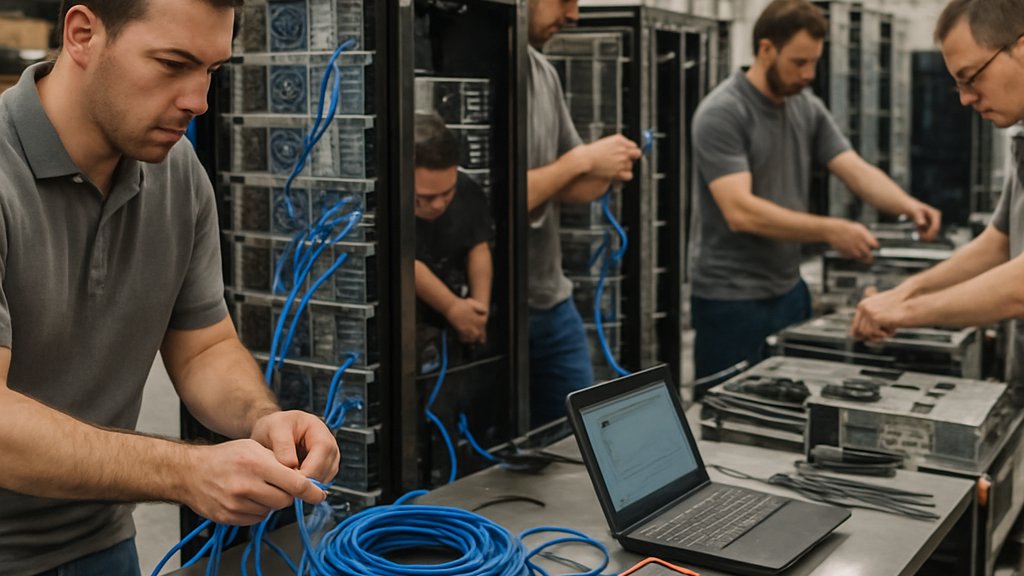
Foxconn quickly matched the mood. Subsequently, its board cleared NT$42 billion for an AI compute cluster and supercomputer. Investors applauded the move because visibility into hyperscaler orders remains strong. In contrast, smaller firms seek consortium financing to shoulder ballooning capital needs. The AI Supply Chain thus benefits from a rising tide of shared infrastructure bets.
Funding Numbers At Glance
- AMD investment: more than $10 billion toward Helios and packaging plants
- Foxconn approval: NT$42 billion (≈US$1.37 billion) for GPU clusters
- Projected hyperscaler 2026 capex: $710-$830 billion, TrendForce data
Capital intensity keeps rising across the network. However, money alone cannot solve technical chokepoints.
Therefore, packaging limitations deserve closer examination.
Advanced Packaging Bottleneck Risks
CoWoS and SoIC remain indispensable for high-bandwidth memory stacks. Nevertheless, capacity trails incoming orders despite aggressive expansion plans. Industry trackers estimate monthly CoWoS output may quadruple by late 2026. Yet, the AI Supply Chain still faces allocation disputes when volumes surge.
Furthermore, analysts warn that substrate shortages could frustrate Vera Rubin launch windows. HBM supply also stays tight, pressuring bill-of-materials forecasts. Consequently, design teams explore chiplet tweaks to maximize scarce packaging slots.
Key constraints highlighted by Counterpoint include limited substrates, long HBM lead times, and thermal challenges for MGX racks.
ASE and Amkor both signal double-digit percentage expansions for their CoWoS lines over the next eighteen months. Furthermore, substrate makers in Hsinchu have ordered extra lithography tools to meet demand forecasts.
These factors confirm packaging as a gating variable. Moreover, delay risks ripple across every contract.
Subsequently, attention shifts to server assembly capacity.
Server ODM Capacity Race
Quanta, Wistron, and peers enlarge halls across the island and Arizona to strengthen the AI Supply Chain. Meanwhile, Nvidia has block-booked entire production lines for MGX racks through 2026. Such deals create predictable demand that reassures bankers yet compresses flexibility for smaller buyers.
Wistron’s new Zhubei AI park opened in mid-2025. Additionally, reports suggest full utilization within months as Vera Rubin test systems roll off conveyors. ODM executives label the push a marathon rather than a sprint.
Because capacity is finite, scheduling now begins at the rack-scale platform level. Therefore, matching GPU, memory, and cooling units in advance becomes mandatory. The term “hardware ecosystem” gains renewed relevance as contracts bundle chips, boards, and power distribution.
Moreover, factory planners integrate inventory dashboards to visualize the AI Supply Chain from wafer starts to finished racks.
Server builders are evolving into orchestrators of multiple inputs. Consequently, integration quality differentiates winners from laggards.
Next, platform roadmaps illustrate why coordination matters.
Rack Scale Platform Demand
Nvidia’s Vera Rubin architecture and AMD’s Helios blueprint both adopt rack-scale integration principles. Such designs align GPU thermal envelopes with MGX racks and liquid cooling loops. Moreover, hyperscalers favor pre-validated bundles to cut deployment cycles.
Consequently, system design migrates upstream in the AI Supply Chain. Suppliers now share real-time yield and logistics data to ensure slot availability. This transparency reduces idle capital while supporting massive deployment programs.
In contrast, siloed planning once caused multi-week slips during prior GPU launches. Furthermore, unified validation frameworks shorten bring-up by automating firmware checks across the hardware ecosystem.
Standardization committees are drafting performance baselines so that new Vera Rubin nodes can slot into existing deployments without rewiring power planes. Meanwhile, ODM roadmaps now extend through 2028, reflecting unprecedented visibility.
Integrated racks compress deployment time and stabilize costs. However, united planning also propagates failures faster.
That reality underscores logistical and environmental constraints.
Energy And Geopolitics Risks
Large GPU farms demand multi-megawatt power feeds plus low-latency fiber. Moreover, public utilities struggle to approve expansions quickly. Consequently, some ODMs investigate modular data centers to sidestep lengthy permitting.
Geopolitical tension encourages dual-site strategies that split production between Taiwan and North America. Nevertheless, duplicated lines raise overheads and complicate the AI Supply Chain. Executives therefore weigh policy incentives against operational dilution.
Environmental groups also question water usage for immersion cooling. Meanwhile, suppliers argue that advanced manufacturing supports crucial AI infrastructure for healthcare and science. Regulators must balance climate goals with competitiveness.
Failures in power delivery reverberate through the AI Supply Chain, amplifying cost overruns.
Energy and politics shape site selection as strongly as cost. Subsequently, talent development enters the spotlight.
Skill gaps threaten production momentum.
Upskilling The Talent Gap
Packaging engineers, firmware specialists, and power architects remain in short supply. Consequently, professional development programs are scaling alongside fabs. Managers encourage staff to pursue the AI Architect™ credential. This course covers workload optimization, security, and AI infrastructure design.
Furthermore, cross-disciplinary skills help teams navigate the expanding hardware ecosystem. Graduates can map Vera Rubin compute graphs to MGX racks or debug advanced packaging faults. Therefore, continuous education directly improves tool utilization rates.
Key competencies addressed include:
- System topology planning across heterogeneous accelerators
- Thermal and power budgeting for AI infrastructure clusters
- Lifecycle governance along the AI Supply Chain
Mentorship circles pair senior packaging veterans with graduates to accelerate knowledge transfer. Subsequently, retention metrics improve, reducing onboarding costs.
Workforce readiness safeguards production schedules and product quality. However, leadership must link training metrics to business outcomes.
The final section distills major insights.
Key Takeaways
Capital, coordination, and competence underpin the modern AI Supply Chain. Taiwan suppliers mobilize billions while advanced packaging attempts to catch up. Meanwhile, rack-scale designs such as Vera Rubin and MGX racks raise integration stakes across the hardware ecosystem. Consequently, power grids, policymakers, and educators share responsibility for resilient AI infrastructure. Nevertheless, skill shortages could stall momentum unless organizations invest in certified learning. Professionals eager to lead can strengthen credentials through the AI Architect™ program. Explore the curriculum today and future-proof your role in this transformative era.
Disclaimer: Some content may be AI-generated or assisted and is provided ‘as is’ for informational purposes only, without warranties of accuracy or completeness, and does not imply endorsement or affiliation.


