

AI CERTS
2 hours ago
Scientific Research AI: PromptBio Automates Experiments
Investors anticipate strong demand because global healthcare AI revenue already exceeds forty billion dollars.
Meanwhile, regulators warn that automation without governance could amplify risk.
These contrasting signals create urgent questions for decision makers.
Therefore, this article unpacks technology details, market forces, and practical next steps.
From Intent To Workflow
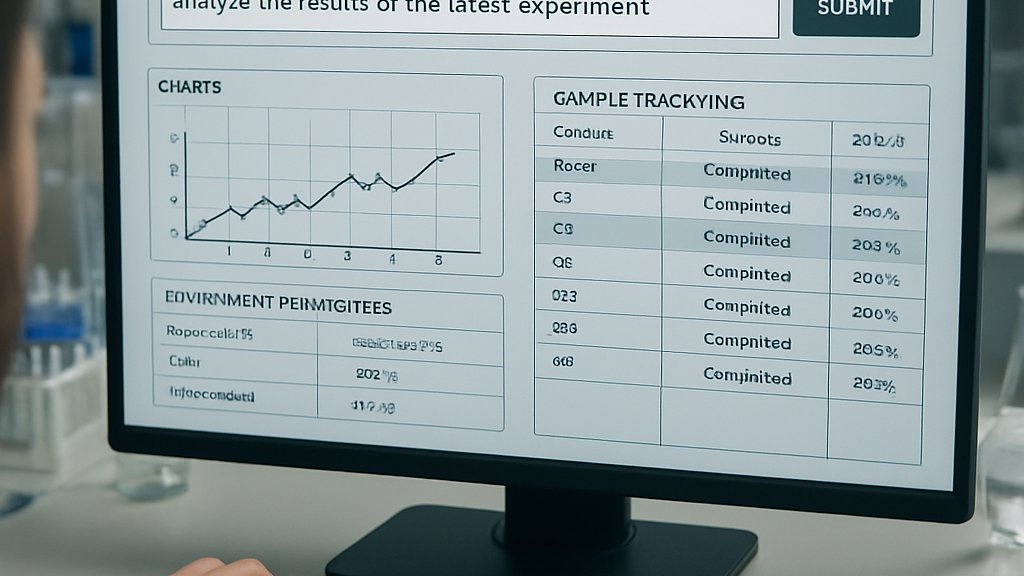
Firstly, the platform frames itself as a conversational assistant rather than another point solution.
Users type biological questions using everyday language.
Subsequently, the Chief Scientific Orchestrator spawns specialized agents for literature mining, data retrieval, and pipeline assembly.
That Scientific Research AI nucleus sustains task ordering and error handling.
These agents collaborate, producing end-to-end analyses across genomics, transcriptomics, proteomics, and cheminformatics.
Therefore, bench scientists obtain notebooks, visualizations, and shareable reports without writing any code.
Additionally, established biotech firms can integrate the system through its API layer.
Intent quickly becomes execution thanks to Scientific Research AI orchestration.
However, architecture choices decide scalability.
Inside PromptBio System Architecture
PromptBio's architecture follows the multi-agent pattern described in a 2025 bioRxiv preprint.
At the helm sits the Chief Scientific Orchestrator, which decomposes prompts into ordered tasks.
Furthermore, subordinate agents such as PromptGenie, DiscoverFlow, and ToolsGenie map tasks to bioinformatics libraries.
Tools run inside containerized sandboxes, ensuring version control and provenance tracking.
Data connectors link public repositories, institutional clusters, and secure cloud buckets.
Consequently, the system emits hashed manifests that auditors can rerun on demand.
These design decisions mirror core principles of Scientific Research AI infrastructure.
Architecture thus promotes both flexibility and traceability.
Next, competitive positioning reveals strategic stakes.
Industry Context And Competitors
Grand View Research values healthcare AI at USD 42.6 billion for 2025.
Moreover, analysts forecast double-digit growth through 2030 as genomics and lab automation converge.
PromptBio enters this expansion stage alongside Infera, Inductive Bio, and Form Bio.
In contrast, incumbents like Sapio focus on electronic lab notebooks and integration services rather than agentic experiments.
Meanwhile, academic consortia develop open benchmarks, aiming to quantify reproducibility across offerings.
Therefore, buyers now evaluate Scientific Research AI solutions on accuracy, cost, and compliance rather than novelty alone.
Competitive pressure accelerates innovation pace.
However, unresolved limitations could hinder adoption.
Opportunities And Current Limits
The strongest upside involves democratizing multi-omics analytics for small biotech teams.
Because scientists can speak plain language, Scientific Research AI reduces onboarding time and experimental cycles shorten.
Additionally, automated notebooks create audit trails that satisfy funding agencies and institutional review boards.
Yet, Nature Reviews Genetics warns that validation frameworks still trail capability claims.
Benchmark data from the PromptBio preprint show promising precision but limited sample diversity.
Consequently, institutions must run internal comparisons before entrusting agentic experiments with mission-critical questions.
Opportunities remain compelling despite current gaps.
Next, governance challenges demand thorough attention.
Operational And Safety Governance
Automated science raises unique safety and biosecurity concerns.
Multi-agent orchestration could inadvertently design harmful constructs if guardrails fail.
Therefore, PromptBio applies sandboxing, role separation, and rule-based filters to mitigate risk.
Nevertheless, independent audits are essential, especially for pathogen studies.
In contrast, some lab automation vendors embed physical access controls, preventing unauthorized instrument operation.
Subsequently, policy makers advocate standardized red-teaming across Scientific Research AI platforms.
Professionals can enhance their expertise with the AI Researcher™ certification.
Robust oversight underpins sustainable adoption.
Consequently, leadership must balance speed with stewardship.
Strategic Takeaways For Leaders
Technology chiefs face pressure to accelerate discovery while containing cost.
The vendor promises reduced onboarding time, which could save weeks of staff effort.
Furthermore, subscription pricing combined with a free trial eases budget justification.
However, teams should pilot narrowly scoped projects before enterprise deployment.
Run comparative benchmarks, examine reproducibility manifests, and confirm data governance alignment.
- Benchmark Scientific Research AI outputs against your current pipelines.
- Measure runtime, storage, and compute cost for life sciences datasets.
- Audit reproducibility manifests generated by agentic experiments.
- Review security, biosecurity, and compliance alignment across lab automation layers.
- Gather qualitative feedback from biotech researchers after hands-on trials.
Moreover, calculate indirect savings in grant compliance and publication turnaround.
Successful pilots can unlock broader digital transformation, linking agentic experiments to downstream lab automation.
Consequently, Scientific Research AI shifts from novelty to essential infrastructure across life sciences.
Prepared leaders will capture faster discoveries and strategic advantage.
Conclusion And Next Steps
PromptBio exemplifies how intent-driven workflows can speed discovery across diverse omics.
Nevertheless, production success still depends on validation, governance, and staff readiness.
Scientific Research AI will mature rapidly as benchmarks, audit standards, and funding intersect.
Therefore, leaders should pilot, measure, and iterate before scaling budgets.
Moreover, investing in individual skills amplifies platform returns.
Professionals can future-proof careers through the earlier mentioned AI Researcher™ certification.
Act now, request a trial, and advance your next breakthrough.
Disclaimer: Some content may be AI-generated or assisted and is provided ‘as is’ for informational purposes only, without warranties of accuracy or completeness, and does not imply endorsement or affiliation.


