

AI CERTS
2 hours ago
Australians Are Embracing AI at Work but Formal AI Training Remains the Missing Link to Long-Term Success
This growing gap between AI usage and AI readiness highlights one of the most important workforce challenges of the decade.
The findings serve as a wake-up call for organizations worldwide. AI tools are becoming more powerful every day, but without proper training, businesses risk creating a workforce that uses AI without fully understanding its capabilities, limitations, risks, and best practices.
The Rise of AI Adoption Across the Workplace
The speed of AI adoption has been remarkable. Employees are using generative AI tools to draft reports, summarize information, automate repetitive tasks, analyze large datasets, and support decision-making processes. Research has consistently shown that AI can significantly improve productivity when used effectively. Studies have found that AI-assisted workers can complete tasks faster while improving output quality and accelerating learning.
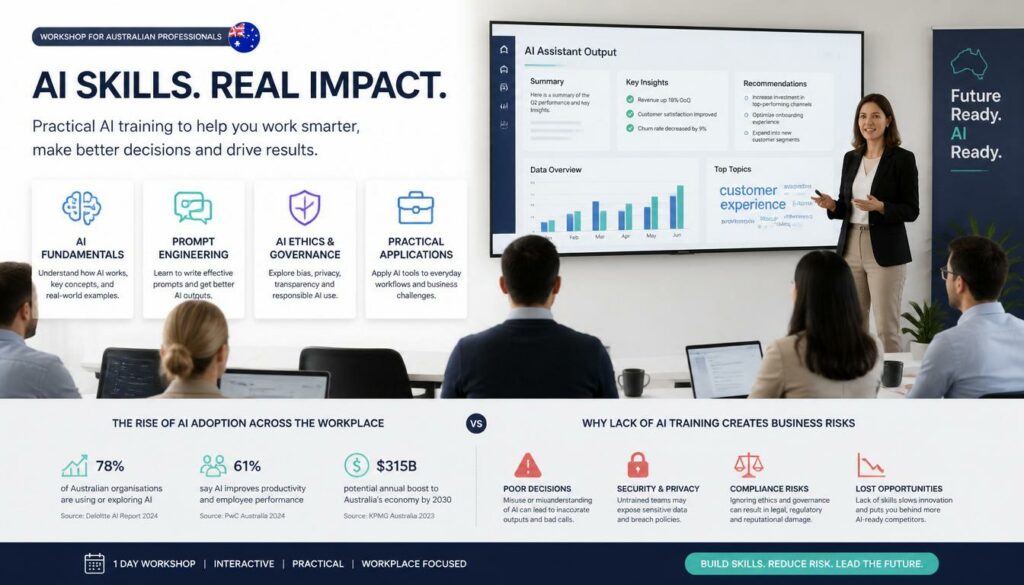
Yet adoption alone does not guarantee success. Many organizations have focused on deploying AI tools without investing equally in employee education. As a result, workers are often left to learn through experimentation, online videos, or trial and error rather than structured learning programs. This creates inconsistencies in how AI is used across teams and departments.
Why Lack of AI Training Creates Business Risks
At first glance, the fact that employees are actively using AI may seem positive. However, untrained AI usage can expose organizations to significant risks.
Without proper training, employees may unknowingly share sensitive information with AI systems, generate inaccurate outputs, rely on biased recommendations, or fail to verify AI-generated content. In regulated industries, these mistakes can lead to compliance violations, security concerns, reputational damage, and operational inefficiencies. Experts continue to warn that AI governance, privacy protection, and ethical usage must become integral parts of workplace AI strategies.
The challenge is not the technology itself. The challenge is ensuring that employees understand how to use AI responsibly, securely, and strategically.
Lessons Organizations Can Learn from This Trend
One of the biggest lessons from the Australian workforce findings is that AI implementation should never be viewed as a software deployment project alone. It must be treated as a workforce transformation initiative.
Organizations that invest in AI training create a stronger foundation for innovation. Employees become more confident in using AI, leaders gain greater visibility into how AI is being applied, and businesses can establish consistent standards for governance and responsible usage.
Another key lesson is that productivity gains depend on skills development. Simply providing access to AI tools does not automatically create better outcomes. Employees need structured guidance on prompt engineering, AI ethics, data privacy, decision support, workflow automation, and human oversight. Without these skills, businesses may struggle to realize the full value of their AI investments.
The Growing Demand for AI Skills
The demand for AI-related skills continues to rise across global job markets. Organizations are actively seeking professionals who can work alongside AI technologies and leverage them effectively. In Australia, AI-related roles are among the fastest-growing job categories, reflecting the increasing importance of AI literacy across industries.
At the same time, business leaders are emphasizing the importance of practical AI experience. Organizations are looking beyond technical expertise and seeking employees who understand how to apply AI strategically, ethically, and productively within real-world business environments.
This shift means that AI training is no longer optional. It is becoming a critical component of career development, workforce readiness, and organizational competitiveness.
Bridging the Gap Between AI Adoption and AI Readiness
The future belongs to organizations that can successfully bridge the gap between AI adoption and AI readiness. Companies must move beyond experimentation and create structured learning pathways that help employees develop practical AI competencies.
Effective AI training should cover not only how AI tools work but also when to use them, when not to use them, how to evaluate outputs, how to maintain data security, and how to align AI usage with business goals. When employees receive proper training, AI becomes a powerful business enabler rather than a potential source of risk.
Organizations that prioritize AI education today will be better positioned to drive innovation, improve productivity, strengthen governance, and build trust in AI-powered workplaces tomorrow.
How an Authorized Training Partner Can Help
As organizations seek to develop AI-ready workforces, choosing the right training provider becomes essential. The Authorized Training Partner (ATP) program from AI CERTs helps organizations and professionals access industry-aligned AI education designed for practical workplace application. Through structured learning pathways, expert-led instruction, and globally recognized certifications, ATPs help bridge the gap between AI adoption and workforce readiness. Whether businesses are beginning their AI journey or scaling enterprise-wide AI initiatives, an AI CERTs Authorized Training Partner can provide the training, skills, and guidance needed to build confidence and competence in an AI-driven world.
Learn more: AI CERTs Authorized Training Partner Program
Frequently Asked Questions
What is the biggest challenge organizations face with AI adoption?
The biggest challenge is often not the technology itself but the lack of employee training, governance frameworks, and clear usage guidelines.
Why is formal AI training important?
Formal AI training helps employees use AI effectively, responsibly, and securely while reducing risks related to privacy, compliance, and misinformation.
Can AI training improve productivity?
Yes. Research shows that properly trained employees can achieve higher productivity, better decision-making, and improved work quality through effective AI usage. (arXiv)
What skills should AI training programs include?
Strong AI training programs should cover AI fundamentals, prompt engineering, ethics, governance, data privacy, automation, and practical business applications.
How can organizations start building an AI-ready workforce?
Organizations can begin by assessing current AI usage, identifying skill gaps, establishing governance policies, and partnering with recognized AI training providers to deliver structured learning programs.
Disclaimer: Some content may be AI-generated or assisted and is provided ‘as is’ for informational purposes only, without warranties of accuracy or completeness, and does not imply endorsement or affiliation.


