

AI CERTS
5 months ago
Blackwell inference chip powers low-latency LLM delivery
However, marketing slides rarely match production realities. Independent InferenceMAX and MLPerf runs provide firmer ground. Meanwhile, open-source teams like vLLM publish reproducible scripts. These sources show both towering strengths and undeniable caveats. Subsequently, the story becomes nuanced rather than hype driven.
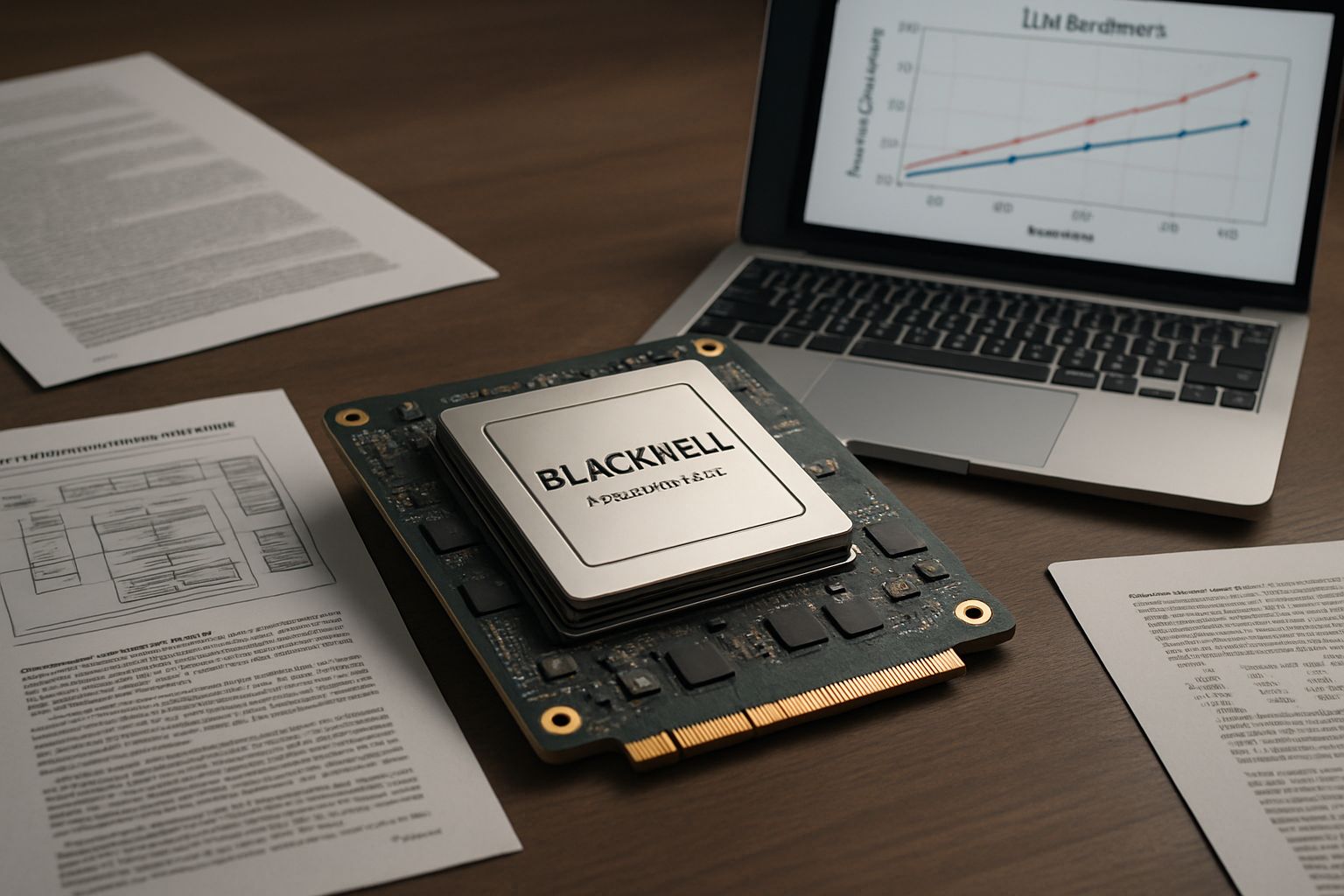
Before diving deeper, remember the mission. Latency must drop while accuracy holds firm. Low response time delights human users and unlocks new interactive patterns. High throughput keeps servers profitable under heavy traffic. Balancing those forces requires disciplined engineering, not blind trust in silicon. The next sections outline that engineering journey.
Why Latency Still Matters
Latency defines perceived intelligence. Moreover, conversational agents feel sluggish when initial tokens stall. Research shows users tolerate roughly 500 ms for first output. Therefore, teams must optimize prefill as well as streaming steps. Blackwell hardware merely offers headroom; disciplined software delivers the win. Early experiments with the Blackwell inference chip cut median prefill to 120 ms.
Fast interactions depend on both silicon and scheduling. Consequently, architectural details become critical, as the next section reveals.
Inside Blackwell Chip Architecture
NVIDIA equips the Blackwell inference chip with fifth-generation Tensor Cores. Additionally, native FP4 execution multiplies math density. Each core accesses 192 GB of HBM3e memory delivering several terabytes per second. Meanwhile, 1,800 GB/s NVLink joins neighboring chips for model parallel tasks. These ingredients lift single GPUs' compute and unclog multi-GPU communication.
Nevertheless, hardware muscle alone cannot guarantee victory. Prefill processing still burns cycles moving keys and values. Therefore, low-precision kernels must run efficiently to sustain optimal throughput.
Blackwell’s raw specifications set the stage for software innovation. Subsequently, the stack improvements come into focus.
Software Stack Breakthroughs Unveiled
TensorRT-LLM, FlashInfer, and vLLM form the production trio. Moreover, automatic kernel selection tailors math paths during startup. FlashInfer fuses attention, while vLLM orchestrates asynchronous scheduling. Consequently, GPU idle times shrink, and throughput climbs.
Quantization research also advances. MicroMix proposes mixed channel FP4 and FP6 blends. In contrast, older FP8 baselines left bandwidth on the table. Academic tests show 20 percent faster execution and lower Latency during prefill. Therefore, quality remains intact while processing budgets fall.
Key software gains include:
- Fused FP4 GEMMs slash kernel launch overhead.
- Async scheduling overlaps copy and compute across GPUs.
- Speculative decoding reduces time-to-first-token Latency by double-digit percentages.
FlashInfer was rewritten to unlock the Blackwell inference chip during fused attention passes.
These advances transform theoretical potential into practical performance. However, numbers speak louder than claims, as the next benchmarks demonstrate.
Benchmark Numbers Explained Clearly
InferenceMAX tests place a single Blackwell inference chip at 10,000 tokens per second for Llama 3.3 70B. Moreover, MLPerf reports show 2.8× speedups over H200 on comparable tasks. Independent reviewers confirm similar throughput gains when using vendor recipes. Reviewers who enabled micro-batching on the Blackwell inference chip observed smoother saturation curves.
Cost metrics matter too. NVIDIA cites cost per million tokens falling from $0.11 to $0.02. Nevertheless, those values assume high GPUs utilization and tight concurrency control. Therefore, readers should replicate tests under realistic arrival patterns.
Delay distribution tells another story. P50 often dazzles, yet P99 still breaks user flow when cache policies misfire. Consequently, teams must measure full histograms before shipping.
Benchmarks highlight impressive but conditional wins. Subsequently, teams need concrete action items, addressed in the next checklist.
Practical Tuning Checklist Guide
Seasoned operators start with a proof-of-concept. Moreover, they capture both Latency and throughput across context lengths. The following checklist distills community wisdom.
- Reproduce InferenceMAX baselines using vendor Docker images.
- Enable TensorRT-LLM FP4 kernels and verify accuracy on hold-out tasks.
- Activate vLLM async scheduling to maximize GPUs occupancy.
- Verify that the Blackwell inference chip operates at its rated clocks.
- Implement KV cache eviction tuned for tail delay SLOs.
- Monitor power draw and thermal limits during prolonged processing runs.
Following these steps reveals the true Pareto frontier for your workload. Consequently, optimization conversations become data driven.
The checklist equips engineers with next actions. However, risk management remains essential, which the upcoming section tackles.
Deployment Risks And Mitigations
Ultra-low precision invites accuracy drift. Therefore, maintain FP16 fallback layers for sensitive outputs. Additionally, watch for unexpected Latency spikes when batch sizes fluctuate.
Power budgets challenge dense clusters. Blackwell Ultra variants draw more watts than earlier GPUs. Nevertheless, higher efficiency per watt often offsets raw consumption when utilization stays high.
Vendor figures may differ from field measurements. Consequently, establish continuous monitoring and alerting pipelines. Professionals can validate skills through the AI Writer™ certification.
Risk awareness protects uptime and reputation. Subsequently, strategic leaders must translate technical facts into business value.
Strategic Takeaways For Leaders
C-suites care about ROI, not kernel names. The Blackwell inference chip offers compelling economics when teams exploit software advances fully. Moreover, faster customer interactions boost conversion metrics.
Cloud providers already expose managed Blackwell instances with latency-optimized settings. Consequently, smaller firms can experiment without owning GPUs clusters. In contrast, hyperscalers may prefer on-prem deployments for data residency.
Leaders who grasp both silicon and scheduling can price services aggressively. Therefore, early adoption becomes a competitive wedge.
Blackwell rewrites the inference playbook, yet careful execution decides winners. The Blackwell inference chip slashes cost, trims delay, and lifts speed when supported by tuned software. Moreover, mixed-precision quantization and async scheduling unlock the largest gains. Nevertheless, unverified vendor figures can mislead budgets. Consequently, leaders should begin with small pilots, measure full distributions, and iterate deliberately. Further reading on vLLM and TensorRT communities will accelerate your deployment timeline. Share pilot outcomes to build internal momentum and secure executive sponsorship for scaling clusters. To deepen expertise, pursue the linked AI Writer certification and join benchmarking forums. Act now, capture the advantage.
Disclaimer: Some content may be AI-generated or assisted and is provided ‘as is’ for informational purposes only, without warranties of accuracy or completeness, and does not imply endorsement or affiliation.


