

AI CERTS
2 months ago
Nvidia Vera Rubin: AI Hardware Redefines Data Centers
This article dissects the platform across architecture, economics, and strategic context. Readers will gain clarity on specifications, partner readiness, and deployment timelines. Additionally, the piece compares Nvidia claims against independent reporting to support informed decisions. Moreover, we outline training opportunities, including the AI Cloud Architect™ certification, for teams preparing to operate these environments. Every section follows strict technical journalism standards for accuracy and brevity. Therefore, professionals can confidently evaluate whether Vera Rubin aligns with their AI Hardware roadmap.
Major Market Shift Drivers
Demand for longer context windows fuels fresh infrastructure requirements. In contrast, 2024-era clusters struggle with token throughput per watt. Nvidia positions Vera Rubin to close that gap with integrated GPUs, CPUs, and DPUs. However, hyperscalers also seek predictable procurement amid export–control uncertainty. Micron’s HBM4 production announcement consequently reassured memory-constrained operators. Subsequently, Microsoft and CoreWeave confirmed early access plans. These signals suggest momentum, yet supply ramp realities remain unresolved. Hence, the market still values transparent delivery metrics before committing significant capital.
Stakeholders see promise in performance and ecosystem alignment. Nevertheless, supply clarity will dictate purchasing pace as we progress to architecture specifics.
Core Hardware Architecture Details
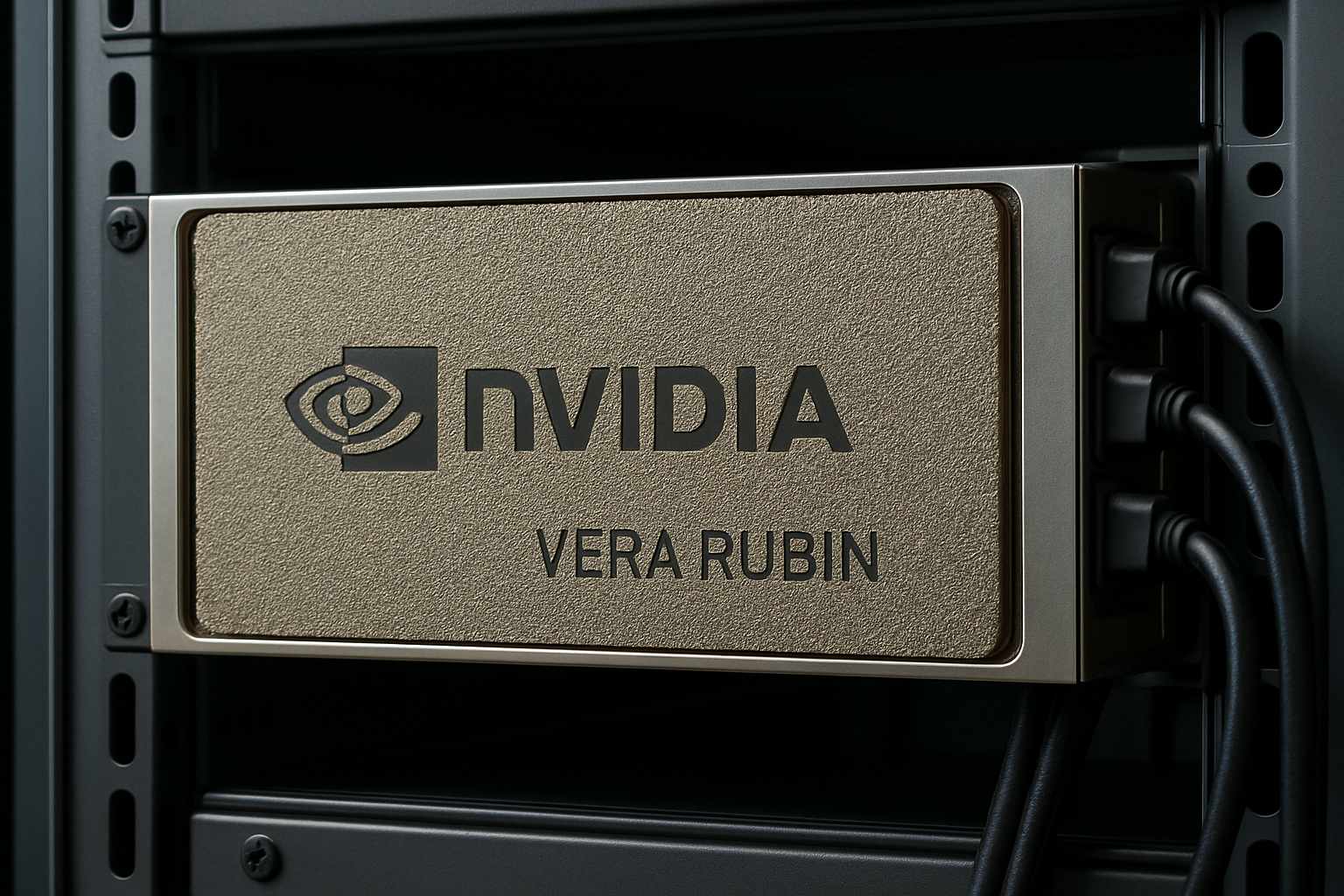
Rubin CPX GPU delivers up to 30 PFLOPS using NVFP4 precision. Furthermore, each GPU integrates 128 GB GDDR7 dedicated to long-context inference. NVL72 racks tie 72 GPUs and 36 Vera CPUs through NVLink 6 switching fabric. Moreover, rack memory reaches 100 TB in the larger NVL144 configuration. Every system node mounts two NVMe arrays for scratch storage. BlueField-4 DPUs manage storage and networking, keeping compute cycles focused on tokens. Consequently, Nvidia claims 10x higher inference throughput per watt against Blackwell baselines. Liquid cooling supports 8 exaflops per rack without violating one-megawatt thermal envelopes. Therefore, data centers must budget dense power and chilled water loops when planning integration.
Rubin’s tightly integrated stack exemplifies vertical optimization within AI Hardware. Next, performance claims face external scrutiny before buyers finalize orders.
Performance Claims Scrutinized Rigorously
Nvidia asserts cost per token drops to one-tenth of Blackwell on select workloads. However, WIRED reminded audiences that "full production" often implies low-volume ramps. Tom’s Hardware, citing vendor quotes, reports NVL72 racks at roughly seven million dollars. Consequently, real total cost of ownership hinges on volume discounts and facility readiness. Analyst Austin Lyons noted previous schedule slips during Blackwell deployment. Nevertheless, early customer pilots will soon reveal whether throughput metrics translate beyond benchmarks. OpenAI and Anthropic publicly praise Vera Rubin performance yet declined to share measured numbers. Meanwhile, Micron bandwidth data aligns with Nvidia’s memory claims, lending partial validation. System efficiency gains depend on software tuning.
Independent coverage balances optimism with caution around AI Hardware projections. Accordingly, ecosystem partnerships deserve closer attention.
Ecosystem Partnerships Expand Rapidly
March 2026 brought announcements from Thinking Machines, OpenAI, and several hyperscalers. Additionally, Micron confirmed HBM4 high-volume readiness for Rubin shipments. SK hynix signaled complementary capacity, reducing single-supplier risk. Moreover, system integrators like HPE and Switch joined NVIDIA’s DSX blueprint initiative. Consequently, reference designs cover power trains, chillers, and network spine layouts. In contrast, rival cloud providers advance proprietary ASIC projects, hedging dependency on one vendor. Nevertheless, many will still source Rubin racks for peak performance tiers. Professionals can enhance operational readiness through the AI Cloud Architect™ program, reflecting broader skills demand.
Partner breadth fortifies supply confidence and accelerates innovation cycles. Subsequently, financial teams examine deployment economics.
Deployment Economics Under Review
Quoted NVL72 prices range between five and seven million dollars. Therefore, CFOs compare Rubin capital intensity with alternative accelerators. Energy modeling shows each rack draws near one megawatt under sustained load. Moreover, DSX templates claim optimized tokens per watt mitigate operational expense over time. A quick calculation illustrates potential savings:
- 10x inference throughput per watt, per Nvidia lab tests
- 75% GPU reduction for select mixture-of-experts training
- 1/10 cost per token versus Blackwell baseline
However, these gains assume full workload compatibility with Rubin architecture. Tax incentives for energy-efficient facilities could further shift total cost calculations. Consequently, enterprises may pursue phased rollouts beginning with research clusters.
Robust financial models help translate headline specs into board approval. Next, we evaluate risks tempering adoption timelines.
Operational Risks And Realities
Regulatory export controls continue reshaping chip allocation across regions. In contrast, demand from China shifts toward alternative accelerators under current restrictions. TSMC reportedly reallocated capacity away from H200 toward Rubin lines. Consequently, earlier products could face extended lead times. Heat density and liquid cooling complexity raise maintenance training requirements. Nevertheless, DSX blueprints embed operational guidelines that mitigate early pitfalls. Vendor lock-in also looms; moving off tightly integrated AI Hardware can prove costly. Hence, procurement contracts increasingly demand flexible licensing and interoperability commitments.
Technical and geopolitical factors inject tangible uncertainty into Vera Rubin scaling. Still, structured roadmaps can navigate these challenges toward phased implementation.
Structured Implementation Roadmap Guidance
Begin with pilot clusters sized at one NVL72 rack. Additionally, allocate redundant chillers and 1.2 MW power to absorb peak loads. Parallel training for operations staff should employ vendor simulation tools within Omniverse DSX. Moreover, establish joint working groups with Nvidia, integrators, and cloud partners for issue triage. Quarterly checkpoints must evaluate token-per-watt targets against baseline objectives. Consequently, expansion phases trigger only after metrics align with financial models. System audits must verify firmware alignment before scaling fleets. Professionals should reinforce skill sets using the linked AI Cloud Architect™ curriculum. Therefore, organizations mature operational excellence while hedging against evolving AI Hardware demands.
Disciplined planning converts aspiration into repeatable execution. Finally, we summarize key insights and outline next actions.
Vera Rubin introduces integrated AI Hardware that targets performance, efficiency, and operational simplicity. Independent reporting validates several claims yet flags supply and cost variables. Consequently, decision makers must balance hype with rigorous due diligence. Ecosystem partnerships, memory readiness, and DSX blueprints collectively strengthen the AI Hardware proposition.
However, export controls, facility complexity, and vendor concentration introduce real risks. Therefore, phased pilots, transparent contracts, and continuous skills development become critical safeguards. Teams can upskill through the AI Cloud Architect™ offering and stay aligned with evolving AI Hardware standards. Act now, build knowledge, and position your organization to harness next-generation AI Hardware competitively.
Disclaimer: Some content may be AI-generated or assisted and is provided ‘as is’ for informational purposes only, without warranties of accuracy or completeness, and does not imply endorsement or affiliation.


