

AI CERTs
6 months ago
Google AI Studio streamlines natural language app development
Developers crave faster ways to ship intelligent products. Consequently, Google AI Studio promises app creation through plain conversation. The web IDE now pairs Gemini 2.5 Pro with a chat-driven code editor. Therefore, prototypes emerge in minutes, not weeks. Industry adoption has surged since Google I/O 2025 announced sweeping upgrades. Moreover, the platform straddles professional developers and citizen builders, aligning with rising No-code AI demand. This article dissects the new capabilities, enterprise path, risks, and future roadmap. Finally, you will learn which certifications boost credibility when launching generative products.
Gemini Models Powering Studio
Gemini models drive the core creativity inside Google AI Studio. Gemini 2.5 Pro delivers large context windows and native code generation. Additionally, Gemini 3 Flash arrives with lower latency and sharper reasoning, according to DeepMind’s Tulsee Doshi. During I/O 2025, Sundar Pichai claimed seven million developers already build with Gemini. In contrast, last year’s tally was below two million, reflecting fivefold growth. These numbers confirm serious traction among professional teams. Engineers appreciate how Google AI Studio surfaces model settings transparently. Gemini’s rapid evolution underpins Studio’s expanding feature set. Consequently, understanding the build flow becomes critical next.
Adoption Statistics In Focus
Monthly active users for the Gemini app reportedly exceed 400 million. Meanwhile, Vertex AI usage climbed fortyfold, highlighting backend scalability. These benchmarks reassure managers evaluating supply-chain capacity. The metrics illustrate market confidence. Therefore, attention shifts toward hands-on creation.
Natural Language App Building
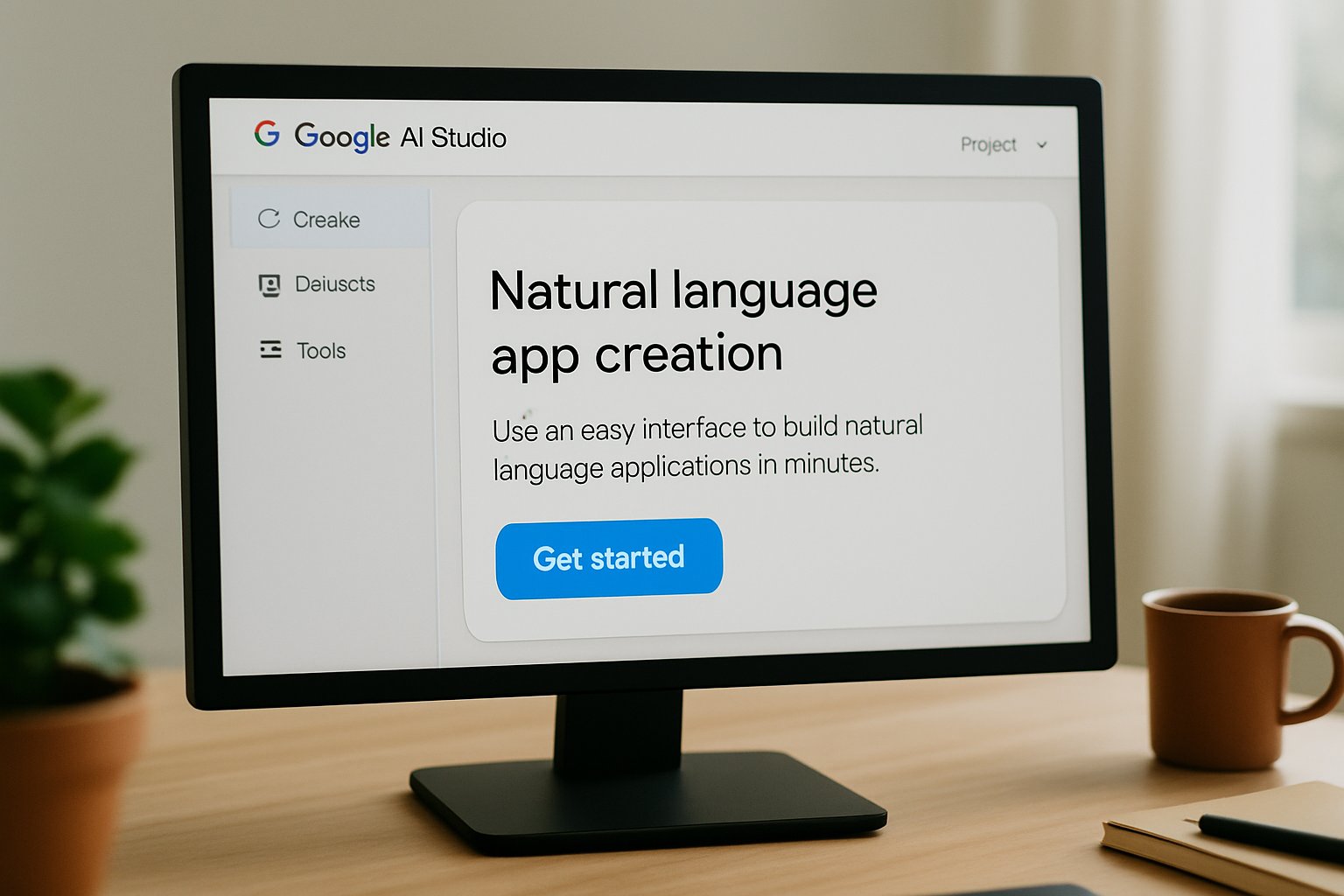
Google AI Studio now offers Build mode for conversational programming. Describe a web idea, upload assets, and watch full React projects materialize. Furthermore, iterative chat editing shows code diffs, letting teams refine flows safely. One-click Cloud Run deployment shortens the feedback loop further.
- Gemini writes UI and backend stubs within seconds.
- Studio proxies API calls using placeholder keys during previews.
- Developers export to GitHub for rigorous code review before production.
- No-code AI enthusiasts iterate through natural language, avoiding complex CLI setups.
- Google AI Studio exports entire projects into GitHub with one command.
Nevertheless, generated code requires manual security audits. Google’s docs urge server-side key storage once projects leave the sandbox. Build mode turns ideas into runnable demos rapidly. Subsequently, teams must evaluate deployment options.
Enterprise Deployment Pathways Explained
Many prototypes graduate by exporting from Google AI Studio to Vertex AI Studio. There, enterprises gain governance, fine-tuning, and compliance tooling. Moreover, Workspace Studio extends agent creation to business users inside Gmail and Docs. The trio forms a funnel from idea to audited production workload.
Pricing Snapshot And Tiers
Pricing remains pay-as-you-go per million tokens. For example, Gemini 2.5 Pro input costs around $1.25, while output costs $10. Flash variants trade power for lower fees and faster responses. Consequently, teams mix models to balance budget and performance. Adoption of No-code AI inside Workspace Studio accelerates broader rollout. Enterprise paths offer compliance and predictable billing. Next, we examine potential pitfalls.
Risks And Precautions Discussed
Projects exiting Google AI Studio encounter several notable risks. Developers have reported proxy bugs and 502 errors after deployment. Additionally, placeholder key substitution can confuse newcomers, exposing credentials when mis-configured. Hallucinations persist; therefore every output needs verification and grounding.
Google recommends using Model Context Protocol for secure database access. Nevertheless, open standard adoption demands extra DevSecOps planning. Independent researchers urge red teaming before customer release. Understanding these risks ensures sustainable rollouts. Future updates promise to mitigate several gaps.
Future Roadmap And Competition
Sundar Pichai previewed Deep Think mode for extended reasoning. Meanwhile, Live API adds streaming audio output for real-time assistants. Competitors watch how Google AI Studio handles multimodal updates. In contrast, OpenAI and Microsoft tout similar agent capabilities within Copilot stack. Consequently, differentiation will hinge on deployment ease and multimodal breadth.
Tulsee Doshi called Gemini 3 Flash a huge upgrade in speed and nuance. Moreover, Google plans broader regional releases this quarter. Stakeholders should monitor model availability pages before locking roadmaps. Roadmap visibility helps align talent investments. Skills discussion follows accordingly.
Skills And Certifications Needed
Even with No-code AI advances, foundational understanding remains vital. Professionals can validate expertise through the AI+ Everyone certification. Additionally, cloud architecture fluency ensures secure deployments and cost control. Teams should practice prompt engineering, version control, and threat modeling.
- Prompt design experiments with guardrails.
- Code review for AI-generated modules.
- MCP connector configuration for data safety.
- FinOps tracking of token spend.
Cultivating these abilities reduces production surprises. Therefore, companies maximize gains from Google AI Studio.
Google AI Studio now sits at the center of Google’s generative ecosystem. It converts plain ideas into shareable prototypes with remarkable speed. Furthermore, enterprise pathways secure compliance and scale. Nevertheless, proxy quirks and hallucinations still require vigilance. Developers who master prompt design and governance practices will stand apart. Professionals should pursue credentials and follow evolving model documentation. Consequently, early movers can unlock fresh revenue while shaping responsible standards. Start experimenting today, then earn the AI+ Everyone credential to validate your leadership.
Disclaimer: Some content may be AI-generated or assisted and is provided ‘as is’ for informational purposes only, without warranties of accuracy or completeness, and does not imply endorsement or affiliation.


