

AI CERTs
5 months ago
Continuous Model Risk Monitoring Platforms Become Enterprise Norm
Boards once treated model validation as a periodic checkbox. However, regulators and investors now demand always-on assurance. That shift is propelling Continuous Model Risk Monitoring Platforms into mainstream budgets. Consequently, enterprises are replacing static dashboards with streaming telemetry and automated guardrails. These new platforms watch every prediction, flag drift, and create immutable audit trails. Meanwhile, early adopters report faster remediation and lower incident costs. Market analysts expect the tooling category to pass USD six billion next year. Additionally, we review how cloud providers and specialist vendors are converging. Finally, we outline concrete steps toward compliant, scalable adoption. In short, continuous oversight is moving from aspiration to requirement. Failure to prepare could expose firms to severe operational risk and regulatory censure.
Continuous Model Risk Monitoring Platforms
At its core, such a platform instruments data pipelines end-to-end. It streams input features, predictions, embeddings, and agent traces into rich telemetry. Moreover, automated detectors watch for performance drift, bias, hallucinations, and security misuse in real time.
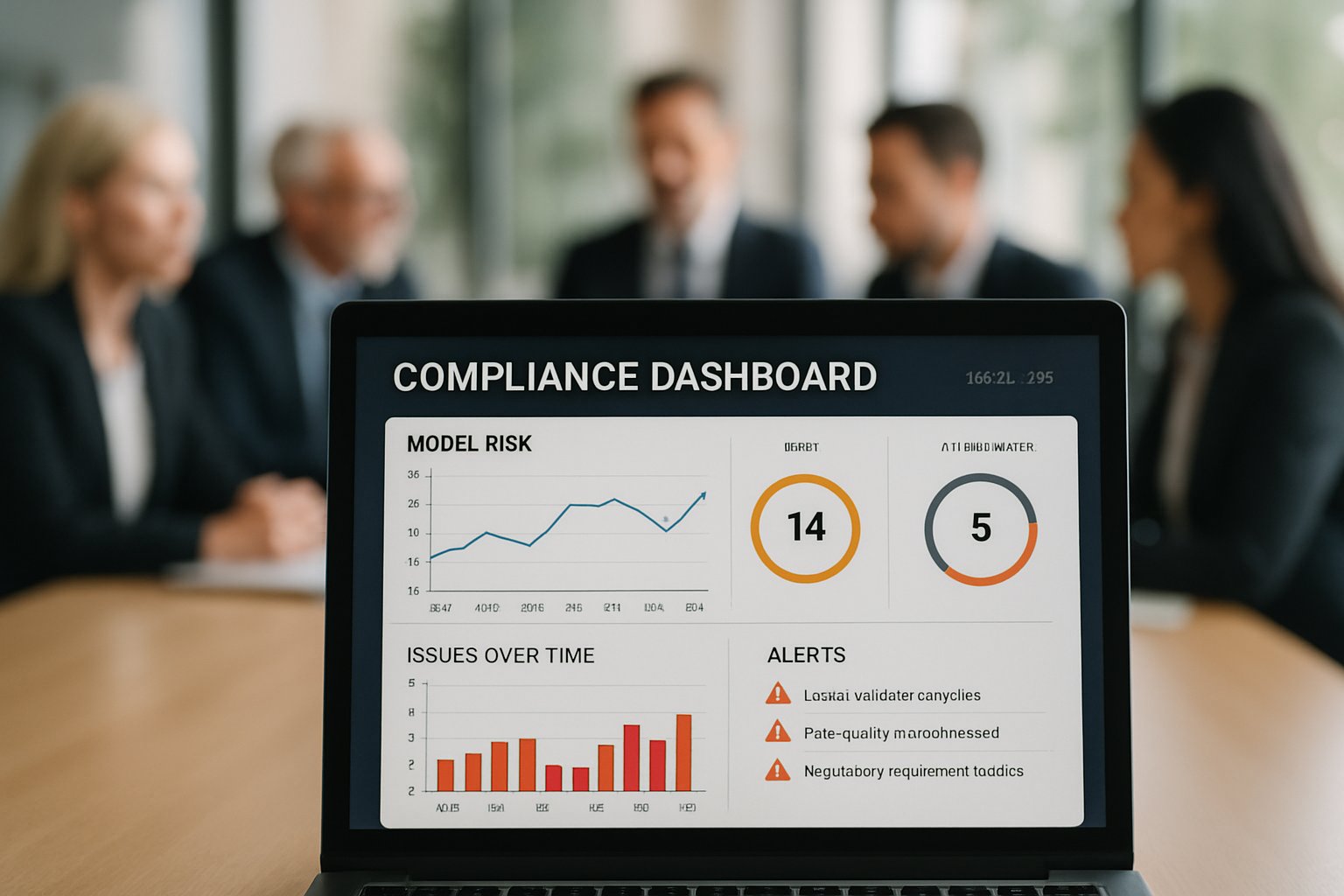
Root-cause analytics sit beside alerting to prioritize true incidents. Consequently, model owners can trace errors to specific features or prompts within minutes. Audit modules then package evidence for internal validators and external supervisors.
Modern offerings align with MLOps, DevSecOps, and AI governance processes. They integrate with feature stores, CI pipelines, and ticketing systems for closed-loop remediation. In contrast, legacy batch checks cannot match this speed or transparency. Therefore, enterprises with high compliance exposure treat continuous oversight as non-negotiable.
Together, these capabilities define the new technical baseline. The next section explains why regulators accelerated the shift.
Regulatory Momentum Drives Adoption
Supervisors in North America have raised expectations sharply. U.S. guidance SR 11-7 has always required ongoing monitoring. However, Canada’s Guideline E-23 sets an explicit 2027 compliance deadline.
Consequently, banks and insurers face board-level scrutiny over model evidence retention. OSFI now labels model risk an enterprise concern demanding lifecycle controls. Additionally, European regulators reference similar principles in draft AI Act texts.
Firms must show robust monitoring frameworks during examinations. Inspectors expect live dashboards, alert policies, and remediation playbooks. Failure now triggers capital surcharges and public enforcement actions.
Therefore, procurement teams are standardizing on Continuous Model Risk Monitoring Platforms to satisfy auditors quickly.
Regulatory heat transformed nice-to-have tools into mandated infrastructure. Market sizing trends illustrate how budgets follow that pressure.
Market Size And Growth
Market researchers value the segment at roughly USD 6.4 billion for 2025. They project double-digit compound growth through 2032.
Moreover, vendors report startling telemetry volumes. Arize processes billions of predictions monthly, while TruEra handles hundreds of billions across clients. Such numbers indicate production deployment rather than pilot experimentation.
Investors have noticed. Consequently, funding continues to flow into observability startups and cloud integrations. Hyperscalers also embed guardrails to protect core consumption revenue. As spend rises, Continuous Model Risk Monitoring Platforms capture a growing share of risk budgets.
- Estimated CAGR: 12.4% through 2032
- Predictions observed: 100B+ monthly across leading vendors
- Compliance deadline: May 1, 2027 for Canadian banks
These figures underscore growing demand and urgency. Technology developments next reveal how providers meet that scale.
Technology Stack Evolution Accelerates
Early monitoring tools logged metrics and latency. However, LLMs and agents required deeper context tracing. Vendors responded with embedding drift monitors, prompt capture, and multi-turn session maps.
AWS added Bedrock Guardrails while Google extended Vertex AI monitoring hooks. Meanwhile, IBM folded watsonx.governance into its broader risk suite. These moves bring continuous observability inside enterprise cloud landing zones.
Specialists differentiate through detailed root-cause analytics and explainability visualizations. Fiddler’s report generator exports regulator-ready PDFs in one click. WhyLabs offers security filters that redact sensitive payloads automatically.
Integration breadth remains critical for AI governance orchestration. Therefore, open APIs and SDKs have become table stakes.
Technology stacks now support turnkey continuous oversight at petabyte scale. Implementation challenges still threaten timelines, as the next section outlines.
Implementation Challenges And Mitigations
Enterprises struggle first with data instrumentation. Legacy models hide feature lineage, complicating telemetry capture. Furthermore, privacy rules restrict exporting personally identifiable data.
Noise is another pain point. Naive thresholds spawn alert floods that exhaust on-call teams. Consequently, platforms add adaptive baselines and root-cause clustering.
Cost pressures also surface. Continuous pipelines demand storage, compute, and skilled validators. Many firms offset expenses by adopting managed MRM services from consultancies.
Pragmatic teams follow a structured rollout:
- Risk tier models and prioritize high-impact ones first.
- Establish PII redaction in telemetry streams.
- Tune drift detectors using historical incident logs.
- Automate evidence archiving for regulatory audits.
Professionals can boost expertise through the AI Network Security™ certification.
Collectively, these steps reduce operational risk and accelerate regulator acceptance.
Implementation remains complex yet manageable with disciplined processes. The next section details benefits that justify the effort.
Strategic Benefits For Enterprises
Continuous visibility delivers measurable gains. Early drift detection prevents revenue loss and brand damage. Additionally, automated reports cut validation cycle times by up to 50%.
Continuous Model Risk Monitoring Platforms also create shared metrics for data scientists and executives. Board members appreciate clearer risk dashboards that link model performance to financial exposure. Consequently, budget approvals for data science programs accelerate.
From a compliance stance, live telemetry supports defensible AI governance evidence under tight deadlines. Supervisors value immutable logs that demonstrate timely remediation. This directly lowers operational risk capital charges.
Moreover, centralized guardrails create consistent policy enforcement across business units. That reduces fragmentation and shadow IT deployments.
These benefits extend beyond risk containment to strategic agility. However, organizations must keep pace with evolving standards, explored next.
Future Outlook And Recommendations
Regulators will likely codify telemetry granularity for specific model classes within two years. Therefore, enterprises should design schemas flexible enough for future rules.
Industry alliances may define open evidence formats, easing audits across jurisdictions. Meanwhile, vendors plan to embed generative RCA assistants that propose fixes automatically.
To stay ahead, leaders should fund continuous upskilling and cross-functional AI governance task forces. Continuous Model Risk Monitoring Platforms must integrate tightly with incident response and business continuity plans.
Finally, procurement contracts should include service level objectives for drift detection and alert latency. Consequently, stakeholders can quantify residual operational risk accurately.
The landscape will mature rapidly yet unpredictably. Proactive planning positions firms to seize opportunities while containing downside.
Continuous Model Risk Monitoring Platforms now sit at the heart of modern AI governance programs. They satisfy demanding regulators, cut operational risk, and sustain customer trust. Moreover, real-time analytics unlock faster experimentation and clearer business alignment. Leaders who invest today secure a durable compliance foundation for tomorrow’s complex models. Explore the linked certification to deepen expertise and guide your organization toward resilient, responsible AI. Subsequently, they can negotiate favorable capital treatment and accelerate innovation cycles. Consequently, hesitation is the costlier path.
Disclaimer: Some content may be AI-generated or assisted and is provided ‘as is’ for informational purposes only, without warranties of accuracy or completeness, and does not imply endorsement or affiliation.


