

AI CERTS
1 hour ago
AI Uncovers Hidden Ocean Currents and Signals a Massive Skills Gap the World Cannot Ignore
Researchers have developed an AI-driven system called GOFLOW that can transform ordinary satellite images into high-resolution maps of ocean currents. These currents, especially small-scale and fast-moving ones, were previously impossible to track directly. By analyzing subtle temperature changes over time, AI can now detect patterns that were invisible to human observers and traditional tools.
What makes this breakthrough remarkable?
It is not just the discovery itself, but how it was achieved. Instead of launching new satellites or investing in expensive infrastructure, scientists used existing data and applied advanced AI models to extract deeper insights. This shift from collecting more data to understanding data better—marks a turning point in scientific research.
The implications are massive. Ocean currents play a critical role in regulating Earth’s climate, distributing heat, and storing carbon. By mapping these hidden flows, scientists can better predict climate change, improve weather forecasting, and protect marine ecosystems. This could directly impact industries ranging from agriculture and fisheries to disaster management and global logistics.
Yet, beneath this technological triumph lies a more urgent story. Breakthroughs like these are no longer rare. AI is accelerating discoveries across fields—from predicting cancer spread to improving energy efficiency and even enhancing human creativity. The pace of innovation is exponential. But the workforce readiness to understand, implement, and scale these innovations is not.
This is where the real gap emerges.
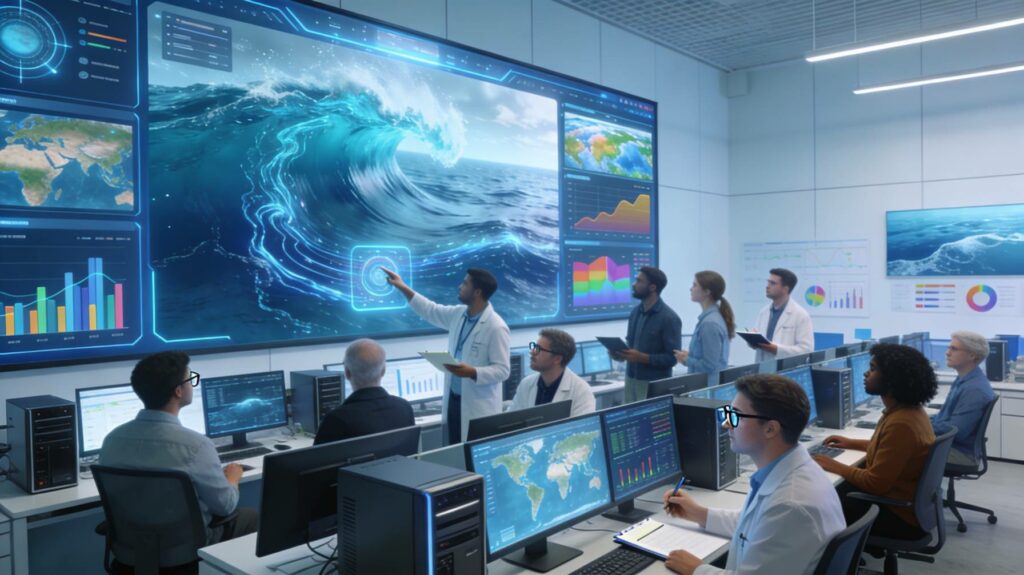
Most organizations today are eager to adopt AI, but very few have teams equipped to interpret complex AI outputs, integrate them into decision-making, or build solutions from scratch. In the case of the ocean current discovery, the value lies not just in the algorithm, but in the ability to translate insights into actionable strategies—something that requires trained professionals, not just tools.
Without proper AI training, businesses risk becoming passive consumers of technology rather than active innovators. They may use AI dashboards, but fail to question results, optimize models, or identify new opportunities. This creates a dangerous dependency gap—where AI becomes powerful, but human capability lags behind.
To bridge this divide, structured and scalable AI education is no longer optional. It is essential.
Programs like the AI CERTs Authorized Training Partner (ATP) Program are designed precisely to address this challenge. Instead of offering fragmented learning, ATP provides a complete ecosystem for organizations and training providers to deliver industry-relevant AI education. It enables partners to equip professionals with practical, role-based AI skills—from foundational understanding to advanced implementation.
This matters because AI is no longer confined to data scientists. In today’s world, marketers, operations managers, healthcare professionals, and even policymakers must understand how AI works, what it can and cannot do, and how to apply it responsibly.
The ocean current breakthrough is a perfect example. The technology itself is powerful, but its real-world impact depends on how well industries can leverage it. Fisheries can optimize routes, climate analysts can refine models, and governments can improve disaster preparedness—but only if they have people who understand AI deeply enough to act on its insights.
We are entering an era where AI is not just a tool, but a collaborator in discovery. It can see patterns we cannot, process data at unimaginable speeds, and unlock insights that redefine entire industries. But collaboration requires understanding. And understanding requires training.
If organizations fail to invest in AI skills today, they risk being left behind in a world where intelligence—both artificial and human—must evolve together.
The message is clear. The future is not just AI-powered. It is AI-trained.
FAQs
What is the recent AI breakthrough about ocean currents
The breakthrough involves an AI system called GOFLOW that uses satellite data to map previously invisible ocean currents by analyzing temperature changes over time.
Why are ocean currents important for the planet
Ocean currents regulate climate, distribute heat, influence weather patterns, and support marine ecosystems, making them critical for environmental balance and human survival.
How does AI make this discovery possible
AI processes massive datasets from satellites and identifies subtle patterns that traditional methods cannot detect, enabling more accurate and detailed mapping.
Why is AI training becoming essential for professionals
As AI becomes central to decision-making across industries, professionals need the skills to interpret results, implement solutions, and innovate using AI tools effectively.
What is the role of the AI CERTs Authorized Training Partner Program
The ATP program helps organizations and training providers deliver structured, practical AI education, ensuring professionals are equipped to apply AI in real-world scenarios and drive business value.


