

AI CERTS
2 hours ago
Google Cloud Unleashes Agentic AI Revolution and Signals Urgent Need for Workforce Training
The announcements signal the arrival of what experts are calling the “agentic era” a world where AI doesn’t just assist humans but actively executes tasks, manages workflows, and drives decisions at scale.
A New Era of Autonomous AI Begins
Google Cloud’s latest innovations center on “agentic AI,” a form of artificial intelligence designed to operate independently and handle complex, multi-step tasks without constant human input. These AI agents can analyze data, make decisions, and take action across business systems—transforming how organizations function.
At the core of this shift is the newly launched Agentic Data Cloud and Gemini Enterprise Agent Platform, which together allow businesses to build, deploy, and scale AI agents across their operations.
This isn’t just incremental innovation. Google is reimagining enterprise infrastructure so that data, workflows, and AI systems are seamlessly connected. The result is a “reasoning engine” where AI agents can access unified data, eliminate silos, and act in real time.
In parallel, Google introduced advanced infrastructure, including next-generation TPUs and large-scale networking systems, to handle the massive computational demands of agentic AI.
The message is clear: AI is no longer a tool—it is becoming an autonomous workforce.
From AI Experiments to Enterprise Transformation
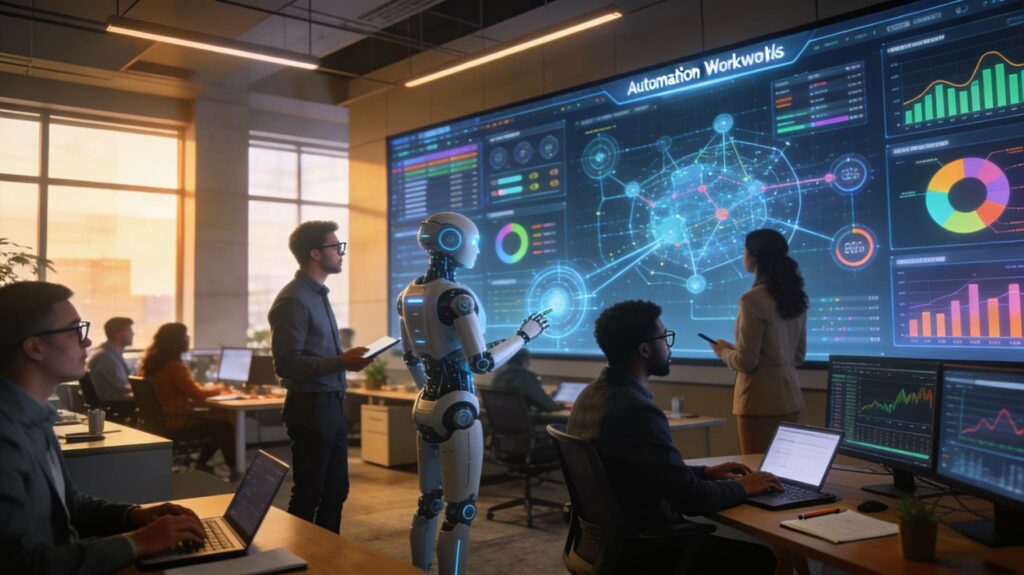
For years, companies have experimented with AI through pilots and isolated use cases. Google’s new platform changes that by enabling full-scale enterprise adoption.
With agentic AI, businesses can automate entire workflows—from customer service and supply chain decisions to financial forecasting and software development. These systems don’t just respond; they proactively execute tasks based on goals.
Early adopters like major global enterprises are already using these capabilities to streamline operations and improve efficiency.
Google is also backing this transformation with a $750 million fund aimed at accelerating partner-led AI development and deployment, highlighting the growing importance of ecosystems in scaling AI adoption.
This marks a turning point. The question is no longer whether businesses will adopt AI—but how fast they can scale it.
The Talent Gap Is Now the Biggest Risk
While the technology is advancing rapidly, workforce readiness is lagging behind. Agentic AI systems require a new set of skills—ranging from AI strategy and prompt engineering to governance, ethics, and integration.
Without trained professionals, organizations risk underutilizing these powerful tools or, worse, implementing them incorrectly.
The rise of autonomous AI also introduces new challenges, including data governance, security risks, and ethical considerations. Experts warn that agentic systems can amplify errors or vulnerabilities if not properly managed.
This makes AI training not just a competitive advantage, but a necessity.
Why AI Training Partnerships Matter More Than Ever
As enterprises rush to adopt agentic AI, structured training ecosystems are becoming critical. This is where programs like the AI CERTs Authorized Training Partner (ATP) Program come into play.
The ATP model enables organizations, training providers, and consultants to deliver industry-recognized AI certifications and hands-on learning experiences. Instead of fragmented knowledge, businesses gain access to standardized, scalable training that aligns with real-world AI implementation.
In the context of Google Cloud’s announcements, ATP-like frameworks become even more valuable. They help bridge the gap between cutting-edge AI capabilities and workforce readiness—ensuring teams can actually deploy, manage, and optimize AI agents effectively.
In a world where AI agents can run operations, the real differentiator will be the humans who know how to guide them.
The Road Ahead for Businesses
The shift to agentic AI is not a distant future—it is happening now. Companies that embrace it early will gain significant advantages in efficiency, innovation, and scalability.
But technology alone is not enough. Success will depend on how well organizations invest in their people.
Businesses must move beyond experimentation and focus on building AI-ready teams. This includes upskilling employees, partnering with training providers, and embedding AI literacy across all levels of the organization.
The enterprises that combine advanced AI systems with a trained workforce will lead the next decade of innovation.
FAQs
What is agentic AI and how is it different from traditional AI
Agentic AI refers to autonomous systems that can plan, decide, and act independently to achieve goals. Unlike traditional AI, which typically responds to prompts, agentic AI executes multi-step tasks with minimal human intervention.
What did Google Cloud announce at the 2026 event
Google introduced the Agentic Data Cloud, Gemini Enterprise Agent Platform, advanced TPUs, and new infrastructure designed to help businesses build and scale AI agents across their operations.
Why is AI training becoming essential for businesses
As AI systems become more complex and autonomous, organizations need skilled professionals to implement, manage, and govern them effectively. Without training, businesses risk poor adoption and operational inefficiencies.
How can companies prepare for the agentic AI era
Companies should invest in workforce upskilling, adopt structured AI training programs, and partner with certification providers to ensure their teams are ready to work with advanced AI systems.
What is the role of the AI CERTs Authorized Training Partner Program
The ATP Program helps organizations deliver standardized AI education and certifications, enabling businesses to build skilled teams capable of deploying and managing AI technologies at scale.


