

AI CERTs
5 months ago
Foundation Model Physics Drives Nvidia Cosmos Simulations
Robots and autonomous vehicles crave a deeper grasp of real-world dynamics. Consequently, Nvidia has introduced Cosmos, a platform that combines cutting-edge world models with powerful data pipelines. The launch spotlights Foundation Model Physics, a discipline blending generative AI with rigorous mechanics. Moreover, industry analysts see the move as a pivotal step toward scalable Physical AI.
Cosmos Platform Emergence Now
Nvidia revealed Cosmos at CES 2025 after months of private testing. Subsequently, developers gained access to open model checkpoints on GitHub and Hugging Face. The suite supplies diffusion and autoregressive world models that output photoreal video consistent with Newtonian rules. Furthermore, Cosmos links tightly with Omniverse and Isaac Sim, speeding end-to-end Simulation workflows. Early adopters include Wayve, Uber, and Agility Robotics.
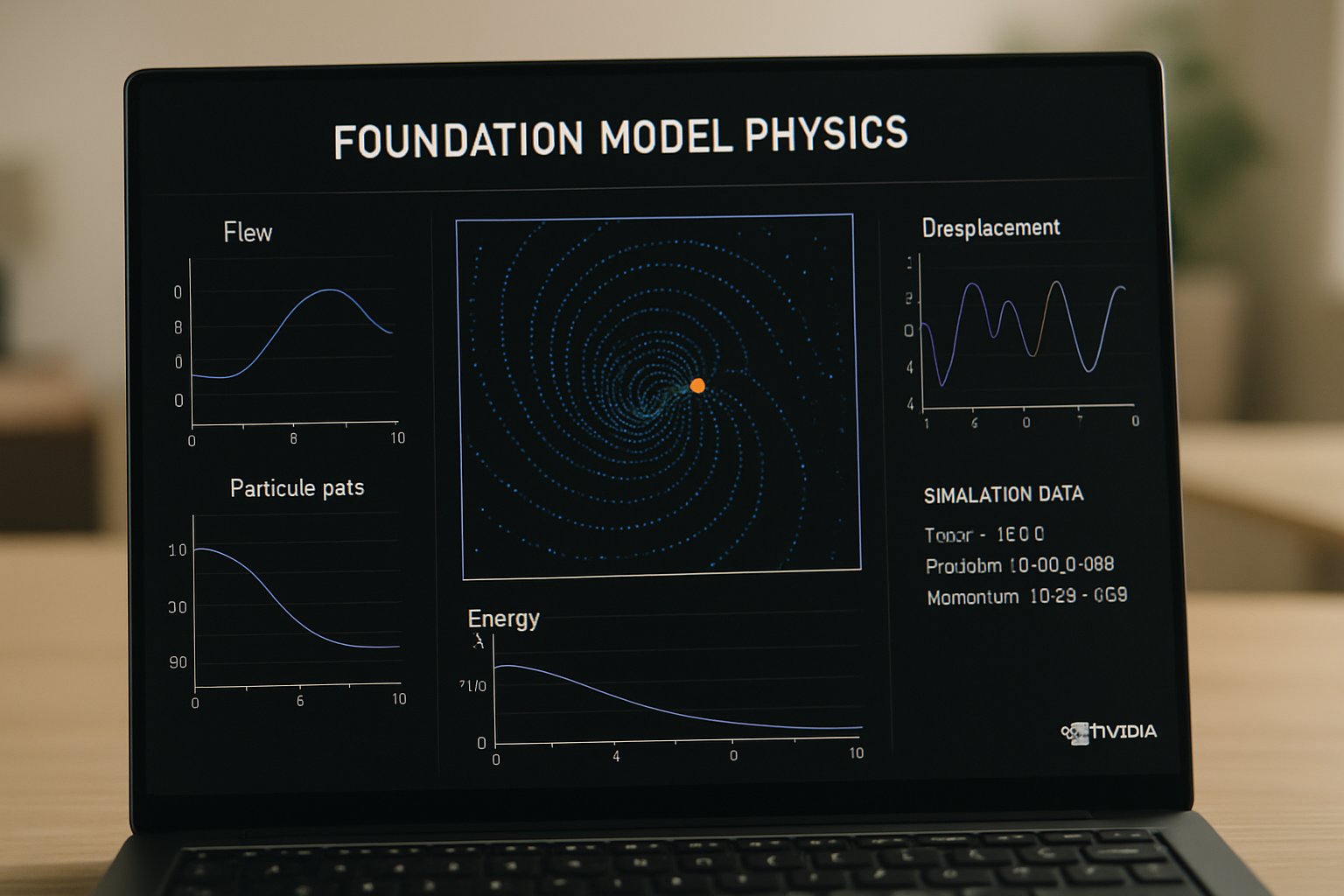
The public release also featured a Cosmos Tokenizer promising eight-fold compression over prior visual encoders. Therefore, teams can process 20 million hours of footage in 14 days on Blackwell GPUs. These figures underscore Nvidia’s hardware-software synergy. These launch details set the stage for deeper technical exploration.
Foundation Model Physics Explained
Foundation Model Physics underpins every Cosmos component. It appears when models predict future frames, respecting inertia, friction, and occlusion. However, the concept extends beyond simple motion equations. It fuses multimodal token streams—text, depth, and tactile signals—inside a shared latent space. This joint space lets agents imagine counterfactual worlds while obeying energy conservation.
Developers fine-tune these world models on domain-specific scenarios. Consequently, a warehouse robot can forecast pallet shifts after impact. Researchers claim that Foundation Model Physics shortens policy training cycles by 40 percent in controlled tests. Nevertheless, external validation remains limited. Additional benchmarks will clarify performance in unpredictable urban streets.
A concise summary closes this segment: Foundation Model Physics embeds real mechanics within generative models. Meanwhile, upcoming paragraphs will examine tokenization breakthroughs that enable such scale.
Tokenizers And Dataflow Speed
The Cosmos Tokenizer converts raw video into compact tokens at record speed. Moreover, published benchmarks show twelve-times faster reconstruction versus earlier methods. This gain matters because training a single Foundation Model Physics network may require nine quadrillion tokens. In contrast, legacy tokenizers choked on that volume.
Key performance insights include:
- 8× spatial compression with minimal perceptual loss
- Temporal subsampling factors up to 8× for long sequences
- CUDA-optimized kernels delivering 1.3 ms per frame encoding
Consequently, data engineers can curate giant corpora without ballooning storage budgets. Additionally, NeMo Curator integrates directly, automating deduplication and quality scoring. Professionals can enhance their expertise with the AI Foundation Essentials™ certification.
These innovations compress workflow latency dramatically. However, real-world adoption depends on demonstrable return on investment, which the next section addresses.
Industrial Adoption Momentum Builds
Commercial traction has surged since the release. Figure AI leverages Cosmos to synthesize edge-case humanoid scenarios. Meanwhile, XPENG taps the platform for adverse-weather Simulation of highway driving. Nvidia reports over a dozen pilots across robotics, logistics, and mobility.
Partners cite three compelling benefits:
- Reduced field-testing hours by up to 60 percent
- Faster corner-case generation for lidar and radar sensors
- Seamless deployment through DGX Cloud microservices
Consequently, project timelines compress while safety metrics improve. Nevertheless, some firms worry about vendor lock-in tied to Blackwell silicon. A hybrid deployment roadmap could ease those concerns. These adoption trends illustrate growing confidence. Yet legal clouds still hover, as the following section explores.
Legal And Ethical Storm
Investigative reports from 404 Media allege large-scale scraping of copyrighted video for Cosmos training. Subsequently, a class action emerged in August 2024 and lingered through procedural twists. YouTube’s leadership also warned that unlicensed downloads violate platform terms. Therefore, questions around data provenance persist.
Nvidia asserts transformative fair-use defenses. However, intellectual-property scholars remain divided. In contrast, some open-source advocates criticize limited dataset transparency. Companies adopting Cosmos must monitor litigation dockets and evaluate indemnity clauses carefully.
To summarize, legal uncertainty threatens wider rollout. Nevertheless, market forecasts still expect strong growth, which the next section quantifies.
Market Outlook And Competition
Market researchers project synthetic-data revenue to exceed USD 2 billion by 2027 with 35 percent CAGR. Robotics spending could approach USD 100 billion by 2030. Consequently, vendors rush to capture share. Nvidia leads with vertical integration, yet rivals such as DeepMind and Parallel Domain push alternative pipelines.
Competitive differentiators include:
- Hardware acceleration tightly paired with models
- Open model checkpoints encouraging community tweaks
- Enterprise support through NIM microservices
Moreover, Foundation Model Physics offers a branding edge that highlights fidelity. Nevertheless, critics note reproducibility gaps without full dataset disclosure. These market dynamics create both urgency and caution for technology buyers. Strategic guidance follows next.
Strategic Guidance For Leaders
Decision makers should pilot limited-scope projects before large commitments. Additionally, cross-functional teams must verify sim-to-real transfer with controlled A/B tests. Procurement officers ought to negotiate escape clauses that mitigate hardware dependence. Meanwhile, compliance units should track emerging copyright rulings impacting Foundation Model Physics datasets.
Furthermore, ongoing staff education remains vital. Professionals can deepen domain mastery through the previously mentioned AI Foundation Essentials™ certification. Documented learning pathways accelerate onboarding and standardize best practices.
In summary, prudent governance paired with upskilled talent unlocks Cosmos value. Consequently, enterprises will be prepared for rapid advances still on the horizon.
These sections have detailed technology, adoption, and risk. However, a concise recap will solidify main insights.
Foundation Model Physics anchors Nvidia’s Cosmos, delivering realistic Simulation that accelerates Physical AI. The tokenizer’s compression powers scalable dataflow, while industry pilots showcase measurable gains. Yet unresolved legal disputes warrant vigilance. Moreover, competitive pressure underscores the need for strategic foresight. Leaders should combine technical pilots, legal oversight, and continuous education to harness the full potential.
Therefore, explore Cosmos resources, monitor legal developments, and pursue relevant certifications today.
Disclaimer: Some content may be AI-generated or assisted and is provided ‘as is’ for informational purposes only, without warranties of accuracy or completeness, and does not imply endorsement or affiliation.


