

AI CERTS
4 hours ago
Labor Economics Faces Wired Belt AI Job Risk
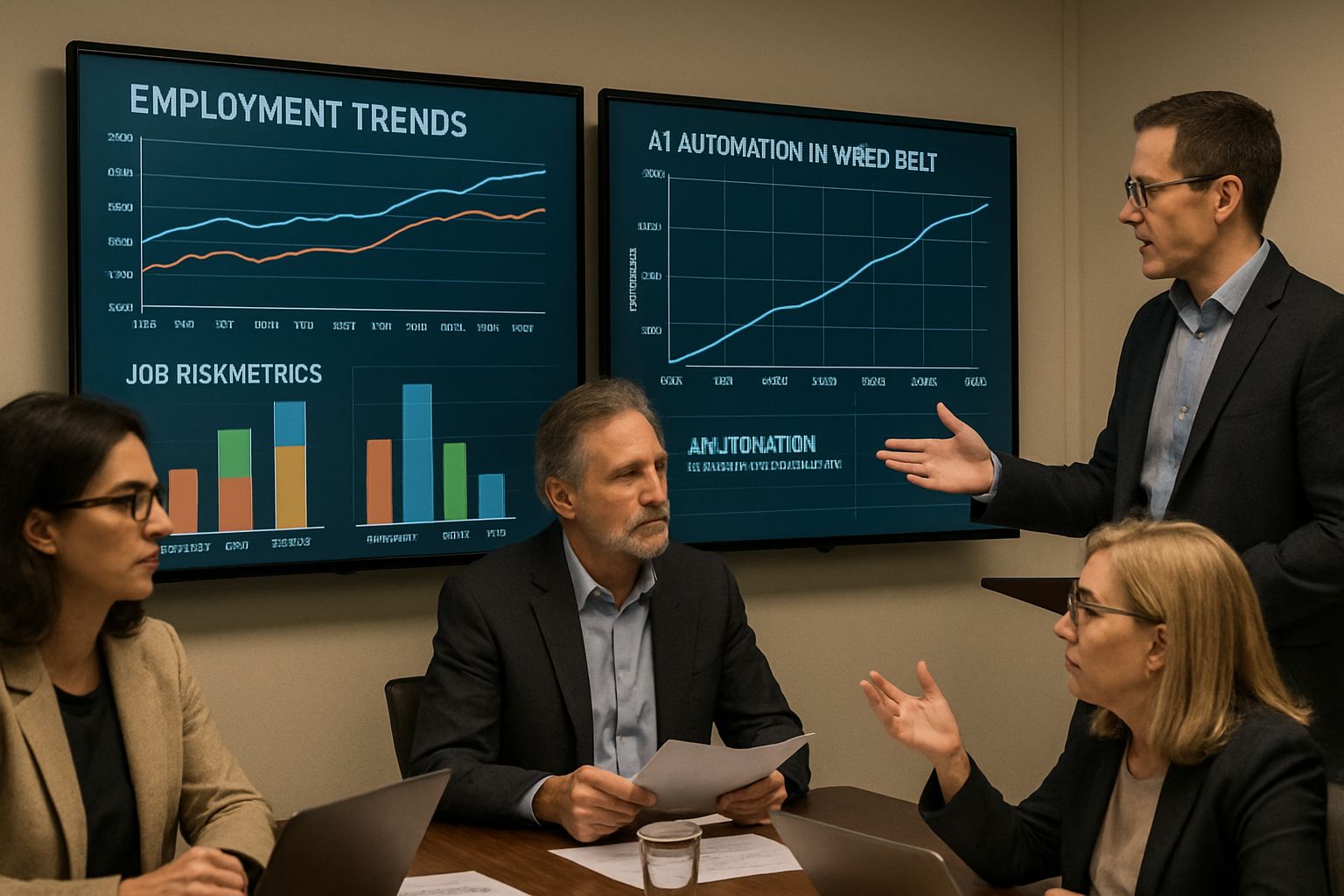
Moreover, the Index projects $757 billion in household income at stake.
Innovation hubs like Boulder, Durham, and Austin dominate the vulnerability leaderboard.
Therefore, leaders must weigh rapid gains against sudden displacement and localized fiscal shocks.
Subsequently, competing forecasts from Forrester and PwC paint alternative futures.
Nevertheless, all agree that policy timing will determine winners and losers.
Meanwhile, companies accelerate adoption, citing cost pressure and shareholder demands.
Understanding the geography, scale, and policy levers becomes essential for practitioners and scholars alike.
Wired Belts Concept Explained
The Tufts Digital Planet team coined the Wired Belts term in March 2026.
Unlike the Rust Belt, these corridors feature software firms, biotech campuses, and university spin-outs.
Yet, their occupational mix skews toward tasks highly exposed to large-language-model automation.
Furthermore, the Index merges ONET task data, Anthropic usage metrics, and Microsoft Copilot telemetry.
This blended approach converts abstract exposure into quantified job-loss probabilities.
Consequently, the median scenario shows about 6% of total U.S. employment under threat.
Labor Economics frameworks help interpret which consumer markets and tax bases might contract first.
These figures reposition perceived safe zones as risk centers.
However, deeper measurement methods clarify why concentration matters.
Measuring AI Job Risk
Tufts analyzed 784 occupations across 530 metropolitan and rural areas.
Moreover, they calculated three adoption scenarios, yielding a displacement range from 2.7 to 19.5 million jobs.
Goldman Sachs earlier offered a global exposure count of 300 million, but timeframes differ.
For comparison, Forrester predicts 10.4 million U.S. losses by 2030, roughly 6% of payrolls.
PwC, in contrast, highlights 56% wage premiums for AI-skilled staff in exposed categories.
Therefore, metrics pivot on whether firms replace or augment human effort.
Labor Economics researchers must scrutinize underlying definitions before contrasting projections.
Varied baselines complicate headline comparisons.
Nevertheless, the Tufts dataset offers granular, location-specific insight addressed next.
Regional Shock Wave Patterns
Digital Planet ranks Seattle, Austin, Denver, and Durham among the highest-risk metros.
Additionally, several midwestern college towns surface, including Ann Arbor and Madison.
Each region depends heavily on professional, scientific, and technical services roles.
Consequently, any displacement could erode large property-tax bases while reducing consumer demand.
Universities amplify exposure because they employ writers, programmers, and instructional designers now vulnerable.
Meanwhile, state legislators in North Carolina and Colorado debate targeted AI training subsidies.
Labor Economics models suggest migration flows could intensify if wage growth stalls locally.
Localized shocks will ripple through housing and retail sectors.
In contrast, national aggregates may hide those disturbances until budgets tighten.
Occupations Near Tipping Point
The Index spotlights 33 occupations that generate outsized risk.
Moreover, writers and authors face a 57% task-loss share, the highest reading.
Computer programmers and web designers follow closely at 55%.
However, finance associates, paralegals, and procurement officers also surface, underscoring white-collar vulnerability.
Subsequently, Forrester warns that firms eliminating such roles sometimes rehire within a year.
Displacement shocks can therefore rebound, creating planning uncertainty for HR teams.
Professionals can enhance their expertise with the AI+ Human Resources™ certification.
Labor Economics tools can benchmark wage elasticity when automation targets these pivotal jobs.
- Information sector: 18% jobs at risk
- Finance & insurance: 16% jobs at risk
- Professional services: 16% jobs at risk
- Overall economy: 6% jobs at risk
These figures reveal concentrated exposure in knowledge positions.
Consequently, policy design must address sector specificity, as discussed next.
Potential Policy Response Pathways
Tufts recommends modernizing safety nets, mandating firm disclosures, and harmonizing federal and state metrics.
In contrast, PwC emphasizes corporate upskilling incentives over direct wage insurance.
Meanwhile, Forrester advocates staged adoption to avoid expensive over-automation reversals.
Furthermore, several governors push for innovation tax credits tied to retraining commitments.
Harmonized data would help Labor Economics scholars quantify program effectiveness across counties.
Federal Versus State Tension
Federal executive guidance now preempts some state AI rules, sparking jurisdictional disputes.
Consequently, risk-heavy Innovation hubs lobby Washington for transitional funding.
Nevertheless, rural delegations argue that past subsidies favored coastal metros.
Policy clashes may delay coordinated safety measures.
However, strategic upskilling efforts provide a parallel route, explored next.
Upskilling And Opportunity Signals
PwC reports a 56% wage premium for AI-skilled workers despite exposure worries.
Moreover, job postings grew in many vulnerable categories during 2025.
Innovation hubs increasingly partner with university career centers to design micro-credentials.
Subsequently, community colleges launch accelerator programs that blend prompt engineering with domain knowledge.
Therefore, local employers gain flexible talent pipelines rather than rely solely on external hires.
Labor Economics studies indicate that wage premiums partly offset short-term displacement costs.
Nevertheless, benefits accrue mainly to early adopters who secure complementary human capital.
Upskilling transforms risk into measurable opportunity.
Consequently, executives require a concise framework, provided next.
Key Strategic Takeaways Ahead
The Wired Belts story blends technology diffusion with classical regional theory.
Additionally, adoption speed shapes whether Innovation hubs sustain growth or face contraction.
Below is a condensed checklist for boards and policymakers.
- Audit occupations using the Tufts vulnerability scores.
- Model fiscal exposure under median and rapid adoption paths.
- Invest in targeted upskilling tied to measurable hiring goals.
- Disclose AI workforce impacts to build stakeholder trust.
Labor Economics frameworks, when integrated with real-time telemetry, offer predictive power for these steps.
These actions align incentives across firms and governments.
Nevertheless, continued research remains essential, leading to our conclusion.
AI is advancing, yet choices still matter.
Tufts’ Wired Belts analysis demonstrates that disadvantaged regions may soon include wealthy knowledge enclaves.
However, diverse studies show outcomes vary by management quality, policy timing, and worker skills.
Consequently, proactive disclosure, safety nets, and ambitious training can narrow the risk window.
Moreover, Innovation hubs collaborating with university partners exemplify practical acceleration paths.
Labor Economics will continue guiding scenario planning and ROI assessments for these interventions.
Sound Labor Economics analysis guards against over-automation missteps.
Professionals eager to lead change should secure credentials like the earlier mentioned AI+ Human Resources™ certification.
Start mapping your organization’s exposure today and turn disruption into durable advantage.


