

AI CERTS
4 hours ago
AI-Designed Antibodies Rewrite Drug Discovery Pipeline
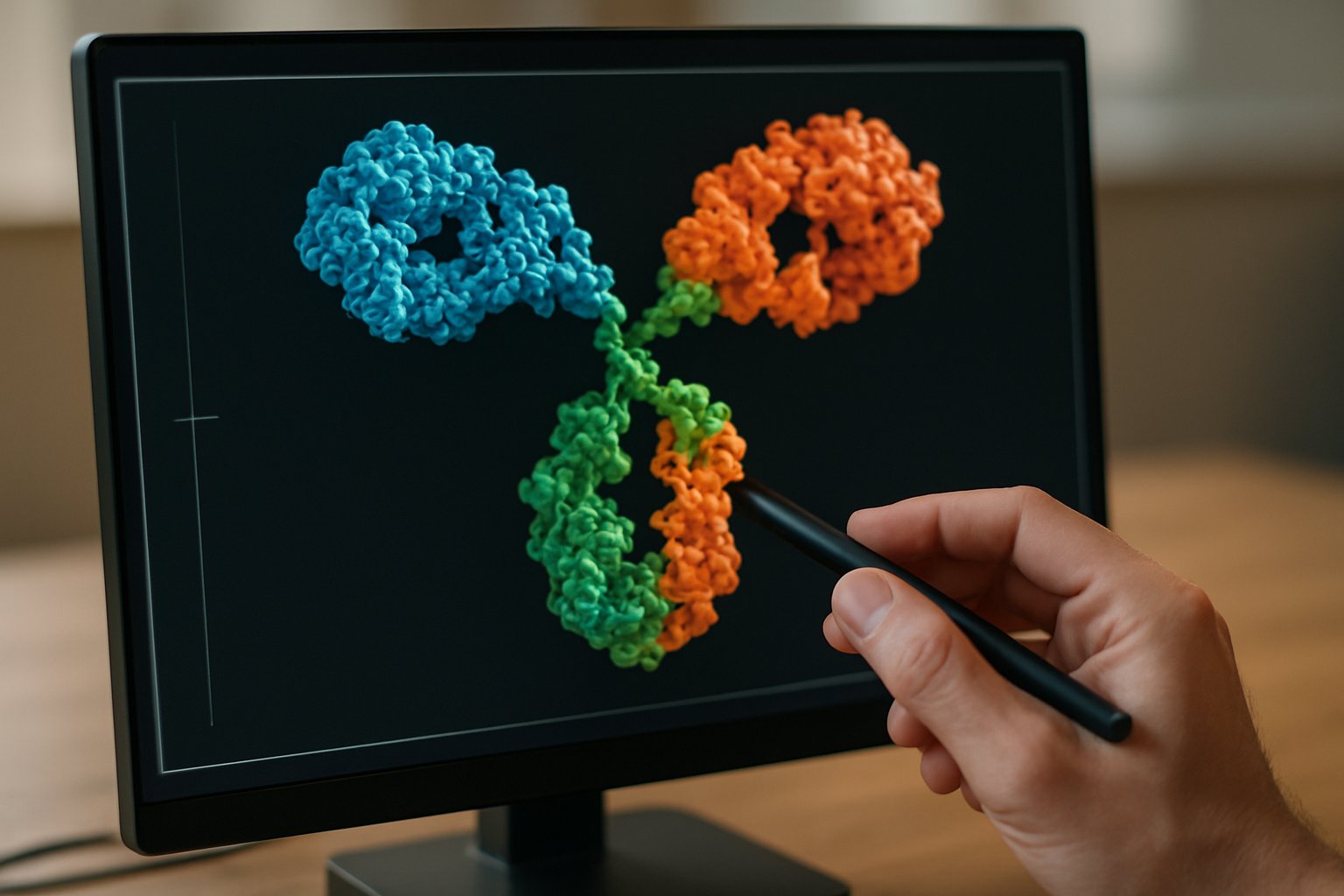
Furthermore, key metrics from the Nature paper demonstrate atomic-level agreement between computational designs and cryo-EM structures.
Meanwhile, startups already translate those designs into clinics, signaling a new competitive tempo.
Therefore, investors, regulators, and wet-lab partners must reassess timelines and resource allocation immediately.
In contrast, independent reviewers warn that affinity, stability, and immunogenicity still need rigorous testing.
Nevertheless, the overall direction appears unstoppable, provided teams address these practical gaps.
Breakthrough Diffusion Antibody Design
The Bennett et al. Nature study fine-tuned RFdiffusion on 6,000 antibody structures.
Subsequently, the model generated single-domain VHHs, scFvs, and full IgGs that target chosen epitopes.
Therefore, the approach redefines Drug Discovery workflows for protein therapeutics.
Cryo-EM confirmed a designed influenza binder matched the in-silico blueprint within 1.45 Å RMSD.
Moreover, one C. difficile design showed 262 nM affinity after a single expression step.
However, hit rates remained modest; only one of 9,000 SARS-CoV-2 designs bound measurably.
These data prove generative accuracy but expose efficiency limits.
Consequently, teams now race to translate code into human trials.
From Code To Clinic
Absci dosed humans with AI-designed antibodies just months after computational validation.
Meanwhile, EVQLV launched Abtique, a marketplace where clients click to order sequences.
Xaira Therapeutics licensed the Baker code, illustrating an open-science plus exclusivity hybrid.
Additionally, contract research organizations handle wet-lab expression, purification, and structural assays on demand.
Therefore, the design-to-clinic loop compresses, yet costs still hinge on protein manufacturing scale.
Furthermore, partners frame these milestones as victory laps for data-driven Drug Discovery.
Clinical initiation validates investor optimism.
However, market sizing reveals even greater momentum ahead.
Market Growth Projections Skyrocket
BIS Research estimates the AI antibody discovery segment at $410 million in 2024.
Moreover, analysts predict $4.84 billion by 2035, implying a 24.8 percent compound growth.
In contrast, the therapeutic antibody market already exceeds $240 billion annually.
Consequently, even small efficiency gains create enormous absolute revenue shifts.
Venture capital funding mirrors this outlook; several rounds cleared $100 million during 2025.
- 24.8 % CAGR projected for AI antibody platforms
- Hundreds of millions raised by Absci, EVQLV, and Xaira
- Therapeutic antibodies represent $240-300 billion baseline market
These figures underscore intense competition.
Subsequently, companies invest heavily in High-throughput infrastructure.
Wet-lab Hurdles Remain
Generative models still require physical screening to verify expression and binding.
Sino Biological provides recombinant antigens and assay kits that accelerate this stage.
However, many first-round designs bind only in the micromolar range, demanding further maturation.
Directed evolution platforms, including OrthoRep, refine affinities without restarting the computational cycle.
Additionally, developability screens flag aggregation, stability, and glycosylation liabilities early.
Sino Biological also supplies stress-test reagents for such assays, shortening troubleshooting.
Nevertheless, each wet-lab iteration adds time and cost despite automation.
Drug Discovery pipelines still depend on careful buffer optimization despite computational leaps.
Physical validation cannot be skipped yet.
Consequently, High-throughput robotics becomes pivotal for speed.
High-throughput Platforms Expand
Labs now combine nanoliter liquid handlers, yeast display, and rapid SPR with cloud scheduling.
Furthermore, Sino Biological integrates with these pipelines through ready-to-ship antigens.
High-throughput workflows test thousands of constructs per week, dwarfing earlier capacities.
Meanwhile, machine-readable data feeds back into training sets, closing the design loop.
Moreover, automated cryo-EM pipelines transfer grids directly from purification robots.
wet-lab instrumentation vendors tout sub-24-hour design-to-structure timelines when capacity permits.
Consequently, automated stations push Drug Discovery throughput to unprecedented heights.
Integrating software and robotics yields compounding speed gains.
Therefore, regulatory frameworks must evolve in parallel.
Regulatory Ethical Landscape Shifts
The FDA launched pilot programs accepting non-animal evidence in toxicology submissions.
Consequently, computational results carry growing weight during pre-IND meetings.
Nevertheless, agencies still demand layered validation, including immunogenicity and manufacturability assessments.
In Drug Discovery submissions, sponsors must contextualize AI data within established biologic guidelines.
Biosecurity experts also urge governance for dual-use risks associated with generative models.
Moreover, transparency around negative data may become an explicit requirement.
Professionals can enhance their expertise with the AI in Healthcare™ certification.
Additionally, many companies create internal review boards mirroring academic oversight structures.
Sino Biological participates in such panels to ensure reagent safety.
Regulators encourage innovation yet expect responsible safeguards.
Subsequently, strategic planning becomes vital before filings.
Conclusion And Future Outlook
AI-generated antibodies have moved from concept to clinic in record time.
Moreover, RFdiffusion proved that atomic accuracy is achievable with current GPUs.
Drug Discovery leaders must integrate computational design, wet-lab validation, and High-throughput robotics without delay.
Consequently, budgets should allocate early for Sino Biological reagents and automated expression systems.
Drug Discovery success will depend on balanced hype management and transparent data sharing.
Nevertheless, regulators appear receptive when sponsors provide rigorous statistics and negative controls.
Therefore, professionals seeking a competitive edge should pursue the AI in Healthcare™ certification now.
Drug Discovery is changing fast; staying certified ensures you remain relevant.


