

AI CERTS
2 days ago
Infrastructure Conflict: Project Tango Vote Delayed to July
This article unpacks the timeline, legal maneuvers, community concerns, and economic stakes shaping the debate. Additionally, we explore how similar AI infrastructure battles influence policy nationwide. Readers will find essential context for the forthcoming hearing and potential industry implications. Ultimately, understanding this Infrastructure Conflict helps technology leaders anticipate regulatory friction in fast-growing markets.
In contrast, some analysts view the delay as a necessary pause that could strengthen eventual approvals. Nevertheless, time pressures grow as hyperscale builders compete for scarce grid capacity near power stations.
Hearing Timeline Key Updates
Originally, the Board of County Commissioners scheduled the decisive hearing for 23 April 2026. However, paperwork filed by the applicant’s law firm Carlton Fields prompted an administrative postponement. Consequently, staff moved the agenda item to 15 July 2026 without requiring another public vote. County spokespersons confirmed the rescheduling, citing the developer’s need to finalize technical studies. Meanwhile, community organizers welcomed extra preparation time for their opposition campaign.
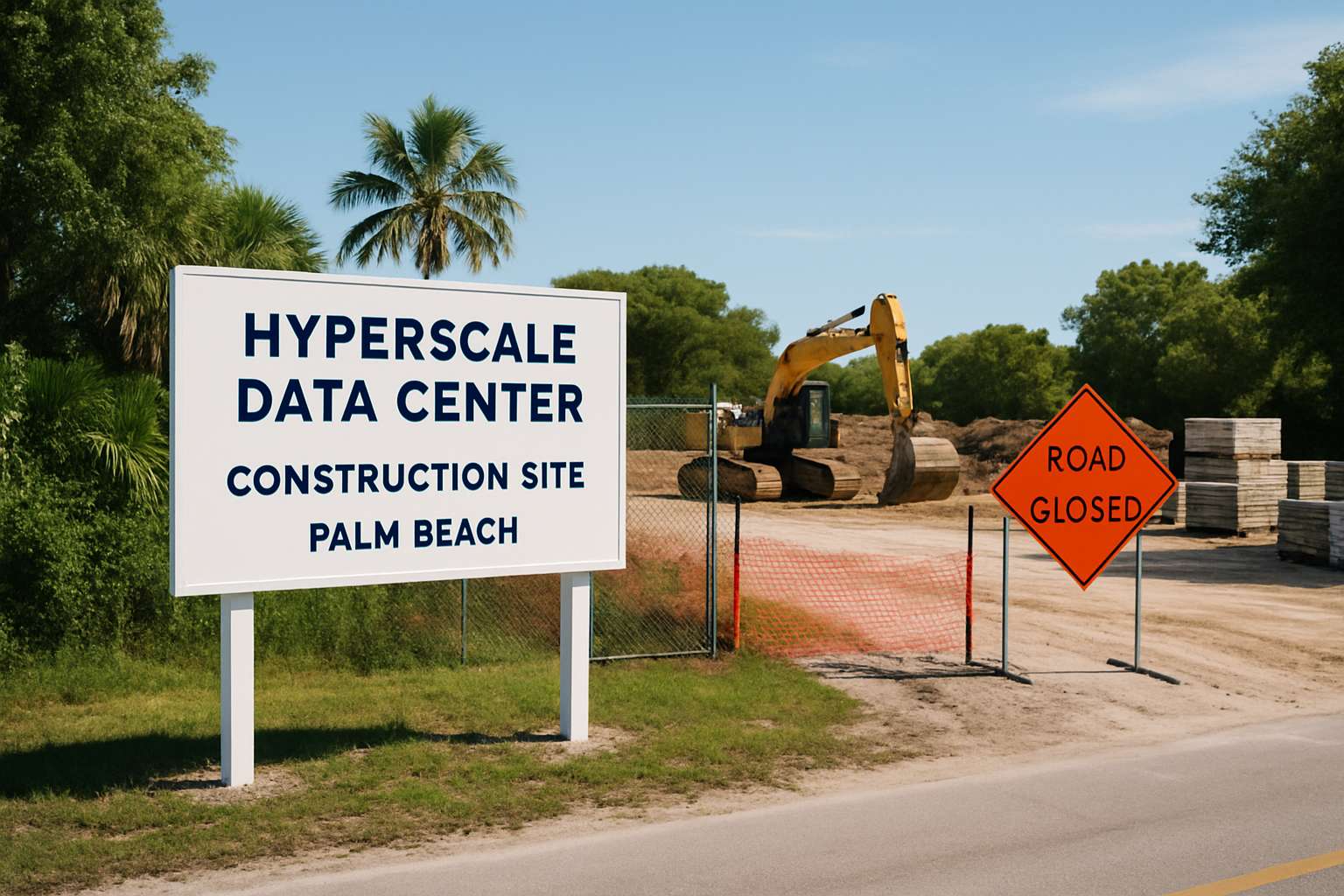
- 18 Nov 2025: Public hearing notice issued.
- 4 Dec 2025: Zoning Commission granted conditional approval.
- 10 Dec 2025: Commissioners postponed to April.
- 23 Apr 2026: Cancelled hearing date.
- 15 Jul 2026: New vote currently scheduled.
These milestones demonstrate a complex procedural dance. The revised schedule underscores administrative flexibility. However, it also extends uncertainty ahead of the zoning review details.
Zoning Process Detailed Mechanics
Palm Beach zoning rules allow applicants to request one administrative continuance before commissioners must vote. Therefore, law firm Carlton Fields exercised this option through a brief letter referencing ongoing acoustic modeling. County staff accepted the filing under code section 2-413 without opening public comment. In contrast, the December 2025 delay required a formal motion and individual commissioner votes. Additionally, the zoning application carries identifier DOA/ZV-2025-01602, a detail vital for record searches.
Developers will submit an updated staff report before mid June. That document must address power usage, traffic counts, and groundwater draw thresholds. Subsequently, planners will publish recommendations three weeks ahead of the July hearing. Consequently, stakeholders gain a narrow window to review thousands of technical pages.
These procedural nuances shape the dispute’s tempo. Meanwhile, unfamiliarity with zoning jargon often intensifies Infrastructure Conflict misunderstandings.
Community Concerns Keep Mounting
Residents from the nearby Arden neighborhood packed previous hearings to oppose the facility. Noise, water use, and visual scale dominated testimony. Commissioner Maria Sachs even declared, “I want to reject the whole application.” However, project manager Ernie Cox promised advanced liquid cooling and a rigorous acoustic study. Furthermore, he argued proximity to Florida Power & Light’s West County Energy Center reduces transmission losses.
Environmental groups such as Food & Water Watch cited Everglades aquifer risks. Consequently, petitions demanding denial gathered thousands of digital signatures within weeks. In contrast, some business coalitions praised expected construction jobs and taxable equipment purchases. Nevertheless, political momentum presently favors caution given the vocal neighborhood activism.
Local sentiment remains deeply divided. Therefore, community pressure will likely escalate as Infrastructure Conflict narratives circulate on social media.
Economic Project Stakes Debated
PBA Holdings estimates multibillion-dollar capital spending over several construction phases. Additionally, developer forecasts mention hundreds of direct positions plus thousands of induced jobs. County staff confirmed that ad valorem tax revenues could fund road upgrades and park expansions. However, opponents counter that automation may limit workforce benefits compared with traditional warehouses.
Moreover, rising electrical demand may trigger costly utility infrastructure upgrades borne by all ratepayers. Consequently, critics frame the situation as another Infrastructure Conflict where private profits rely on public networks. Professionals can enhance their expertise with the AI Policy Maker™ certification to analyze such trade-offs.
Financial projections provide persuasive headlines. Yet, unresolved cost allocation questions intensify Infrastructure Conflict discussions before commissioners vote.
Evolving Legal Strategy Shifts
Legal observers note that the applicant’s law firm chose an administrative path to avoid another bruising public session. In contrast, public opponents remain ready to file appeals under Florida’s Growth Management laws. Moreover, Commissioner Sachs hinted at possible denial, raising litigation stakes for both sides. Consequently, mediation or negotiated conditions may emerge before that hearing.
Stakeholders also watch Tallahassee, where lawmakers debate streamlining data center incentives. Nevertheless, local zoning autonomy remains strong, leaving final authority with Palm Beach commissioners.
Strategic postponements buy critical time. However, extended chess moves can magnify Infrastructure Conflict legal exposure.
Energy And Water Impacts
Hyperscale AI training clusters demand massive electricity and cooling resources. Project Tango could draw several hundred megawatts, according to Uptime Institute benchmarks. Therefore, proximity to the West County Energy Center appeals to engineers. Water usage remains less clear, though developers suggest closed-loop liquid cooling to reduce withdrawals.
Additionally, a pending noise study will quantify low-frequency hums from cooling towers. Subsequently, staff can propose decibel caps and landscaping buffers as mitigation. Nevertheless, residents doubt such measures will preserve rural soundscapes.
Technical reports may reassure officials. Yet, any perceived shortcomings could amplify Infrastructure Conflict narratives across Palm Beach neighborhoods.
Anticipated Next Steps Ahead
County planners expect supplemental documents by 14 June, giving staff one month for analysis. Subsequently, the agenda package will post online, opening the public comment portal again. Additionally, community groups schedule town hall meetings to brief new homeowners. Developers, meanwhile, continue marketing the site to potential cloud tenants under nondisclosure agreements.
Consequently, July could deliver a decisive outcome, yet further continuances remain possible. Therefore, stakeholders should monitor the official Palm Beach agenda portal for last-minute changes.
The coming weeks will clarify data impacts and political will. Meanwhile, every update feeds the broader Infrastructure Conflict story shaping Florida’s digital future.
Project Tango’s postponement illustrates the fragile balance between innovation and community resilience. Moreover, the hearing delay extends negotiations over power, water, taxes, and neighborhood welfare. Consequently, Palm Beach leaders must assess whether proposed mitigations outweigh remaining risks. Nevertheless, hyperscale demand is accelerating, guaranteeing similar Infrastructure Conflict battles statewide. Therefore, professionals should track the July vote and prepare policy frameworks that support equitable growth. Explore advanced governance skills through the linked certification and stay ahead of disruptive infrastructure debates. Inaction today may hinder tomorrow’s cloud opportunities.


