

AI CERTS
2 days ago
Financial AI Needs Insurance Dialogue, Not Mythical Data Sets
This article clarifies the reality, maps current resources, and outlines practical steps for data-driven insurance chatbots. Furthermore, it examines privacy, synthetic generation, and emerging releases. Financial AI leaders will gain an actionable roadmap grounded in evidence.
Insurance Data Landscape Today
Industry hype often eclipses Financial AI facts. WDC-Dialogue offers 1.4 billion social media pairs, yet none relate to policies. Consequently, teams seeking domain depth face scarcity. Financial AI products cannot learn policy nuance from generic social chatter.
InsuranceQA remains the canonical benchmark with only 12,889 training questions. Meanwhile, CallCenterEN brings 91,706 PII-redacted calls across several verticals, including insurance. These numbers underscore the gap. In contrast, banking datasets dwarf these numbers, highlighting the insurance gap.
Large size does not equal relevance. Nevertheless, the next myth deserves separate attention.
Myth Of 1.4B Dataset
Many slide decks cite a 1.4B insurance corpus. In contrast, academic searches reveal only the open-domain Chinese WDC-Dialogue.
EVA researchers confirm its social origin. Therefore, vendors promising a billion insurance turns must prove provenance, PII handling, and licence clarity to Financial AI buyers. Such confusion often appears in investor memoranda too.
Verification protects budgets. Subsequently, teams should explore legitimate public alternatives.
Emerging Public Datasets Explained
Several smaller resources now complement InsuranceQA.
- InsuranceQA: 12,889 training questions and 21,325 answers; licence: research only.
- CallCenterEN: 91,706 calls, 10,448 hours; PII-redacted, CC BY-NC 4.0.
- Hugging Face synthetic sets: 5k-50k rows, quality varies; check dataset cards carefully.
- Synthetic policy pairs: thousands of autogenerated question-answer items; useful for quick prototype tuning.
Furthermore, hybrid sets mixing synthetic and real utterances appear in recent Scientific Reports work. Financial AI experiments with such hybrids often outperform pure synthetic baselines. Researchers publish incremental updates on GitHub, yet sustained maintenance remains rare.
Public releases remain modest yet useful. Consequently, synthetic dialogue takes center stage next.
Synthetic Dialogue Approaches Rise
Researchers now auto-generate policy conversations using large language models. Moreover, rule-based checks filter jargon and ensure clause coverage. Furthermore, template based generators inject policy numbers to improve retrieval testing.
Ping An pioneers this practice, blending generated utterances with real claims calls. The insurer reports faster chatbot iteration and improved first-response accuracy.
Such synthetic-real blends support downstream automation tasks like quote generation and claims triage. However, artifacts may skew edge-case handling for Financial AI systems.
Synthetic data widens coverage yet adds quality risks. Therefore, privacy safeguards demand equal attention.
Privacy And Compliance Hurdles
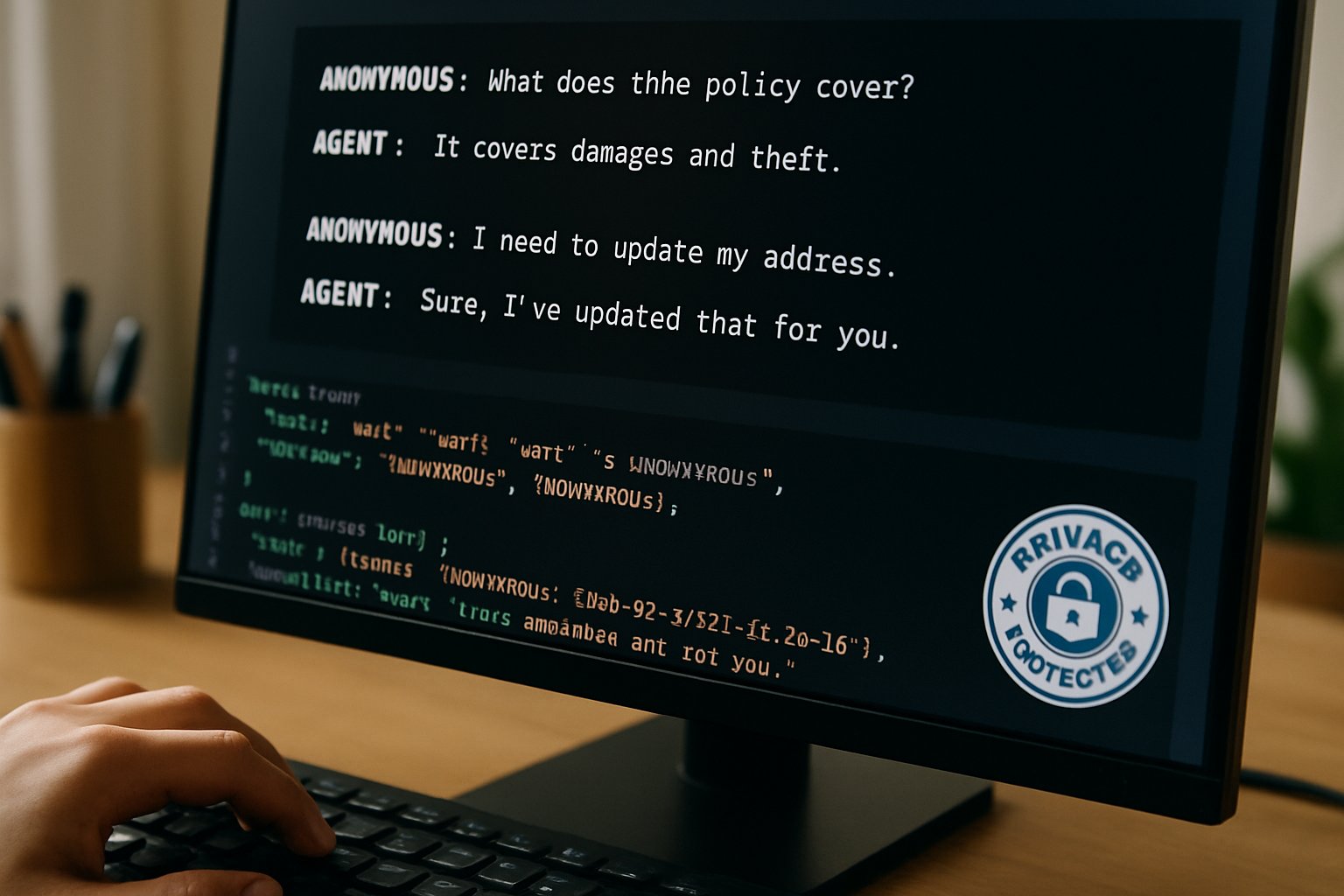
Insurance dialogue embeds sensitive policy numbers and health details. Consequently, public release mandates rigorous PII redaction.
CallCenterEN demonstrates automated masking combined with manual audits. Ping An applies similar pipelines before model training for Financial AI chatbots.
Regulators increasingly monitor claims handling fairness. Therefore, audit logs and consent records must accompany any large-scale automation initiative. Insurers must document every masking rule for audit readiness.
Compliance lapses invite fines and reputational harm. Subsequently, real-world adoption stories illustrate feasible paths.
Enterprise Adoption Case Study
Ping An deployed a hybrid RAG assistant across motor claims servicing. Moreover, customer wait times dropped by 27% within three months.
The assistant retrieves policy clauses, then generates concise answers. Automation workflows push confirmed intents to adjuster queues, reducing manual data entry. Consequently, adjusters focus on complex negotiations rather than data entry routine.
Internally, the insurer tracks precision, latency, and escalation rates. In contrast, previous rule bots lacked learning loops valued by Financial AI architects.
Results show measurable ROI when data, retrieval, and processes align. Consequently, the next section shares a practical roadmap.
Strategic Roadmap For Teams
Leaders should start with a data inventory. Additionally, benchmark existing performance on top claims intents. Meanwhile, business analysts should quantify intent volume before model deployment.
Procure or build a hybrid corpus combining InsuranceQA, CallCenterEN, and vetted synthetic rows. Professionals can enhance their expertise with the AI Data Robotics™ certification.
Implement retrieval-augmented pipelines before full finetuning. Moreover, integrate continuous evaluation against fairness metrics mandated for critical solutions.
Finally, track automation impact on adjuster workloads, customer satisfaction, and compliance audits. Ping An style dashboards help. Therefore, objective dashboards ensure Financial AI ethics goals stay visible.
A phased roadmap mitigates risk while scaling value. Consequently, the discussion now concludes with key insights.
Strategic Roadmap For Teams
Large language models crave domain grounding. However, no mythical 1.4B insurance corpus exists today. Market leaders already budget millions for data partnerships.
Teams must blend modest public datasets, synthetic augmentation, and strict PII governance. Consequently, Ping An's journey proves scalable results, faster claims cycles, and tangible automation gains for Financial AI deployments.
Nevertheless, success demands skilled talent. Explore the linked certification to deepen data-centric design skills and propel your next Financial AI initiative. Moreover, share your progress with the community to foster open benchmarks.


