

AI CERTS
2 hours ago
Cerebras Soars 89% in Historic Wafer-Scale IPO Debut
However, others warned that a single day cannot validate a trillion-parameter hardware bet. This article unpacks the record listing, the wafer-scale technology behind it, and what comes next for the semiconductor sector.
Historic Nasdaq Market Debut
Opening bell euphoria defined the first minutes. The Wafer-Scale IPO debuted at $350, or 89% above offer. Moreover, intraday highs briefly approached $385 before profit taking set in. Trading volume exceeded 40 million shares, triggering multiple five-minute volatility pauses. Consequently, CBRS closed near $311, granting a fully diluted valuation above $100 billion.
Key Day-One Trading Stats
- Offer size: 30 million shares at $185 with a 4.5 million-share option.
- Gross proceeds: $5.55 billion before underwriter exercise.
- Opening price: $350; intraday peak: $385; closing price: $311.07.
- Implied price-to-sales multiple: nearly 200× trailing 2025 revenue.
These numbers underscore outsized enthusiasm around novel chip architectures. However, lofty valuations often invite intense scrutiny.
The next section explores the wafer-scale engine that fuels such expectations.
Wafer-Scale Engine Deep Dive
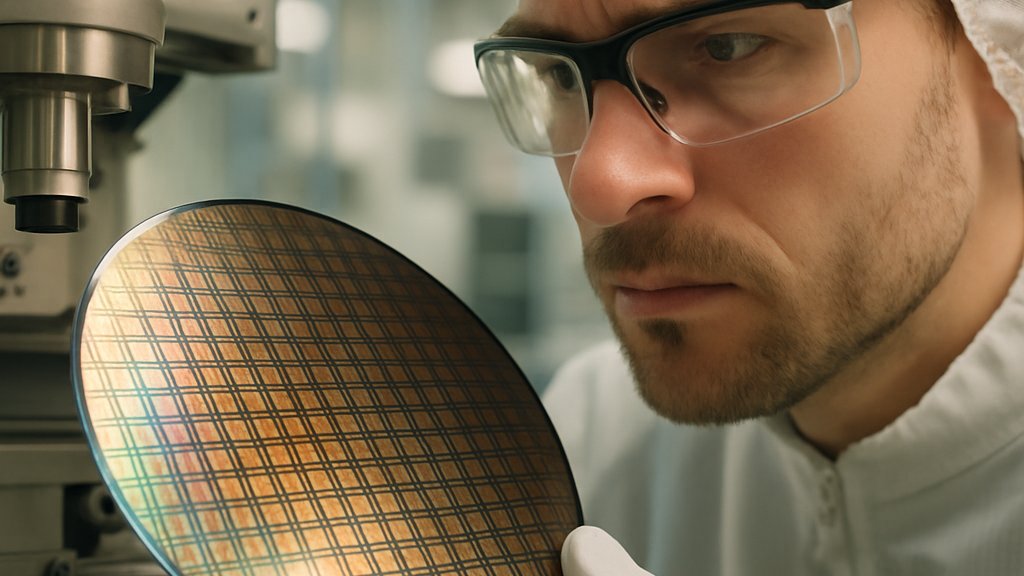
At the heart of Cerebras lies its Wafer Scale Engine, a single silicon wafer etched into one colossal die. Consequently, the design packs 2.6 trillion transistors and 850,000 cores onto 46,225 mm² of silicon. Such density delivers enormous on-chip memory bandwidth, reducing costly off-chip traffic.
In contrast, traditional GPU clusters rely on interconnects that add latency and energy overhead. Therefore, Cerebras markets the platform as ideal for both large-model training and lightning-fast inference. The approach resonates with hyperscalers seeking efficient AI infrastructure.
Nevertheless, fabricating a wafer this large challenges every known semiconductor yield metric. Cerebras partnered with TSMC’s advanced packaging group to reach commercial volumes. These manufacturing feats partly justify the premium valuation attached to the Wafer-Scale IPO.
The wafer-scale design offers compelling speed and simplicity gains. Yet, scaling production will test Cerebras and its suppliers.
Financial metrics provide another lens on the ambitious narrative.
Financials And Valuation Metrics
Cerebras booked $510 million in 2025 revenue, a 76% jump year over year. Moreover, filings showed positive operating income, a rarity for pre-IPO chip startups. The feat impressed observers across the fragile semiconductor capital markets. Even so, the Wafer-Scale IPO valued CBRS at nearly 200 times trailing sales. Consequently, bulls argue the multiple reflects exploding demand for AI infrastructure across cloud and sovereign data centers.
Benchmark and Eclipse converted early stakes into multibillion-dollar positions. Meanwhile, founders Andrew Feldman and Sean Lie retained significant voting power through dual-class shares. Such concentration amplifies governance questions once the initial honeymoon passes.
- Proven revenue growth of 76% year over year.
- First profitable year before public listing.
- Strategic AI hardware partnerships, including Amazon.
- Scarcity of high-performance semiconductor alternatives.
These factors paint an optimistic picture for short-term momentum. However, every upside case contains embedded execution risks.
The following section reviews how investors balance excitement and caution.
Investor Reaction And Risks
Initial coverage from Bloomberg pitched CBRS as the purest large-model hardware play available. Consequently, momentum traders piled in, amplifying the first-day rally. Nevertheless, several bank analysts issued neutral notes within hours. They argued the Wafer-Scale IPO premium leaves little margin for operational hiccups.
Execution risk tops the worry list. Cerebras must scale manufacturing while expanding software support beyond PyTorch variants. Moreover, future secondary offerings could flood supply once lockups expire. In contrast, supporters stress vast AI infrastructure orders placed by Amazon, OpenAI, and governmental labs.
The broader semiconductor cycle also influences sentiment. If memory prices spike or capacity tightens, margins could compress quickly.
Investors appear split between fear and greed. Therefore, upcoming earnings will offer the first calibration point.
Meanwhile, competition from incumbents and startups demands closer examination.
Competitive Landscape And Partners
Nvidia remains the de facto standard for large-scale training workloads. However, its GPU lead does not guarantee dominance in inference bound by memory bandwidth. Cerebras positions the Wafer-Scale IPO proceeds to fund aggressive data-center expansion, challenging incumbent share.
Amazon disclosed pilot projects using the CS-3 system within its Bedrock generative platform. Furthermore, Abu Dhabi’s G42 ordered nine clusters for regional AI infrastructure sovereignty. Partnerships like these provide diversified revenue streams beyond US government contracts.
Still, several stealth hardware startups tout photonic architectures that could undercut wafer-scale economics.
Cerebras enjoys early partner validation and fresh capital. Yet, rival roadmaps evolve at breakneck speed.
Strategic plans after the listing deserve close attention.
Strategic Outlook Post IPO
Management outlined three priorities during the roadshow. Firstly, funds from the Wafer-Scale IPO will scale production capacity at TSMC. Secondly, Cerebras plans to double headcount in compiler and networking teams. Finally, the company will subsidize early deployments to accelerate AI infrastructure adoption.
Consequently, cash burn will rise before new revenue offsets expenses. However, CBRS expects gross margin expansion once second-generation wafers reach risk production. Moreover, management signaled interest in strategic M&A across software and packaging segments.
Such moves could integrate novel semiconductor IP and differentiate offerings from commodity accelerators.
Professionals can deepen expertise through the AI Architect™ certification.
The roadmap signals confidence in long-term demand. Nevertheless, flawless execution remains the decisive variable.
The conclusion synthesizes lessons for investors and technologists.
Cerebras delivered a textbook Wafer-Scale IPO that electrified Wall Street and the broader tech sector. Moreover, the soaring CBRS valuation reflects hunger for differentiated AI infrastructure amid tightening semiconductor supply. However, every Wafer-Scale IPO invites scrutiny once quarterly numbers replace narrative. Investors should weigh execution risk, competitive responses, and macro cycles before chasing post-pop gains.
Technologists exploring deployment options can monitor Amazon pilots or pursue the linked AI Architect™ program for applied skills. Ultimately, the Wafer-Scale IPO may catalyze new funding paths for hardware heavy startups worldwide. Stay informed, stay certified, and stay ahead.
Disclaimer: Some content may be AI-generated or assisted and is provided ‘as is’ for informational purposes only, without warranties of accuracy or completeness, and does not imply endorsement or affiliation.


