

AI CERTS
2 months ago
Transforming Mecha Robots: Unitree GD01 Signals Market Shift
However, GD01 is more than showmanship; it signals a new commercial push for embodied AI vehicles. Consequently, executives across manufacturing, entertainment, and security want to understand the business case. This article dissects Unitree's announcement, separating hype from engineering fact for professional readers. Additionally, we examine market implications, analyst reactions, and pending technical unknowns. Insights will help strategists weigh investment, partnership, and certification opportunities in legged mobility.
GD01 Reveal Key Highlights
Unitree premiered the GD01 on 12 May 2026 through a one-minute demonstration video. Consequently, the footage gained millions of views across Weibo, X, and YouTube within 24 hours.
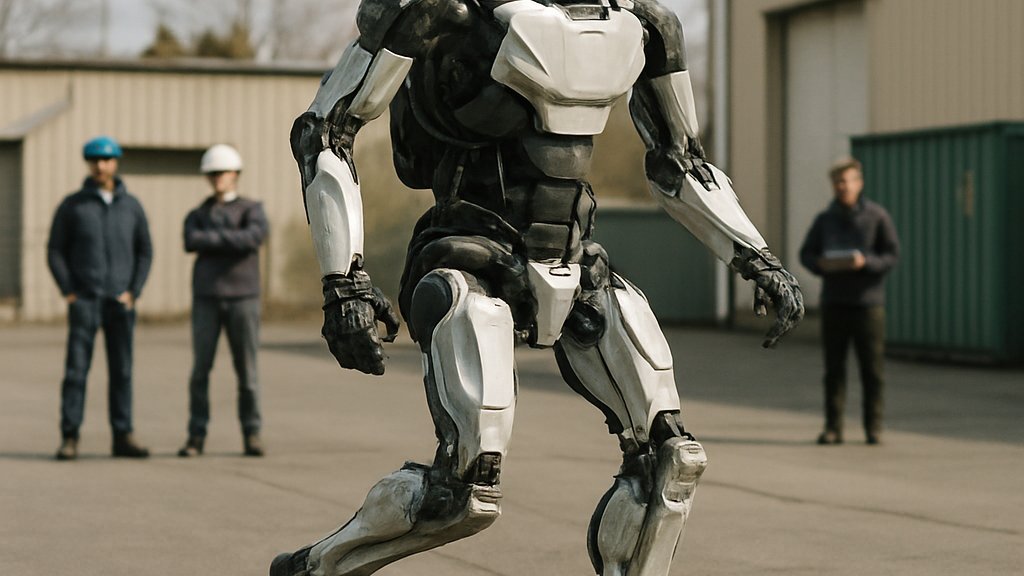
- Price: 3.9 million CNY (about US$600k)
- Weight: roughly 500 kg including pilot
- Height: around 2.7 meters in bipedal stance
- Modes: bipedal walk, quadrupedal crawl, backward spider posture
- Promo actions: wall smashing, arm-driven push maneuvers
Moreover, Unitree labeled the platform the world's first mass-produced manned mecha. Marketing manager Huang Jiawei stressed that the listed price remains preliminary. Nevertheless, no full specification sheet accompanied the dramatic teaser. Industry watchers note the clip positions GD01 among Transforming Mecha Robots aimed at affluent early adopters.
The headline numbers excite prospective buyers and investors. However, engineering depth determines whether curiosity converts into orders. Next, we probe the mechanical foundations.
Engineering Under The Shell
GD01 sits on a welded aluminum frame layered with composite armor panels. Furthermore, Unitree used proprietary actuators derived from its quadrupedal dog series, according to Chinese press sources. Each hip contains a 50-kilonewton joint module that supports dynamic load changes during transformation.
Battery modules mount in the torso behind the seated pilot, though capacity figures remain undisclosed. Consequently, analysts question real-world endurance, especially when the robot hauls ancillary hardware.
GD01 transitions from bipedal stance to quadrupedal crawl through telescopic thigh actuators and rotating shoulder pivots. In contrast, conventional exosuits rely on wheels for stability, limiting terrain flexibility. Therefore, the new linkage geometry showcases meaningful progress in embodied AI locomotion.
Yet hard numbers on torque, speed, and battery swaps are absent. Consequently, serious buyers await verified datasheets before committing capital, which our next section contextualizes.
Market Context And Competition
Unitree shipped more than 5,500 humanoids in 2025, according to Omdia estimates. Moreover, Chinese vendors captured almost 90 percent of the humanoid market last year. Consequently, investors consider GD01 a logical extension of that momentum.
The 3.9-million-CNY sticker undercuts prototype exoskeleton vehicles demonstrated by startups in Japan and the United States. However, the price still dwarfs mainstream industrial machinery budgets, limiting addressable demand. Commercial robotics strategists therefore see initial sales clustering around entertainment parks, research labs, and marketing agencies.
- Developers: Sarcos, Skeletonics, Cyberdyne, Toyota Labs
- Focus: industrial exosuits, untethered prototypes, assisted lifting
- Published prices: mostly non-commercial or undisclosed
In contrast, Unitree publicly declared a retail pathway, albeit with many caveats. Transforming Mecha Robots could redefine attraction design budgets if throughput economics prove viable.
GD01 thus enters an arena hungry for spectacle yet wary of cost. Next, we examine potential applications that could justify the bill.
Potential Use Case Spectrum
Analysts map GD01 opportunities across civilian, industrial, and defense adjacent segments. Furthermore, theme park operators chase immersive ride experiences that differentiate against streaming entertainment. Transforming Mecha Robots offer eye-level thrills without building new roller-coaster superstructures.
Search-and-rescue units envision sending a bipedal platform into unstable debris where wheels fail. Subsequently, the robot might shift to quadrupedal mode for steady evacuation routes. However, unanswered safety certifications restrict field deployment today.
Heavy-industry customers propose using the machine as remote inspection hardware inside toxic refineries. Nevertheless, missing payload numbers impede feasibility calculations.
- Legged adaptability across varied terrain
- Hands-free cockpit allows operator tool use
- Transformable posture lowers center of gravity for tunnel access
These scenarios illustrate imaginative value but hinge on rigorous testing. Consequently, technical unknowns now deserve closer scrutiny.
Unanswered Technical Question Marks
Unitree omitted details on battery capacity, redundant sensing, and emergency egress procedures. Moreover, no independent lab has validated structural resilience or ballistic protection.
Regulatory bodies will demand data on braking distances, slope stability, and electromagnetic compliance. Therefore, early adopters must plan joint verification programs with insurers and authorities.
Chen Jing warned that ingress and comfort remain weak spots for long missions. Meanwhile, maintenance complexity could balloon as moving hardware accumulates wear across two gait patterns. Transforming Mecha Robots will require novel training curricula covering both piloting and mechanical servicing.
The absence of specifications clouds procurement roadmaps. Nevertheless, company statements suggest more data will accompany the planned STAR Market filing. Our next section captures how experts interpret these gaps.
Expert Reactions And Concerns
Industry figures responded swiftly after the video surfaced. Omdia analysts praised the lower price relative to animated hype. However, they questioned stated mass-production readiness without published volume targets.
Chen Jing described the platform as a landmark for embodied AI yet a headache for regulators. In contrast, some venture investors celebrated the entrepreneurial audacity regardless of missing data. Consequently, share prices of sensor suppliers spiked briefly on speculative demand for mecha components.
Social media enthusiasm remains high, sustaining momentum for the Transforming Mecha Robots narrative. Expert comments converge on one point: proof is mandatory. Therefore, commercial robotics strategists monitor upcoming field trials closely.
The broader sector impact is our final focus.
Implications For Commercial Robotics
Unitree's reveal shifts benchmarks for legged platform pricing and user experience. Consequently, rival vendors must accelerate actuator roadmaps and supply-chain agreements. Transforming Mecha Robots also expand public familiarity with non-industrial humanoids.
Growing awareness could boost funding flows into bipedal research, power electronics, and lightweight structural hardware. Additionally, service companies may develop leasing models once durability metrics solidify. Commercial robotics adoption historically spikes when capital expenditure can be amortized over predictable uptime.
Meanwhile, policymakers will revisit mobility regulations that previously ignored cockpited legged machines. Transforming Mecha Robots could therefore catalyze updated standards covering occupant restraints and fall mitigation.
The sector now faces a credibility countdown. Subsequently, verified field deployments will determine who dominates the lucrative frontier.
Unitree's GD01 has reignited debate about practical Transforming Mecha Robots within commercial robotics strategy circles. Analysts applaud the bold prototype, yet they crave transparent testing metrics. Moreover, early customers must weigh thrill value against regulatory hurdles and maintenance overhead. Nevertheless, legged mobility research benefits whenever ambitious examples push actuator science forward.
Consequently, competitors will refine bipedal and quadrupedal playbooks, squeezing costs and improving safety. Professionals can deepen expertise with the AI Robotics™ certification, readying teams for upcoming deployments. Act now to secure insight before Transforming Mecha Robots leave the concept stage behind.
Disclaimer: Some content may be AI-generated or assisted and is provided ‘as is’ for informational purposes only, without warranties of accuracy or completeness, and does not imply endorsement or affiliation.


