

AI CERTS
6 hours ago
3D Motion Mapping Turns Scenes Into Searchable Motion Databases
Meanwhile, performance numbers show double-digit gains in segmentation accuracy and calibrated motion confidence. This article distills key concepts, metrics, use cases, and open challenges for technical leaders. Moreover, it explains how certification programs can accelerate workforce readiness. Prepare to explore the next frontier in spatial AI. That journey starts with the discipline’s fast evolution.
3D Motion Mapping Evolution
The mapping journey began with static occupancy grids. In contrast, early dynamic mapping added per-voxel velocities yet lacked semantic labels. Subsequently, VLMaps attached CLIP embeddings, enabling open text queries about object identity. However, VLMaps still treated every object as rigid. Researchers therefore proposed Motion Map extensions to advance spatial AI during the past year.
MoMaps from ICCV 2025 encoded dense 3D trajectories into image-like layers. Consequently, legacy diffusion models for images learned to forecast plausible scene motion. QueSTMaps focused instead on room topology and language alignment, gaining 20% segmentation improvement. Most recently, the VLMM paper unified semantic movability priors with observed motion and uncertainty. Therefore, the field now covers geometry, appearance, and dynamic behavior within one queryable map.
These milestones reflect rapid convergence between perception, language, and control. Next, we examine the core technical pieces enabling that fusion. Consequently, 3D Motion Mapping now summarises the discipline.
Core Technical Concepts Explained
At the heart lies the pixel-aligned MoMap representation. Specifically, each pixel stores a 3D trajectory curve anchored to a camera frame. Therefore, MoMaps decouple camera motion from scene motion by simple coordinate transforms. Moreover, the image structure lets researchers apply convolutional or diffusion backbones without redesign. This design turns ordinary 2D tools into generators of 4D motion attributes. Additionally, the representation plugs directly into existing 3D scene maps for seamless integration.
Meanwhile, VLMM takes an object-centric route. Each 3D instance receives two channels: a language movability prior and geometry-derived flow evidence. Uncertainty-aware scenes emerge because depth noise is propagated into a Mahalanobis confidence score. Consequently, planners can trust or ignore motion claims based on calibrated error. The model also routes open text queries to either channel using intent rules.
QueSTMaps contributes a complementary topological layer. Rooms become nodes enriched with language embeddings and aggregated motion attributes. Therefore, high-level questions like “Which room stayed static?” resolve in milliseconds. Together, these concepts supply the building blocks of open-vocabulary robotics. However, theory means little without strong empirical metrics, which we analyze now.
Breakthrough Research Metrics Revealed
Quantitative evidence underpins the excitement around 3D Motion Mapping. For clarity, consider three headline numbers.
- VLMM improved moving vs static average precision by 0.10 across six real sequences.
- MoMaps achieved 0.8128 IoU on BRIDGE test foreground masks, surpassing baselines.
- QueSTMaps delivered a 20% relative boost in room segmentation on Matterport3D.
Furthermore, researchers measure motion attributes fidelity using ATE–DTW and foreground IoU. Moreover, calibrated VLMM confidence reduced expected calibration error from 0.30 to 0.10. Meanwhile, MoMaps trained on over 50,000 videos, highlighting the data hunger of spatial AI. Researchers also reported ATE–DTW of 0.0689, outperforming previous trajectory baselines. Therefore, 3D Motion Mapping now reaches parity with perception benchmarks once reserved for static modeling.
These metrics confirm that dynamic reasoning now meets industrial benchmarks. Consequently, enterprises are testing real deployments, a trend explored in the next section.
Industrial Use Cases Emerging
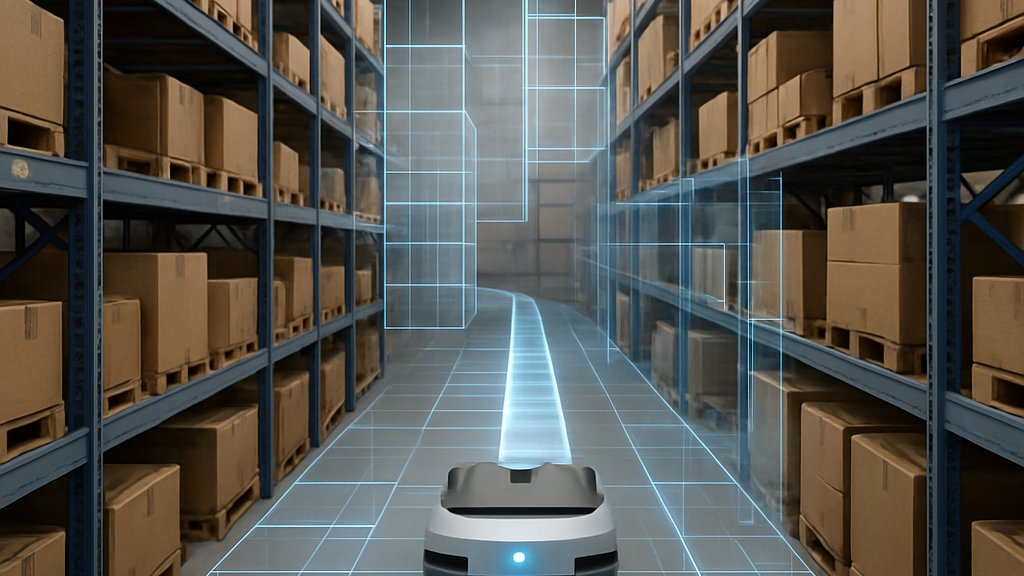
Manufacturing robotics ranks high among early adopters. For instance, pick-and-place arms query motion attributes to avoid grasping anchored fixtures. Consequently, downtime drops because tools no longer collide with rigid parts. Warehouse drones exploit 3D scene maps to locate boxes that shift during transit. Moreover, the queries work in ambient language, supporting open-vocabulary robotics on busy floors.
Smart cities form another growth area. Street scanners build uncertainty-aware scenes, flagging vehicles that deviate from normal paths. Therefore, planners dispatch maintenance crews only when movement metrics exceed thresholds. Entertainment studios leverage MoMaps to inject physically plausible motion into virtual sets. Consequently, artists generate fresh camera trajectories without hand-animating every frame.
Collectively, 3D Motion Mapping powers these deployments across sectors. Yet, practical rollouts still face notable constraints, examined below.
Current Limitations Exposed Clearly
No technology is flawless, and 3D Motion Mapping remains a moving target. Nevertheless, raw VLMM confidences showed an expected calibration error near 0.30 before tuning. Therefore, robots may misjudge movable objects under heavy depth noise. MoMaps currently supports only single-anchor views, limiting multiview consistency.
Dataset coverage presents another gap. Many benchmarks label humans but ignore doors, drawers, or machinery. Consequently, models overfit to pedestrian motion and under-index industrial dynamics. Compute cost also rises because full pipelines process tens of thousands of videos. In contrast, real robots often carry limited edge GPUs.
These limitations demand focused engineering and dataset expansions. Subsequently, researchers have proposed clear roadmaps, discussed next.
Future Roadmap Insights Ahead
Authors across papers outline four development priorities. First, create labeled corpora featuring non-human movers across varied industries. Second, integrate a full LLM query parser to replace rule routing. Therefore, open-vocabulary robotics would accept complex, multi-step instructions with fewer failures. Third, extend MoMaps to multi-anchor, long-horizon generation. Such capability would enrich 3D scene maps used for simulation weeks ahead. Ultimately, 3D Motion Mapping will underpin predictive digital twins for factories and cities. Finally, port uncertainty-aware scenes onto real robots and measure task success.
Funding teams have started open challenges to track progress. Moreover, corporate labs sponsor shared video repositories surpassing 100,000 clips. Professionals can enhance their expertise with the AI Data Robotics™ certification. Consequently, graduates will bridge algorithm research and field deployment.
These steps chart a sustainable growth path for 3D Motion Mapping. Next, we recap the journey and invite readers to act.
Key Takeaways Recap Now
3D Motion Mapping unites language, geometry, and dynamics into one queryable asset. Importantly, VLMM, MoMaps, and QueSTMaps prove the concept with robust numbers. Manufacturing, logistics, entertainment, and smart infrastructure already pilot these systems. Nevertheless, calibration, dataset scope, and compute cost still limit scale. Ongoing roadmaps address those barriers through new datasets and LLM interfaces. Therefore, professionals who skill up early stand to lead the coming wave of spatial AI advancements. Explore the linked certification and prepare your teams for dynamic, open-vocabulary robotics.
Disclaimer: Some content may be AI-generated or assisted and is provided ‘as is’ for informational purposes only, without warranties of accuracy or completeness, and does not imply endorsement or affiliation.


