

AI CERTS
8 hours ago
Nvidia’s 600 kW Racks Redefine Compute Density
Nvidia Power Leap Explained
Jensen Huang declared, “Each rack is 600 kilowatts,” placing Rubin Ultra five times above Blackwell’s 120 kW baseline. Moreover, the NVL576 topology welds 576 GPUs into one scale-up domain using NVLink. Operators therefore face unprecedented power concentration. Current high-density deployments rarely exceed 150 kW, yet Rubin Ultra demands a new bar for Compute Density. In contrast, typical cloud halls distribute loads across many smaller cabinets.
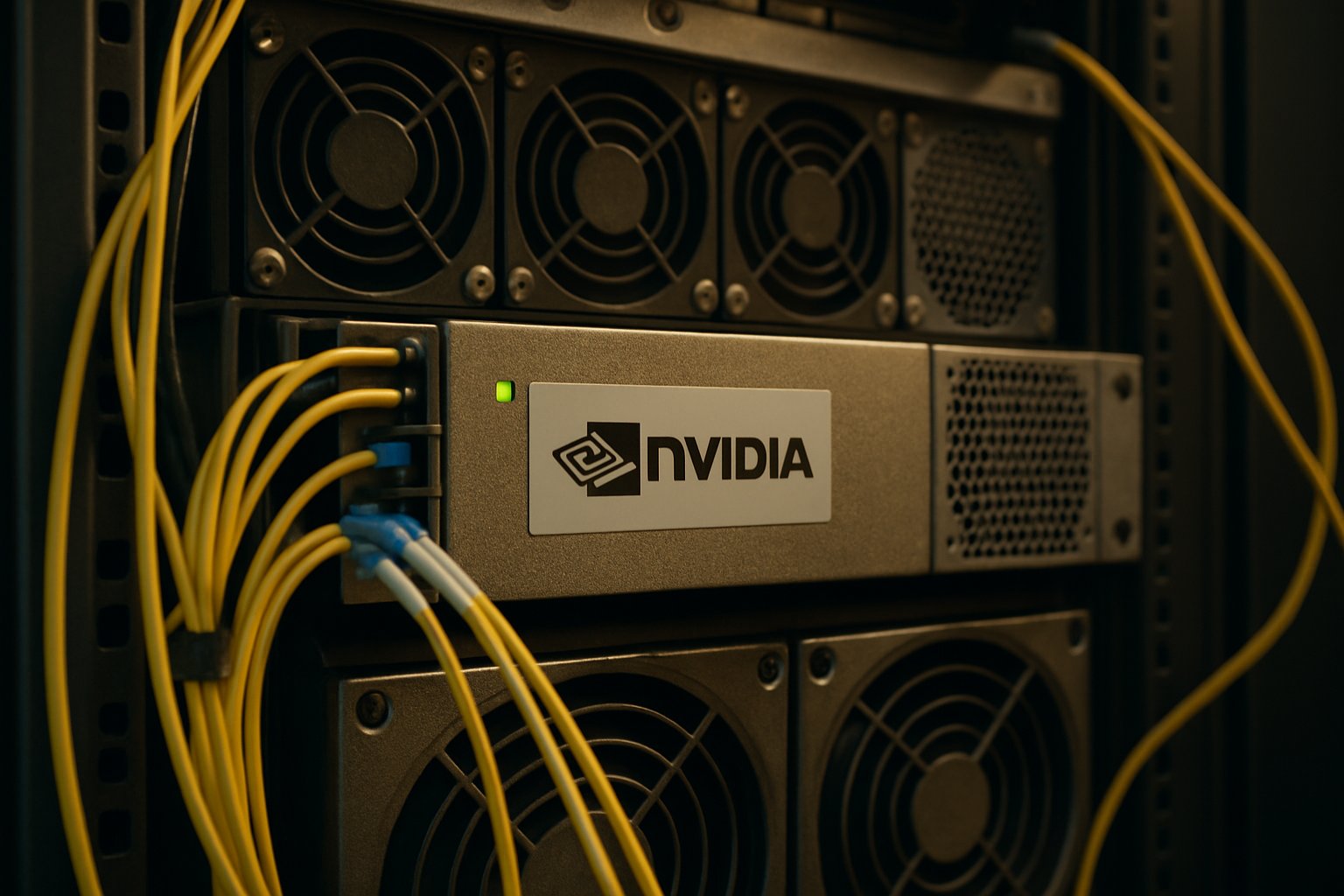
These figures highlight an engineering inflection. However, the timeline offers limited preparation, with H2 2027 already visible on construction calendars. Transitioning now sets the foundation for later readiness.
This leap reframes planning priorities. Consequently, cooling technology becomes the next critical focus.
Cooling Tech Race Begins
Vendors sprinted to GTC booths with 600 kW direct-to-chip demonstrations. DDC and Chilldyne showed negative-pressure loops removing 500 kW at the cold plate plus 100 kW cabinet air. Additionally, Schneider’s Motivair arm announced modular CDUs scaling toward multi-megawatt clusters. Such systems couple tightly with higher Compute Density because heat rejection must match electrical load almost one-to-one.
Bullet points summarize headline specifications:
- DDC demo: 600 kW mixed air/liquid capacity.
- Motivair CDU: up to 2.5 MW rack group service.
- Flex JetCool plates: 800 W / cm² localized flux handling.
Nevertheless, liquid loops add leak, valve, and maintenance risks. Therefore, operators need redundant pumps, sensors, and isolation panels.
Cooling advances set possibilities. Yet, delivering power remains equally challenging.
Power Infrastructure Shift Now
Nvidia and partners push 800 VDC busways to slash current and conductor mass. Furthermore, GaN and SiC converters raise efficiency and shrink footprints. A single Rubin rack could draw what an entire legacy data center row once consumed. Consequently, medium-voltage switchgear migrates closer to the white space.
Utilities warn that transformers above 10 MVA carry multi-year lead times amid the wider Energy crisis. Meanwhile, interconnection queues already stretch construction schedules. The grid must coordinate with hyperscalers on capacity upgrades or host on-site generation like fuel cells and batteries.
Greater Compute Density forces holistic electrical redesigns. However, physical floor layouts also feel the shock.
High-voltage changes improve efficiency. Still, building conversions face structural hurdles, discussed next.
Facility Design Challenges Mount
Most existing colocation halls cannot host 600 kW cabinets due to slab loading, under-floor pipe routing, and ceiling heights. Consequently, greenfield campuses dominate early adoption. Designers place chilled-water manifolds, HVDC busbars, and fire-rated coolant corridors during initial pours. Additionally, leak-containment zones limit single-rack failures and support service isolation.
Retrofits demand expensive trenching and power room expansion, often exceeding original land entitlements. Moreover, community concerns over rising Energy crisis headlines spur tighter permitting reviews. The IEA projects data centers will surpass 500 TWh before 2030, reinforcing scrutiny. That forecast aligns with Nvidia’s aggressive Compute Density trajectory.
Design constraints elevate capital outlays. Nevertheless, certain vendors stand to benefit, as explored next.
Market Winners Emerging Fast
Schneider Electric, Vertiv, and DDC already market 600 kW-rated CDUs and HVDC panels. Consequently, their order books swell as hyperscalers reserve production slots. Power-electronics firms like Navitas supply GaN modules that thrive under high-frequency switching, boosting margins.
Meanwhile, colocation providers capable of guaranteed 300 kW per cabinet attract premium clients. Equinix and Digital Realty race to pre-permit gigawatt campuses near renewable clusters on the western U.S. grid. Professionals can enhance their expertise with the AI Architect™ certification, positioning themselves for these evolving roles.
Higher Compute Density reshapes value chains. However, operators still need actionable checklists to navigate complexity.
Suppliers may profit, yet execution details determine project success. The checklist below addresses that gap.
Operational Action Checklist
The following steps help engineering teams align projects with 600 kW rack requirements:
- Engage utilities 36 months early for transformer procurement and grid interconnection studies.
- Model thermal paths using digital twins to right-size CDUs and chillers.
- Adopt 800 VDC architectures and validate arc-flash boundaries under regional codes.
- Stock critical spares: pumps, cold plates, and HV converters.
- Train staff on liquid containment and high-voltage safety, leveraging vendor certification modules.
Implementing these points supports stable operations at extreme Compute Density. Consequently, executive teams gain confidence in project feasibility.
The checklist clarifies immediate tasks. Finally, industry stakeholders must examine longer-term strategy.
Strategic Outlook Ahead Now
IEA analysts note that AI may double data center electricity within four years. Therefore, policymakers debate incentives for on-site renewables and recycled heat distribution. Moreover, hyperscalers explore submerged coolant loops that export thermal energy to district networks, easing local Energy crisis concerns.
Nevertheless, critics argue that soaring Compute Density anchors workloads to Nvidia’s stack, concentrating market power. In contrast, some cloud providers investigate diversified accelerator pools to hedge supply risks. The debate will intensify as Rubin Ultra approaches launch.
Strategic planning today positions organizations for adaptive success. However, the article’s key insights warrant concise closure.
These trends underscore urgent planning needs. The conclusion synthesizes the main guidance and offers next steps.
Conclusion
Nvidia’s 600 kW vision thrusts Compute Density into uncharted territory. Facilities must integrate cutting-edge cooling, 800 VDC power, and rigorous safety frameworks. Consequently, new market segments bloom for CDUs, GaN converters, and high-capacity campuses. Meanwhile, operators face grid constraints and rising Energy crisis scrutiny. Nevertheless, proactive engagement, digital modelling, and upskilled teams can convert challenge into advantage. Explore deeper expertise through the linked AI Architect certification and prepare for the megawatt rack era.


