

AI CERTS
4 months ago
RNACOREX Tool Illuminates Hidden Cancer Networks
The peer-reviewed study appeared in PLOS Computational Biology on 3 November 2025. Manuscript receipt and acceptance dates were 19 November 2024 and 24 October 2025 respectively. Meanwhile, version 0.1.5 landed on PyPI on 30 September 2025, cementing reproducibility for the broader community.
Open Source Release Details
RNACOREX Tool reached GitHub under an Apache-2.0 license, inviting rapid iteration. Additionally, Zenodo snapshots and quick-start notebooks shorten onboarding for computational biologists. The package ships with an rnacorex.download() A helper that retrieves TargetScan, DIANA, TarBase, and miRTarBase engines automatically.
Aitor Oviedo-Madrid, the first author, stressed accessibility: “The software predicted patient survival on par with complex systems yet remained fully auditable.” Furthermore, press releases in December 2025 amplified that message, underscoring community engagement.
- GitHub repository: digital-medicine-research-group-UNAV/RNACOREX
- PyPI package: rnacorex v0.1.5
- License: Apache-2.0 for unrestricted reuse
These distribution choices empower worldwide labs. Nevertheless, successful installation requires Python ≤3.9 and NumPy ≤2, as documented in the README.
Software openness accelerates independent scrutiny. However, sustainable validation hinges on collaborative testing beyond TCGA cohorts.
Release Section Takeaways
Transparent licensing plus PyPI availability lowers adoption barriers. Consequently, teams can benchmark the RNACOREX Tool within days.
Methodology At A Glance
The RNACOREX Tool ingests matched miRNA and mRNA expression matrices alongside binary phenotypes. Firstly, low-count features vanish through prefiltering. Secondly, differential expression ranks candidate transcripts, narrowing the genetic search space.
A hybrid scoring pipeline then merges structural evidence from curated databases with functional associations measured by conditional mutual information. Therefore, miRNA–mRNA pairs receive composite priorities. Subsequently, top interactions define Bayesian Conditional Linear Gaussian classifiers.
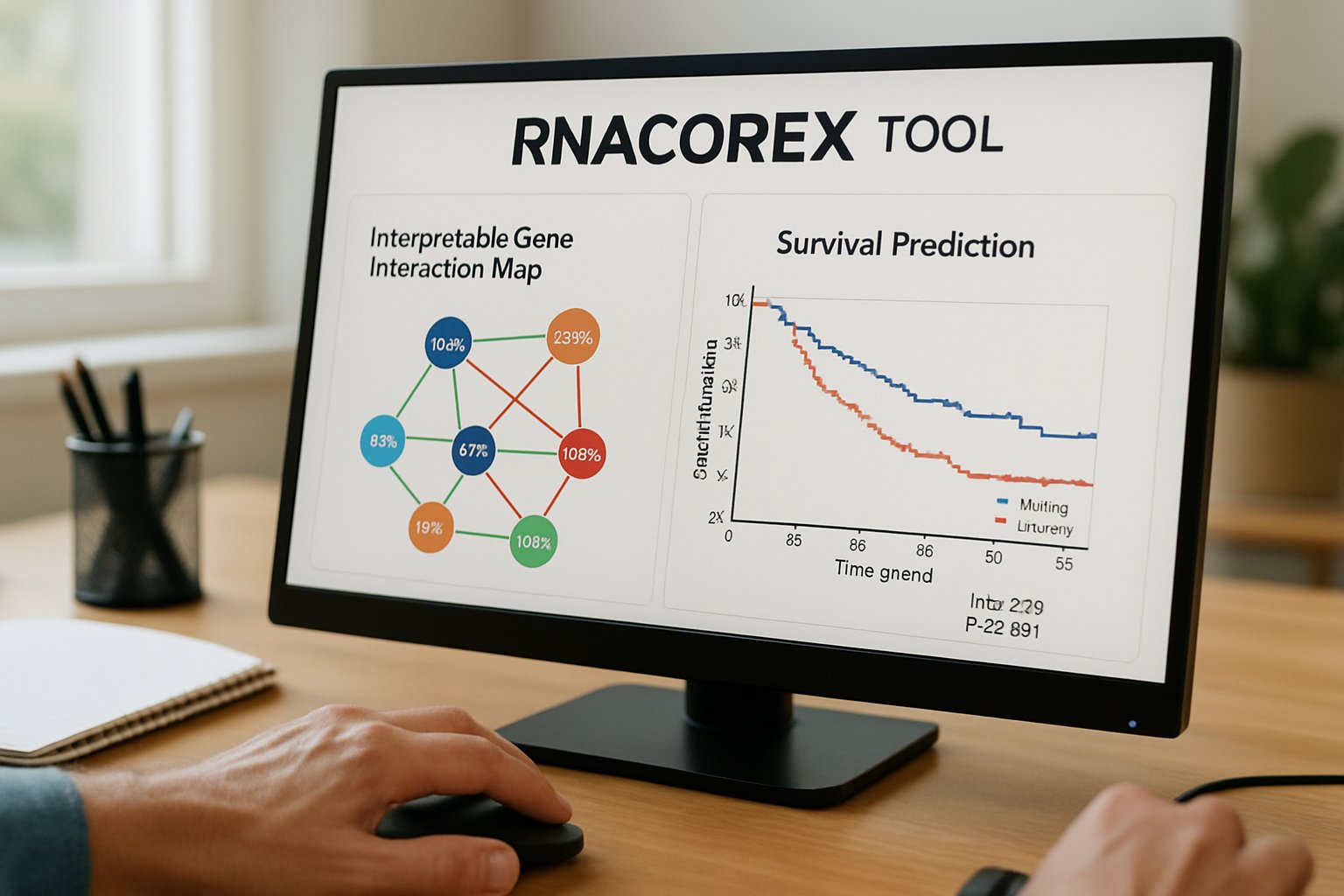
This architecture yields two crucial outputs: probabilistic survival labels and an explicit interaction graph. Moreover, each edge carries a statistical score that investigators can audit easily.
The interpretable backbone differentiates the system from opaque neural models. In contrast, users can trace every prediction back to named molecular links, bolstering biological credibility.
Methodology Section Summary
Hybrid scoring plus Bayesian modeling enables clear genetic network maps. Consequently, the RNACOREX Tool balances prediction with explanation.
Performance Across TCGA Cancers
Thirteen TCGA datasets, including BRCA and LAML, validated the framework. The RNACOREX Tool achieved best accuracies ranging from 0.592 to 0.748. Additionally, area-under-curve values reached 0.796 in acute myeloid leukemia, the strongest cohort.
Authors compared mean AUCs against conventional classifiers, noting competitive performance despite the model’s simplicity. Nevertheless, survival labeling choices and dataset heterogeneity caused variable outcomes across tumor types.
- LAML: accuracy 0.748, AUC 0.796
- BRCA: accuracy 0.683, AUC 0.693
- SKCM: accuracy 0.592, AUC 0.637
These figures underscore promise for interpretable AI in cancer prognosis. However, reviewers flagged potential information leakage from differential expression steps, urging cautious interpretation.
Performance Section Recap
Competitive metrics support continued exploration. However, external validation must confirm the RNACOREX Tool’s reported gains.
Interpretability Versus Black Boxes
Deep learning methods often deliver high accuracy yet hide internal logic. Conversely, the RNACOREX Tool visualizes regulatory graphs where every node and edge is identifiable. Consequently, researchers can prioritize experimental targets with confidence.
Rubén Armañanzas emphasized this advantage: “Our tool provides a reliable molecular map that speeds up cancer research.” Moreover, clear graphs enhance cross-disciplinary communication between computational analysts and wet-lab scientists.
Interpretable outputs also satisfy emerging regulatory guidelines for clinical AI. Furthermore, explainability aligns with FAIR data principles, fostering ethical deployment.
Interpretability Section Points
Explainable graphs bridge the gap between AI predictions and genetic hypothesis generation. Therefore, the RNACOREX Tool addresses transparency demands.
Key Limitations And Caveats
Despite strong results, methodological concerns persist. Specifically, using class labels during differential expression may leak information, possibly inflating accuracy. Reviewers requested fold-specific feature selection to mitigate this bias.
Another limitation involves the lack of experimental validation. Although the RNACOREX Tool highlights high-scoring miRNA–mRNA pairs, laboratory confirmation remains pending. Additionally, reliance on TCGA data restricts generalizability to global patient populations.
Independent teams should test alternative feature pipelines. Moreover, future releases could integrate pathway context and multi-omics layers to enhance robustness.
Limitations Section Wrap-Up
Caveats highlight the necessity for rigorous follow-ups. Consequently, continued community audits will refine the RNACOREX Tool.
Practical Adoption Guidance Steps
Bioinformaticians eager to trial the RNACOREX Tool can install it via pip install rnacorex. Subsequently, the download helper retrieves required prediction engines. Furthermore, example notebooks illustrate end-to-end workflows.
Teams should reserve GPU resources only for preprocessing because the Bayesian core runs efficiently on CPUs. Additionally, controlled environments using Conda ease dependency management.
Professionals can enhance their expertise with the AI+ Network Security™ certification, ensuring best practices when handling sensitive genetic data.
Adoption Section Insight
Quick installation plus detailed tutorials accelerate evaluation. Therefore, organizations can assess fit without heavy upfront investment.
Future Directions And Validation
The authors plan to incorporate pathway analysis and additional molecular layers, broadening the genetic scope. Moreover, they advocate independent benchmarking on prospective cohorts.
Wet-lab collaborations will test top-ranked interactions through reporter assays and perturbation studies. Consequently, validated networks could inform personalized therapy design.
Community engagement remains vital. Therefore, interested researchers should watch the GitHub repository for issue discussions and roadmap updates.
Future Section
Planned enhancements and experimental work will clarify clinical utility. Consequently, the RNACOREX Tool’s trajectory depends on shared validation efforts.
These developments reflect an evolving AI landscape where transparency meets biological insight. However, sustained collaboration will determine real-world impact.
In summary, the RNACOREX Tool offers an interpretable framework that links genetic regulation to survival outcomes. Furthermore, open distribution encourages collective refinement, strengthening precision oncology innovation.


