

AI CERTS
3 months ago
How Hong Kong’s VTC Is Rewriting Education and Why the World Must Catch Up
At the center of this transformation is the Vocational Training Council (VTC), which, in collaboration with Microsoft-backed initiatives, is reshaping how education aligns with industry needs. This isn’t just innovation—it’s a blueprint for the future of global education.
The Shift from Passive Learning to AI-Powered Classrooms
Education has long struggled with a gap between what students learn and what industries actually need. VTC is tackling this challenge head-on by embedding artificial intelligence into every layer of learning. Through its “AI+Professional” model, AI is no longer a separate subject, it is integrated across disciplines, from engineering and design to business and IT.
Students are now required to study critical AI skills such as prompt engineering, generative AI applications, and AI ethics. But the real transformation lies in how these skills are applied. Engineering students work with AI-driven robotics, design students create AI-generated media, and IT students build with advanced AI models.
This approach ensures one powerful outcome: graduates are not just qualified they are job-ready.
Meet the AI Classroom: Virtual Tutors and 24/7 Learning
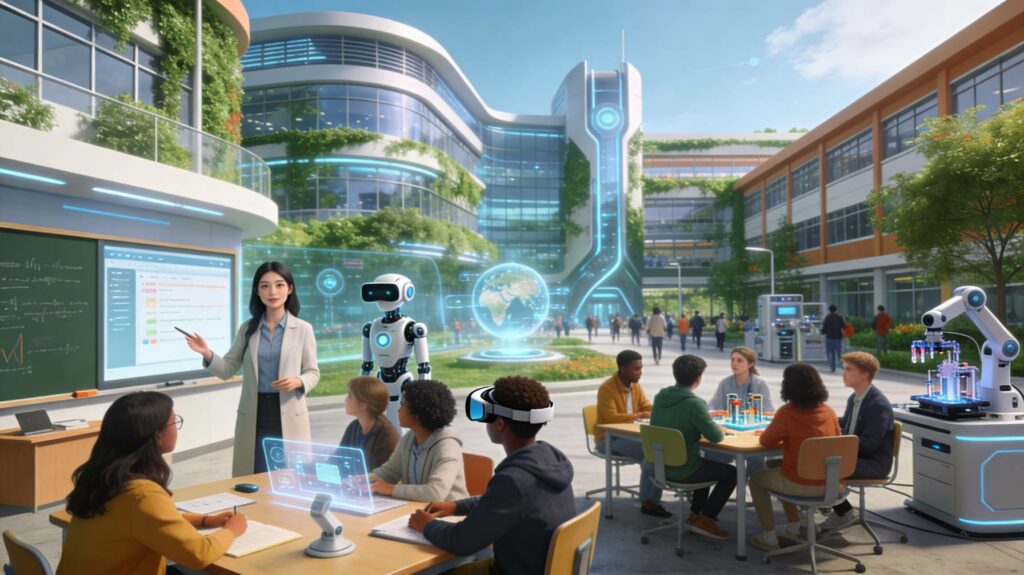
Imagine a classroom where learning doesn’t stop when the bell rings. VTC has introduced a 24/7 AI-powered “Virtual Tutor” that provides students with instant guidance, feedback, and explanations anytime they need. (VTC)
This system is doing more than just answering questions. It is fostering independent thinking, increasing engagement, and enabling personalized learning at scale. Students can explore topics at their own pace, while educators gain insights into learning patterns and performance.
In parallel, teachers are also being trained to use AI tools effectively. Through internal initiatives like “AI for All,” both teaching and administrative staff are learning how to integrate AI into daily workflows, from lesson planning to document summarization.
The result is an ecosystem where AI enhances not replaces, human intelligence.
Building an AI-Native Campus
VTC’s ambition goes far beyond classroom innovation. The institution is moving toward becoming a fully AI-native campus, where AI is embedded in both academic and operational functions.
Administrative staff are being trained in practical AI prompting skills, enabling them to automate routine tasks, improve efficiency, and focus on higher-value work.
At the same time, VTC is collaborating with technology companies to ensure its curriculum stays aligned with the latest industry developments. This includes partnerships that expose students to real-world AI applications in fields like big data, robotics, and digital transformation.
This holistic integration of AI is not just preparing students, it is reshaping how institutions operate.
Solving the Global AI Talent Crisis
The significance of VTC’s model becomes clearer when viewed against the global backdrop. Across industries, there is a growing shortage of professionals who can effectively apply AI in their roles. Governments and businesses alike are recognizing that AI adoption is only as strong as the workforce behind it.
Hong Kong’s strategy reflects this urgency. By making AI education mandatory and industry-aligned, VTC is directly addressing the talent gap and supporting the region’s ambition to become a global innovation hub.
This is not just a local initiative—it is a signal to the world. The future workforce must be AI-literate, adaptable, and capable of working alongside intelligent systems.
Why Traditional Education Models Are Falling Behind
While institutions like VTC are racing ahead, much of the global education system remains rooted in outdated models. Static curricula, limited industry exposure, and slow adaptation to technological change are leaving graduates underprepared.
The reality is stark: learning about AI is no longer enough. Professionals must know how to use it, apply it, and innovate with it.
This is where structured, industry-aligned training becomes essential. The gap between knowledge and application is widening—and only practical, hands-on learning can bridge it.
The Role of Authorized Training Partners (ATP) in Scaling AI Skills
To truly replicate and scale the success seen at VTC, organizations worldwide need a structured approach to AI training. This is where programs like the AI CERTs Authorized Training Partner (ATP) Program come into play.
ATP programs are designed to empower training providers, institutions, and organizations to deliver globally recognized, role-based AI certifications. Unlike traditional courses, these programs focus on real-world applications, ensuring learners gain practical, job-ready skills.
They also provide marketing support, updated curriculum aligned with industry trends, and access to certified trainers—making it easier for institutions to build scalable AI education ecosystems.
In many ways, ATP programs mirror what VTC has achieved: a structured, industry-driven approach to AI learning that prepares individuals not just for jobs, but for the future of work itself.
A Glimpse into the Future of Learning
What’s happening in Hong Kong today offers a glimpse into what education will look like globally in the next decade. AI will no longer be an add-on—it will be the foundation of how knowledge is delivered, applied, and evolved.
Students will learn by building, experimenting, and collaborating with intelligent systems. Teachers will become facilitators of innovation rather than just providers of information. And institutions will operate as dynamic ecosystems powered by data and automation.
The question is no longer whether this transformation will happen, it’s how quickly others will catch up.
The Urgent Need for AI Training
VTC’s transformation highlights a simple truth: the future belongs to those who are prepared to work with AI, not just understand it. As industries evolve, the demand for AI-skilled professionals will only accelerate.
For individuals and organizations alike, investing in structured AI training is essential. Those who embrace it will lead the next wave of innovation. Those who don’t risk being left behind.
FAQs
What is the “AI+Professional” model introduced by VTC?
It is an education approach where AI is integrated across all disciplines, ensuring students learn both theoretical concepts and practical applications relevant to their specific careers.
How does the AI Virtual Tutor work?
The Virtual Tutor is a 24/7 AI-powered assistant that helps students with queries, provides explanations, and supports personalized learning outside traditional classroom hours.
Why is AI training becoming essential in education?
AI is transforming industries globally, and professionals need practical skills to apply AI tools effectively. Without this training, there is a growing risk of a skills gap in the workforce.
What makes VTC’s approach different from traditional education?
VTC focuses on industry-aligned, hands-on learning with real-world applications of AI, rather than relying solely on theoretical knowledge.
How can organizations adopt similar AI training models?
They can partner with structured programs like ATPs, which provide standardized curriculum, certifications, and support to deliver scalable, industry-relevant AI education.
Disclaimer: Some content may be AI-generated or assisted and is provided ‘as is’ for informational purposes only, without warranties of accuracy or completeness, and does not imply endorsement or affiliation.


