How Do Role-Based AI Certifications Improve Corporate Innovation Outcomes?


Executive Summary
Role-based AI certifications transform corporate innovation by turning basic tool access into specialized, functional skills. By looking at real-world data this blog shows how structured, role-specific training programs help companies launch safer experiments, help small teams beat large competitors, and build reliable internal governance.
Table of Contents
- The Real Block to Corporate Innovation
- Point 1: Moving From Tool Literacy to Creative Ownership
- Point 2: Leveling the Playing Field for Smaller Teams
- Point 3: Lowering the Financial Risk of Daily Experimentation
- Point 4: Merging Frontline Execution with Safe Governance
- Why Launching an AI Training Business Is the Ultimate Partner Opportunity
- Frequently Asked Questions (FAQs)
The Real Block to Corporate Innovation
Most corporate leaders think innovation slows down because they do not have the latest software tools. This is a common mistake. Right now, companies are buying millions of tech licenses for their employees. However, providing access to software is not the same as training employees how to use it for their specific jobs. When workers only get basic, generic overviews, they rarely build anything new or valuable. They use the tools for simple tasks like writing short emails, but they do not know how to change their actual daily workflows.
The digital landscape changed completely, proving that basic tool access is no longer enough to win in the market. The Sensor Tower State of AI 2026 Report showed that global time spent on generative applications is on track to more than double year-over-year, jumping to 36 billion hours in the first half of 2026. Consumers and workers are using these tools constantly.
Because tools are everywhere, real corporate value comes from specialized knowledge. This is where professional training programs become necessary. For entrepreneurs, this massive education gap is a golden business opportunity to step in as an authorized training partner and help businesses build real skills.
Moving From Tool Literacy to Creative Ownership
When a company uses generic training, employees tend to copy exactly what the software tells them to do. This makes all corporate output look identical, which kills true innovation. Role-based paths fix this by teaching employees how to mix their personal job expertise with technical systems. It teaches workers that technology should assist them, not replace their personal judgment.
This unique point stands out clearly in the groundbreaking global data published in the Adobe 2026 Creators’ Toolkit Report. The study looked at more than 16,000 professional creators across the United States, United Kingdom, India, Australia, and other regions.
The report revealed that while 87 percent of professionals say smart tools are actively growing their businesses and follower bases, a massive 85 percent emphasize that the final creative decisions must always remain human. Role-based paths give workers the confidence to maintain control. They use automated tools to build rapid drafts but apply their own professional taste to finish the work.
Education providers can easily capture this massive corporate demand by choosing to become a partner in an established network, allowing them to offer specialized certifications instantly.
Leveling the Playing Field for Smaller Teams
In the past, massive corporations dominated innovation because they had huge budgets and massive teams. Small businesses could not keep up with the sheer speed of production. Specialized training completely flips this dynamic upside down. When a small team is fully certified in role-specific workflows, they can build complex projects at the exact same speed as a large global enterprise.
The small, agile teams can innovate faster than slow corporate hierarchies, as long as they possess certified skills. They can build custom applications, design marketing campaigns, and review contracts in a fraction of the traditional time.
For commercial training schools, this data proves that your target audience is not just massive corporations. Small and mid-sized businesses desperately need structured AI training programs to survive. Offering these certifications helps your local clients compete on a global stage.
Lowering the Financial Risk of Daily Experimentation
Innovation requires a lot of experimentation, and experimentation usually comes with a high price tag. In traditional workflows, testing a new product concept or marketing angle requires weeks of manual labor and significant budget allocation. If the experiment fails, the company loses that entire investment. Because of this financial risk, most managers play it safe and avoid trying new things altogether.
Role-specific certifications change how teams handle risk. Certified workers feel they have significantly more freedom to experiment and test alternative strategies before pitching final ideas to clients. Furthermore, automated systems give them the confidence to pursue highly ambitious, complex projects that they would have ignored in the past.
When workers are certified in specific digital workflows, the time required to build a prototype drops from days to minutes. Teams can fail ten times in a single afternoon for almost zero cost until they discover a brilliant, innovative solution.
Merging Frontline Execution with Safe Governance
The fastest way to stop corporate innovation is to create a major security or compliance mess. If an untrained employee uploads private company data or client secrets into a public tool, the company can face massive legal trouble. Because of this danger, many corporate IT departments block advanced tools completely. This security lockdown keeps the company safe, but it also stops all innovation dead in its tracks.
The corporate world is moving fast to fix this friction. Major tech movements highlighted this push for secure execution. For example, Wipro Limited launched its Applied AI Center of Excellence for advanced Claude models. A core part of Wipro’s growth strategy is certifying 10,000 front-line delivery experts over the next 18 months to ensure secure deployment.
On the exact same day, Cognizant and Rubrik expanded their global alliance to embed a specialized governance layer within enterprise systems, allowing companies to watch, control, and even reverse automated actions if an error occurs.
Even SpaceX announced a massive 60 billion dollar deal to acquire Anysphere, the creator of the Cursor coding tool, to safely embed automated systems into their high-stakes engineering workflows. These movements show that the future belongs to companies that can balance fast execution with absolute safety. Role-based certifications teach workers these exact boundaries, giving executives the confidence to keep the innovation engine running.
Why Launching an AI Training Business Is the Ultimate Partner Opportunity
Every company in the world is currently searching for a safe, reliable way to upskill its workforce. They do not want generic tutorials. They want trusted, role-specific professional certifications. For education companies, universities, and business consultants, this demand represents a highly profitable commercial opportunity.
Instead of spending years trying to build your own textbooks, design testing software, and gain international accreditation, you can plug directly into a pre-built global network. By utilizing the AI CERTs Authorized Training Partner (ATP) Program, your business gains immediate corporate trust.
Plugging into this network allows you to scale your business instantly. You can offer a massive catalog of 72 specialized professional certifications, backed by an ecosystem that already supports more than 115,000 learners, 200 expert trainers, and 300 partners across 90 countries.
There is a precise partnership model designed for your specific business goals:
- Build a high-revenue corporate training company through the Authorized Training Partner Program.
- Integrate professional career credentials into collegiate degrees via the Authorized Academic Partner Program.
- Provide large-scale, certified upskilling paths for industry groups as an Association Partner.
- Earn predictable referral revenue by promoting global certifications as an Affiliate Partner.
Frequently Asked Questions (FAQs)
1. Why are role-based AI certifications better than general technical training?
General training only teaches basic software features and definitions. Role-based certifications map those exact technical tools to specific professional functions, such as human resources, legal review, or digital marketing. This ensures employees know how to apply the tools to improve their daily business outcomes.
2. How do these structured certifications help accelerate corporate innovation?
Certifications give employees a clear, safe framework to build rapid prototypes and run digital experiments. Because workers understand the precise operational boundaries and data guidelines, they can test creative ideas quickly without fearing security mistakes.
3. Can a new training business successfully sell these programs to large corporations?
Yes. Trying to sell unverified, custom-built courses to major enterprises is incredibly difficult. However, when you partner with a globally recognized credentialing body, you use an established infrastructure that instantly gives your training business enterprise-level market credibility.
4. What role does human judgment play in certified professional workflows?
According to recent global data, human voice, taste, and oversight remain essential. Role-based training does not teach employees to automate everything blindly. It teaches them how to use technology to handle manual drafting while focusing human energy on high-level strategy and final decisions.
5. How fast can we begin teaching these certified programs to our corporate clients?
By joining an authorized network, you skip the long, expensive process of curriculum development, exam building, and legal compliance tracking. This allows your business to launch a complete, certified enterprise training catalog within a couple of weeks. help me to generate image
Recent Blogs
FEATURED
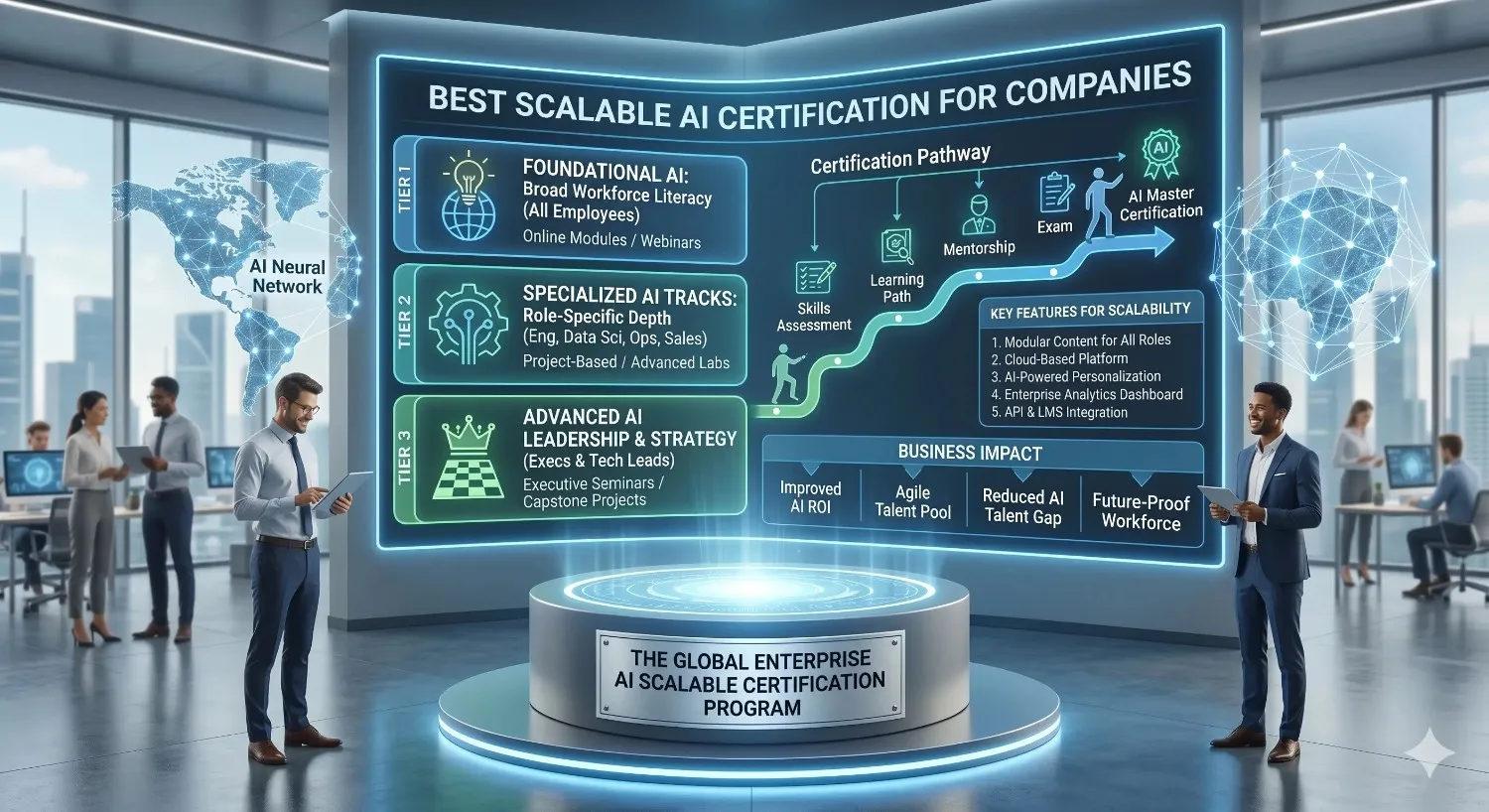
What is the Best Scalable AI Certification Program for Companies?
June 17, 2026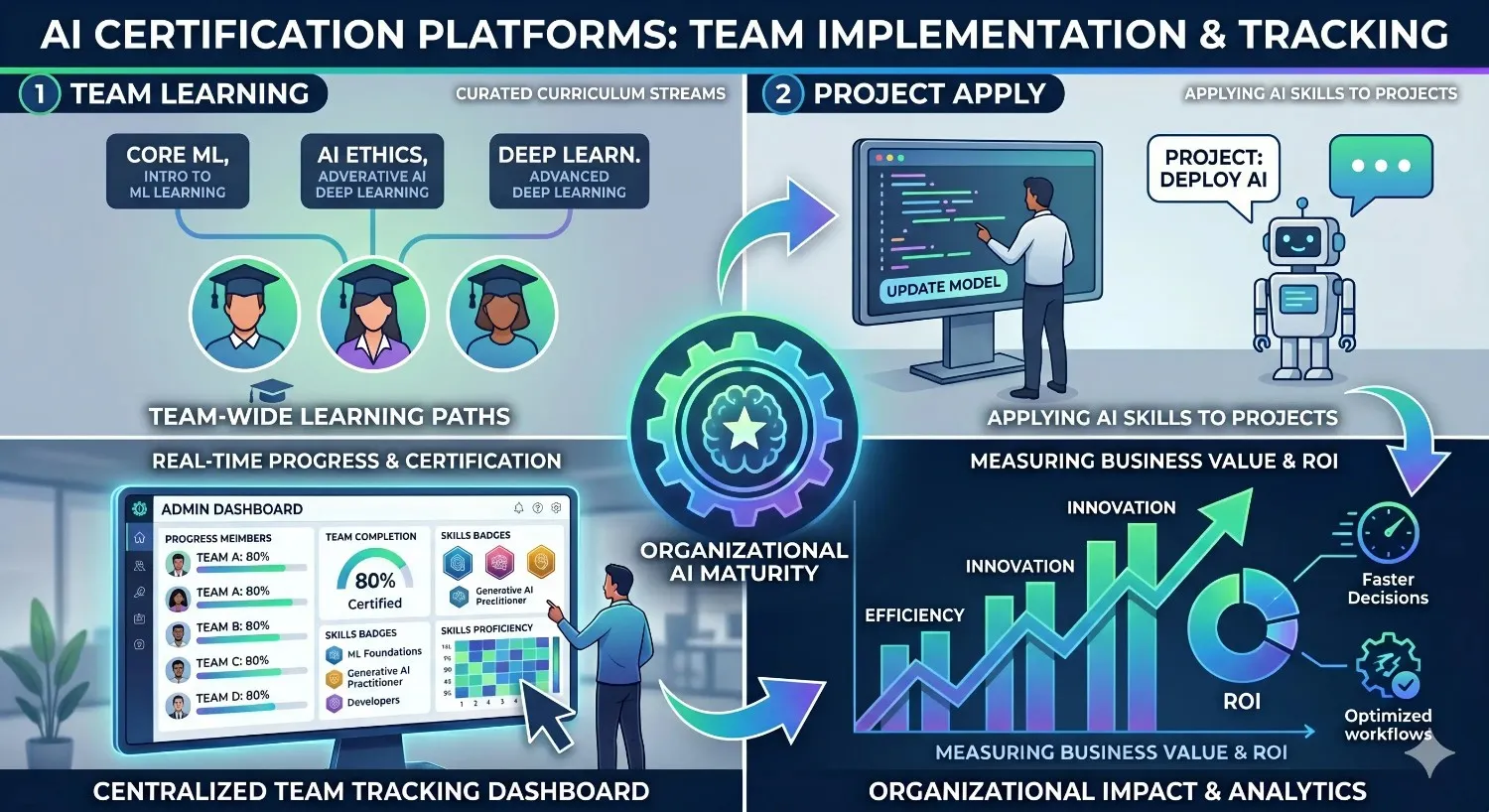
FEATURED
Which AI Certification Providers Support Team-Wide Implementation and Tracking?
June 17, 2026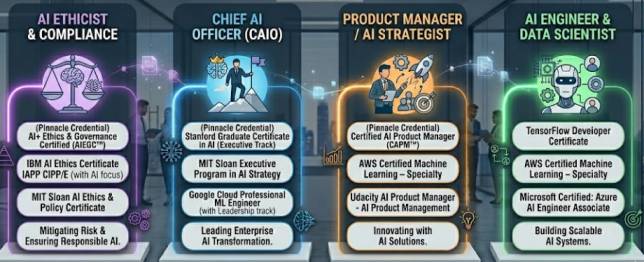
FEATURED
What Are Leading Role-Based AI Certification Options for Enterprises?
June 17, 2026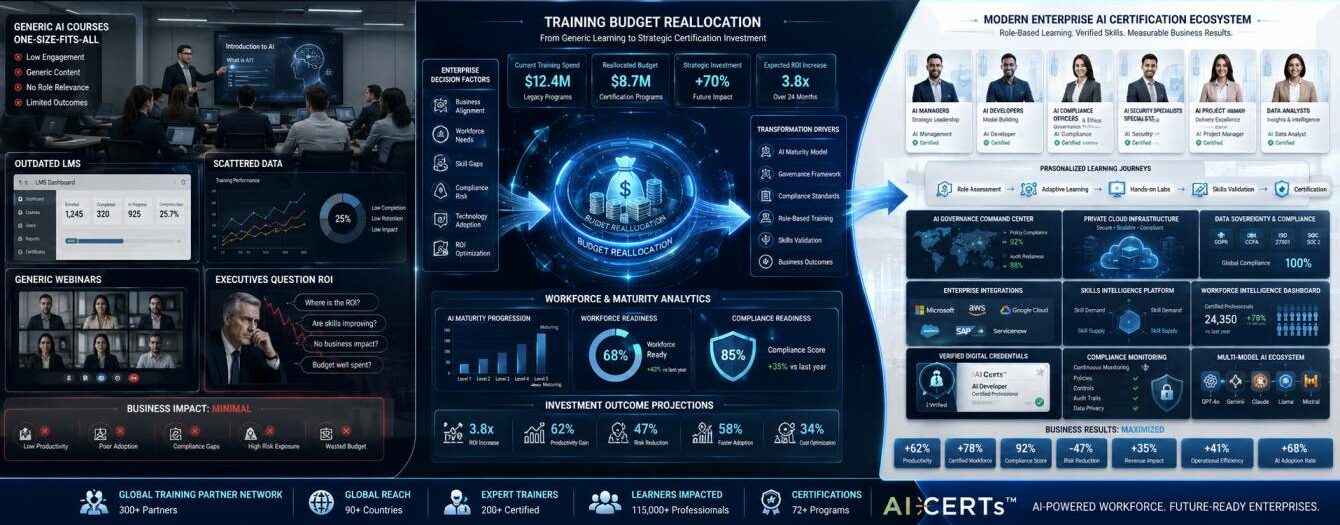
FEATURED
Enterprise AI Training Budgets: Where the Money Flows Now
June 12, 2026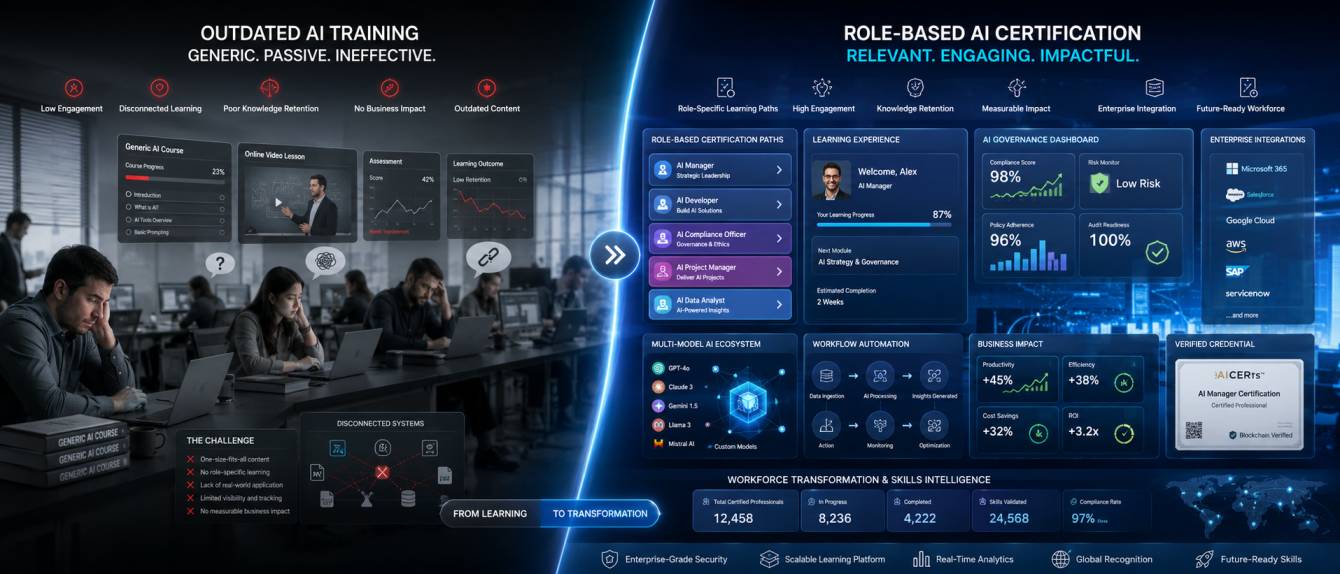
FEATURED
Why Enterprises Stopped Buying Generic AI Training
June 12, 2026