

AI CERTS
1 hour ago
SplatCtrl: Gaussian Scenes Boost Robot Control Systems Safety
This article unpacks the technical advances, benchmarks, and strategic implications for next-generation factories. Moreover, we examine how SplatCtrl slots into modern robotics stack architectures and embodied AI research agendas. The promise hinges on seamless perception-action coupling that links what the robot sees to how it moves. By the end, readers will judge whether the solution fits their own Robot Control Systems roadmap.
SplatCtrl Innovation Fully Explained
SplatCtrl meshes perception and action through a single memory-efficient representation. It performs perception-action coupling by updating Gaussian scene representations at nearly 240 Hz. Meanwhile, a quadratic-program inverse kinematics layer generates joint commands above 100 Hz. Therefore, the stack reacts before obstacles drift into dangerous proximity, even in unseen layouts. Such tight integration distinguishes SplatCtrl from pipelines that bolt planners onto slow meshes. Consequently, forward-looking Robot Control Systems can adopt the method without separate mapping servers.
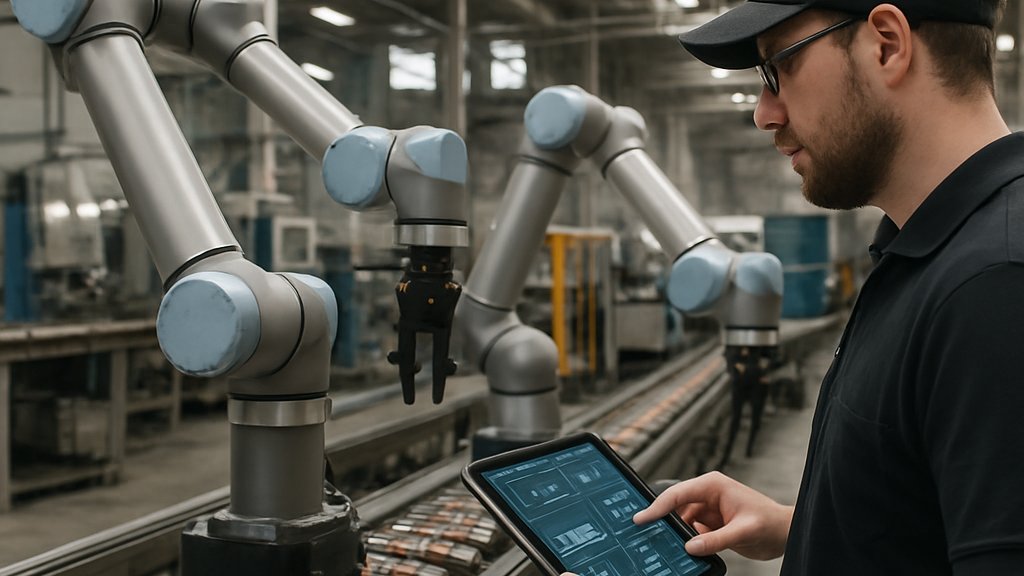
SplatCtrl offers lean perception-action coupling with minimal compute overhead. However, its real power appears in how it builds scenes on the fly.
Rapid Online Scene Reconstruction
The framework starts with RGB-D frames from one or more depth cameras. Each incoming pixel cloud spawns candidate isotropic Gaussians placed using visibility-aware splatting. Voxel occupancy filtering then prunes redundancy and enforces a 5,000-Gaussian budget. Additionally, low-opacity splats drop out to curb phantom barriers. These steps yield Gaussian scene representations compact enough for real-time rendering and distance queries. In contrast, traditional voxel grids choke memory and demand heavier GPU passes.
Key performance metrics underscore the efficiency:
- ≈240 Hz single-view reconstruction iterations with commodity GPUs.
- Up to 5,000 Gaussians maintained without frame drops.
- Gaussian Process interpolation length fixed at two centimeters.
Consequently, SplatCtrl feeds updated geometry to downstream Robot Control Systems without buffering delays. These numbers prove that online updates keep pace with dynamic scenes. Therefore, subsequent control layers can assume fresh geometry every cycle.
Distance Fields For Safety
Safety hinges on knowing how close the robot gets to every Gaussian. SplatCtrl converts opacity-weighted radii into a continuous distance field resembling an SDF. Moreover, gradients from this field feed control barrier functions that wrap the inverse kinematics solver. This perception-action coupling minimizes latency between sensing and actuation. Consequently, torque limits and velocity caps remain intact while enforcing minimum obstacle distances. Simulation studies show average separation gains over baseline 3D-GS of several centimeters. Such margins matter when cobots operate beside humans. Meanwhile, reactive control stays feasible because gradient queries cost microseconds. Therefore, modern Robot Control Systems can guarantee provable safety without sacrificing cycle time.
Distance fields transform raw Gaussians into actionable safety envelopes. Nevertheless, approximating anisotropic splats as spheres introduces minor conservatism, leading into planning trade-offs next.
Reactive Motion Planning Success
Beyond instant reactions, SplatCtrl bundles a BiRRT planner that runs on the same splats. It samples configurations while collision checks use the Gaussian Process distance field at two-centimeter voxels. Moreover, the planner employs path smoothing and time-optimal retiming for efficiency. Simulated benchmarks across 942 trials report success rates above 92 percent in all camera setups. In contrast, baseline 3D-GS planners dipped below 50 percent on identical scenes. Real-robot tests with a Franka Panda achieved 95.8 percent overall success in clutter unknown beforehand. Furthermore, human-robot workspace pilots maintained larger separations and faster completion than safety-monitoring stops.
These victories highlight how Gaussian scene representations unify perception and reactive control under one planner. Such tight perception-action coupling supports emerging embodied AI research that prizes closed-loop learning. Consequently, forward simulation pipelines inside Robot Control Systems gain richer training data. Nevertheless, planners still depend on hyperparameter tuning, as the next section details.
High success rates validate motion planning atop splatted scenes. However, deployment engineers care equally about runtime footprints and integration overhead, topics covered below.
Implementation And Runtime Benchmarks
MERL researchers implemented SplatCtrl in C++ with CUDA acceleration and open-source QP libraries. The full robotics stack runs on a single workstation with an RTX-3080. Loop frequencies stayed deterministic even when multiple cameras streamed concurrently. Moreover, QP solves averaged 0.9 milliseconds, while render-update cycles consumed 4 milliseconds. Memory usage remained under four gigabytes thanks to the limited Gaussian budget. Such headroom benefits Robot Control Systems that must coexist with legacy processes on shared servers. Engineers therefore face modest hardware requirements compared with dense Neural Radiance Fields.
Key implementation caveats are worth noting:
- Sphere approximation ignores anisotropic covariance information.
- Scaling beyond small workcells is untested.
- Grasped object collisions currently rely on heuristics.
Nevertheless, the robotics stack proves sufficient for many reactive control research prototypes. Furthermore, embodied AI teams can piggyback on the open APIs to gather interactive demonstrations. Integrators who seek hardened Robot Control Systems should stress-test those caveats before field deployment. Runtime evidence shows a favorable balance between speed and memory. Consequently, evaluation shifts toward strategic business gains, addressed in the final section.
Key Strategic Industry Implications
Manufacturers face pressure to automate small-batch, high-mix assembly without walled safety cages. SplatCtrl provides a template for adaptive cells guided by fast perception and reactive control. Moreover, its camera-agnostic pipeline lowers integration friction relative to lidar-centric retrofits. These traits align with embodied AI ambitions, where robots learn tasks through direct online interaction.
Consequently, early adopters could unlock flexible automation without rewriting their entire robotics stack. Investors also note that Gaussian scene representations compress data, reducing cloud bandwidth for analytics. Professionals can enhance their expertise with the AI Cloud Architect™ certification.
SplatCtrl thus signals a shift toward tightly coupled perception and action in factory floors. Finally, managers should evaluate pilot data before scaling across global Robot Control Systems portfolios.
SplatCtrl merges fast Gaussian splats, smooth distance fields, and responsive optimization into a coherent toolkit. Benchmarks confirm high success rates, modest hardware demands, and safe human collaboration. Moreover, secondary gains such as compressed analytics streams and simplified robotics stack integration expand its appeal. Nevertheless, unanswered questions around scalability and grasped object modeling deserve careful trials. Therefore, engineers exploring next-generation Robot Control Systems should prototype SplatCtrl in sandbox cells now. Act early to build experience, gather metrics, and position your team for the coming wave of embodied AI manufacturing.
Disclaimer: Some content may be AI-generated or assisted and is provided ‘as is’ for informational purposes only, without warranties of accuracy or completeness, and does not imply endorsement or affiliation.


