

AI CERTS
1 hour ago
Eluna Signals Future of Warehouse Automation AI
Moreover, Eluna promises real-time reasoning, code execution, and strict adherence to standard operating procedures. Such capabilities move beyond chatbots toward digital colleagues that steward complex warehouse operations. In contrast, earlier automation relied on fixed scripts and single-purpose robots. This article unpacks the technology, results, and controversy that follow Eluna’s debut.
Agents Reshape Warehouse Intelligence
Eluna organizes work through multiple specialized agents. Each agent holds a distinct responsibility, similar to experienced shift supervisors. However, the core planner coordinates them through a directed acyclic graph of steps. Progressive disclosure feeds only the necessary context to every agent node. Therefore, prompt length stays small, and reasoning latency remains acceptable. Meanwhile, agents can call live APIs, inspect sensors, or run Python snippets for on-floor decisions.
Consequently, the system behaves more like collaborative logistics agents than static code. In comparison, single monolith models often exceed context windows during extended warehouse operations. Eluna’s modular plan avoids that bottleneck and improves explainability for auditors. Researchers reported that supervisors could trace decisions through the DAG interface within seconds. Such traceability answers regulatory requirements emerging for supply chain AI deployments.
Eluna’s agentic design merges flexibility with oversight. That balance positions the technology for scaled Warehouse Automation AI success. Now, we explore its graph-guided compliance strategy.
Graph-Guided SOP Compliance
Standard operating procedures dominate modern fulfillment floors. Yet human memory and paper binders often allow drift. Amazon engineers encoded those SOPs as nodes and edges in a directed acyclic graph. Subsequently, the planner activates only the current node and related data for each decision. Moreover, the graph structure permits parallel branches when activities can proceed concurrently. Ticket triage, for example, splits diagnostic dialogue from mechanical recovery steps.
During experiments, the research team evaluated 13 diverse tasks using this representation. Student models trained through asymmetric episodic distillation matched or exceeded teacher performance on every task. Consequently, the production student reached 94% expert agreement on a live ticket-processing workflow. That figure surpassed internal accuracy targets set for manual handling. Compliance auditing benefited as inspectors could replay each node with associated sensor snapshots.
Graph guidance locks procedures in code while remaining interpretable. Such rigor boosts confidence for regulated supply chain AI environments. However, compliance alone does not ensure speed, so we next consider performance.
Distillation Accelerates Task Execution
Large teacher models remain costly and slow for real-time warehouses. Therefore, researchers adopted asymmetric episodic distillation to shrink them without accuracy loss. The teacher records failures and corrections during early task execution episodes. Afterward, those corrected traces fine-tune a smaller student model. Consequently, the student internalizes hard-earned fixes yet carries fewer parameters. Latency dropped below 400 milliseconds on internal benchmarks, meeting conveyor control thresholds.
Moreover, the student consumes less GPU memory, cutting edge-server costs. During warehouse operations, many decisions happen simultaneously across different workcells. The lighter model allows dozens of logistics agents to run side by side. Production metrics indicated average pick reroutes declined by 18% during the Tennessee holiday pilot.
- Latency reduction: 38% over baseline rule systems
- Ticket resolution accuracy: 94% expert agreement
- Concurrent agent instances: 25 per edge server
- Manual overrides: down 21% during peak
These numbers underscore the importance of distilled models for scalable task execution under tight service levels. Distillation marries speed with precision. That synergy propels real-time Warehouse Automation AI into production. With performance addressed, attention turns to measured outcomes from live pilots.
Pilot Results And Metrics
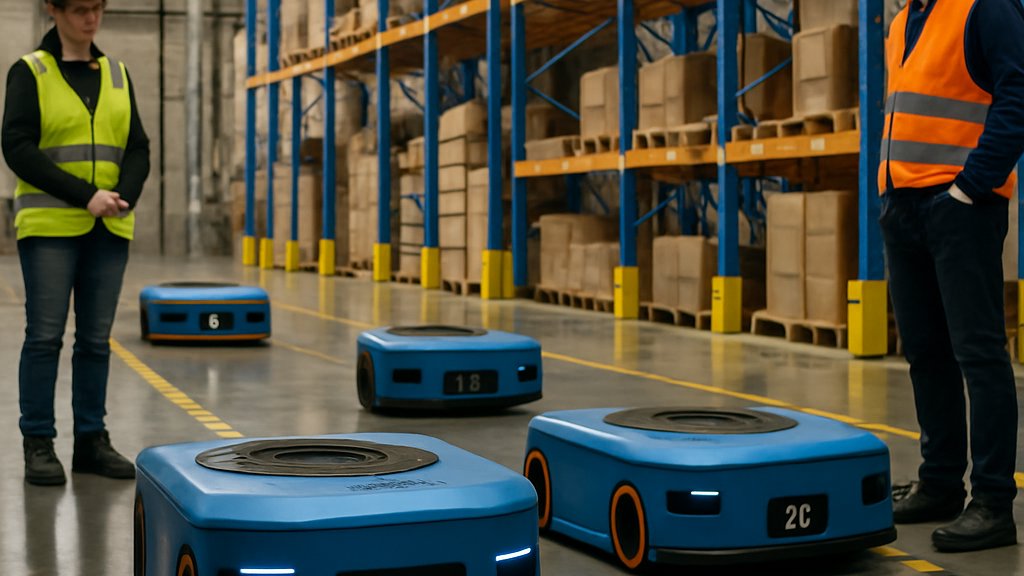
Amazon’s October 2025 blog outlined a Tennessee fulfillment pilot for Project Eluna. Blue Jay robotic sorters handled items, while the AI orchestrated flow balancing. Meanwhile, internal dashboards showed the platform managing roughly 75% of item categories. Independent reporters from GeekWire toured the site and confirmed live agent dashboards. Subsequently, the arXiv paper added empirical evidence across 13 benchmark tasks. Researchers claimed the student equaled the teacher across all metrics and domains.
Moreover, observers noted that the DAG interface let managers inject emergency SOP patches within minutes. In contrast, legacy warehouse operations required code freezes and weekend deployments for updates. Amazon has not yet released full productivity deltas, citing holiday variability. Nevertheless, leaked projections suggested automation could avoid hiring 160,000 roles by 2027. Those estimates fueled public debate about enterprise robotics scaling pace.
Early numbers indicate meaningful throughput gains with human oversight intact. Yet, broader workforce implications remain unsettled for Warehouse Automation AI advocates and critics alike. Discussion inevitably shifts to labor and social impact.
Labor Debate Intensifies Automation
Job displacement fears surface whenever automation advances. However, Amazon leadership frames Eluna as cognitive augmentation rather than headcount reduction. Tye Brady stated that the real headline concerns people, not robots. Nevertheless, leaked internal documents projected hundreds of thousands of avoided hires over a decade. Economists interviewed by the New York Times argued such avoidance still affects regional employment. Meanwhile, warehouse workers express mixed feelings, citing reduced grunt work but increased monitoring.
Supply chain AI policies now dominate legislative hearings in several states. Furthermore, unions request transparent metrics on task allocation between humans and logistics agents. Academic voices call for third-party audits of agent decision logs. Corporate spokespeople promise expanded training programs on enterprise robotics maintenance.
Stakeholders agree on the need for rigorous measurement. Absent clear data, Warehouse Automation AI perceptions will remain polarized. Consequently, governance frameworks become the next focal point.
Governance And Risk Mitigation
Operational AI touches safety, data privacy, and legal liability. Therefore, Eluna includes role-based access controls and rollback hooks. Supervisors can pause individual agents or entire DAG branches during anomalies. Moreover, the system maintains immutable logs for every decision and external call. External auditors can then verify compliance with emerging supply chain AI standards. Industry bodies draft best practices that mirror earlier enterprise robotics safety playbooks. Professionals can enhance expertise through certification.
Consider the AI+ Supply Chain™ program for structured risk training. Additionally, Amazon has established an internal ethics review board for agent deployments. Nevertheless, critics request public disclosure of board findings and incident postmortems.
Current safeguards reflect prudent engineering but not yet full transparency. Robust governance will determine sustainable Warehouse Automation AI credibility. Finally, organizations must plan their adoption roadmaps.
Roadmap For Enterprise Adoption
Executives evaluating agentic platforms should begin with pilot workflows that feature clear KPIs. Consequently, ticket triage, inventory slotting, or pick rerouting offer manageable scopes. Stakeholders must catalog existing SOPs and convert them into graph structures. Furthermore, cross-functional teams should validate node ordering and escalation rules. Edge servers require GPUs, yet distillation keeps hardware footprints modest. Meanwhile, cybersecurity groups must review API permissions granted to logistics agents.
Early adopters report change-management gains when frontline staff access DAG visualizations. Additionally, pairing agent rollouts with reskilling programs creates goodwill. After baseline wins, leaders can expand to broader warehouse operations and upstream transport planning. Enterprise robotics vendors increasingly bundle agent frameworks into turnkey offerings.
Structured pilots, clear metrics, and stakeholder training drive adoption success. Therefore, disciplined roadmaps turn experimental Warehouse Automation AI into enterprise value. The journey concludes with key lessons for industry leaders.
Eluna exemplifies the new generation of agentic platforms guiding real material flows. Academic results and pilot metrics reveal tangible accuracy, latency, and throughput gains. However, workforce and governance challenges demand equal attention. Companies pursuing Warehouse Automation AI should treat technology, policy, and culture as inseparable. Consequently, graph-guided compliance, distilled models, and transparent logs must anchor every deployment.
Robust training, including certifications like the cited AI+ Supply Chain™ course, builds internal expertise. With deliberate planning, leaders can unlock safer task execution at scale while elevating human roles. Now is the moment to explore Warehouse Automation AI strategies before competitors set the pace.
Disclaimer: Some content may be AI-generated or assisted and is provided ‘as is’ for informational purposes only, without warranties of accuracy or completeness, and does not imply endorsement or affiliation.


