

AI CERTS
57 minutes ago
Model Distillation Scaling Laws: Optimizing Compute for Lean LLMs
This breakthrough positions Model Distillation Scaling as a first-class companion to parameter scaling curves. However, practitioners still ask when distillation beats supervised pretraining. The paper covers experiments from 143M to 7.75B student parameters. Meanwhile, compute budgets stretch past 10^21 FLOPs, matching frontier training settings. This article unpacks findings, practical recipes, and open questions for professionals building task-specific LLMs.
Distillation Scaling Law Explained
At its core, the paper extends classic scaling laws to include three extra variables. Those variables capture teacher loss, teacher size, and total distillation tokens. Therefore, the model predicts student cross-entropy with about one percent error across test settings. Researchers validated the formula using seven student sizes and teachers up to 512B parameters. Moreover, the resulting surface reveals smooth power-law behavior similar to parameter scaling. Model Distillation Scaling emerges because the fitted exponents remain stable across orders of magnitude.
Consequently, teams can plug budget numbers into the equation and obtain expected loss instantly. In contrast, early small-scale fits in prior work exhibited high residuals. The new dataset spans three orders of magnitude, reducing variance considerably. These results create a forecasting tool grounded in evidence. Next, we examine how to allocate compute using that tool.
Optimal Compute Allocation Guidelines
The authors separate two scenarios that dominate real projects. First, an existing teacher already sits on disk. Second, the teacher must be trained alongside the student. In the first case, teacher inference costs dominate only if many logits are generated. Additionally, teachers larger than 70B parameters rarely change the optimal split for mid-tier budgets. Consequently, distillation often wins when producing several task-specific LLMs from one teacher.
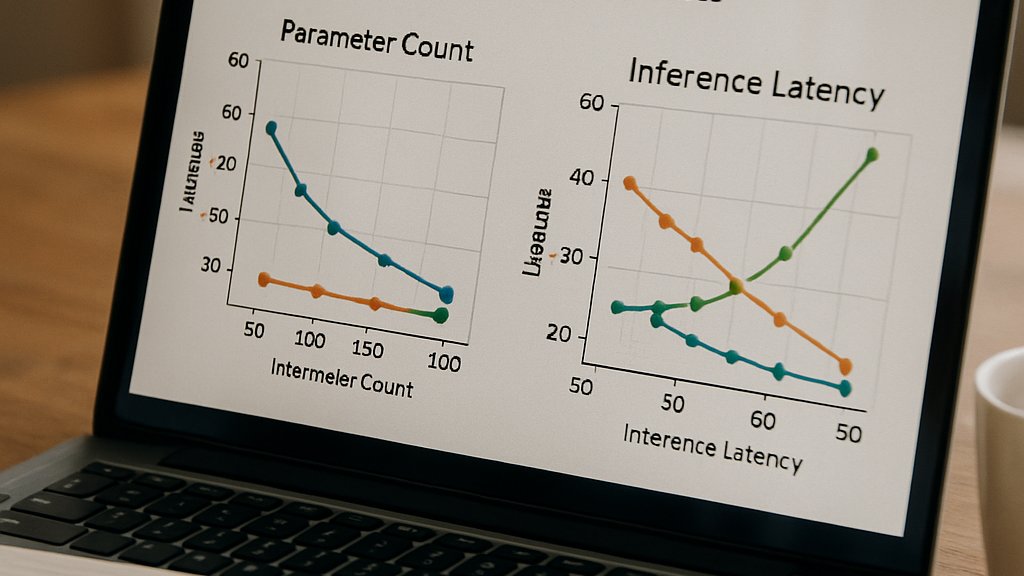
In contrast, single-student pipelines may favor supervised training because teacher pretraining overhead is unavoidable. Moreover, the paper publishes compute-optimal contours that plot loss against budget for each scenario. Engineers can trace those contours to find the sweet spot on their hardware.
- Compute budgets assessed: up to 10^21 FLOPs.
- Student sizes tested: 143M to 7.75B parameters.
- Prediction error: approximately 1% across regimes.
Efficient inference remains a parallel goal for every student deployment. Model Distillation Scaling allows contour exploration within seconds. These numbers contextualize the guidelines for both cloud and on-device deployments. Allocate compute by matching your budget to the published contours. However, capacity gaps also influence that decision, as the next section shows.
Teacher Student Tradeoff Factors
Teacher depth benefits plateau past a 50x capacity ratio. Therefore, adjust teacher size downward when gap exceeds that threshold.
Capacity Gap Impact Analysis
Capacity gap refers to the mismatch between teacher knowledge and student capacity. When the gap grows, additional teacher size yields diminishing return. Therefore, the scaling law flattens in high-gap regions. Apple's experiments demonstrate visible plateaus beyond a teacher-student ratio of roughly 50x. Furthermore, compute-optimal recipes automatically shrink teacher size under tight budgets to avoid waste.
Model Distillation Scaling captures this plateau through an exponent that decreases with token counts. Practitioners must monitor gap curves before over-investing in larger teachers. Recognizing the plateau prevents expensive overtraining. Subsequently, cost modeling becomes the dominant concern.
Engineering Cost Scenario Breakdown
The paper parameterizes teacher inference cost with a delta coefficient. Different infrastructures shift delta dramatically. For example, cached logits reduce delta close to zero. Conversely, remote teacher APIs push delta upward due to network latency and replication. Consequently, a local training shop may prefer distillation, while a SaaS provider may not. Compression research advances such as quantization further lower delta by shrinking memory footprints.
Moreover, efficient inference kernels shorten teacher evaluation time, reinforcing distillation economics. Furthermore, mixed-precision accumulators accelerate both teacher and student passes when memory bound. Teams should benchmark delta on representative batches before committing compute.
- Measure teacher FLOPs per token under intended deployment.
- Estimate storage or caching overhead for logits.
- Plug measured delta into the distillation law spreadsheet.
These steps translate theory into actionable budgets. Accurate delta estimates anchor realistic planning. Subsequently, those savings cascade into lower cooling requirements inside data centers. Now, let us inspect areas where the research remains incomplete. Teams relying on Model Distillation Scaling will appreciate such data-driven budgeting.
Research Limits And Next
Despite breadth, the study leaves replication gaps. Architectures beyond decoder-only transformers require separate curves. Additionally, downstream evaluation on reasoning or safety tasks remains open. Independent groups should test transfer performance across task-specific LLMs used in production. Model Distillation Scaling predictions must still be validated under distribution shift. Moreover, compression research must examine quantized students under the same scaling regime. The authors encourage such extensions and have open-sourced analysis notebooks. Meanwhile, Apple collaborators hint at integrating the law into internal AutoML systems.
- Replicate on vision-language models.
- Validate calibration and robustness metrics.
- Explore safety fine-tuning post distillation.
These actions will stress-test the formula across modalities. Progress here will unlock broader adoption. Consequently, practitioners require concise takeaways for immediate use.
Practical Takeaways For Teams
Engineers want simple heuristics, not theoretical debates. Therefore, we distill five actionable rules.
- Use the published sheets to estimate loss before any training.
- Favor distillation when producing multiple students from one strong teacher.
- Compute delta; if under 0.3, distillation is likely cheaper.
- Monitor capacity gap curves to right-size the teacher.
- Leverage AI Prompt Engineer certification to equip staff with prompt-tuning skills for distilled models.
Furthermore, efficient inference libraries such as FlashAttention complement these rules by slashing runtime. Model Distillation Scaling remains the backbone behind each rule, converting intuition into numbers. These heuristics shorten iteration loops and cut energy costs. Following them accelerates delivery while conserving budgets. Finally, we review the big picture and next steps. Remember, Model Distillation Scaling links each heuristic to empirical evidence.
In summary, Model Distillation Scaling converts compute questions into predictable outcomes. Consequently, scaling laws now address teacher size, token counts, and inference overhead in one formula. Teams can deploy task-specific LLMs faster while sustaining efficient inference across diverse hardware. Moreover, ongoing compression research promises further cost reductions for both teachers and students. Nevertheless, empirical replication remains essential to confirm Model Distillation Scaling under new modalities. Explore the paper, benchmark your delta, and upskill through certifications to stay ahead. Act now to integrate the framework and accelerate your next release.
Disclaimer: Some content may be AI-generated or assisted and is provided ‘as is’ for informational purposes only, without warranties of accuracy or completeness, and does not imply endorsement or affiliation.


