

AI CERTS
1 hour ago
LaGO Elevates Online Reinforcement Learning With LLM Priors
Early experiments show doubled success rates on both discrete and continuous robotics benchmarks. Moreover, stronger language models provide even larger gains, revealing a clear link between prior quality and performance. This article dissects LaGO's method, results, and implications for real-world planning systems. Finally, we outline concrete steps for engineers seeking to leverage this fast-moving strand of control research.
LaGO Method In Depth
First, LaGO adopts a two-stage workflow. During offline preparation, engineers fine-tune a pretrained language model on demonstration trajectories. This step learns a distribution over latent actions aligned with expert intent. KL weighting lets practitioners trade exploitation for exploration with a single hyper-parameter. Subsequently, projection heads map environmental observations into the model's latent space. The language model itself remains frozen, preserving powerful world knowledge.
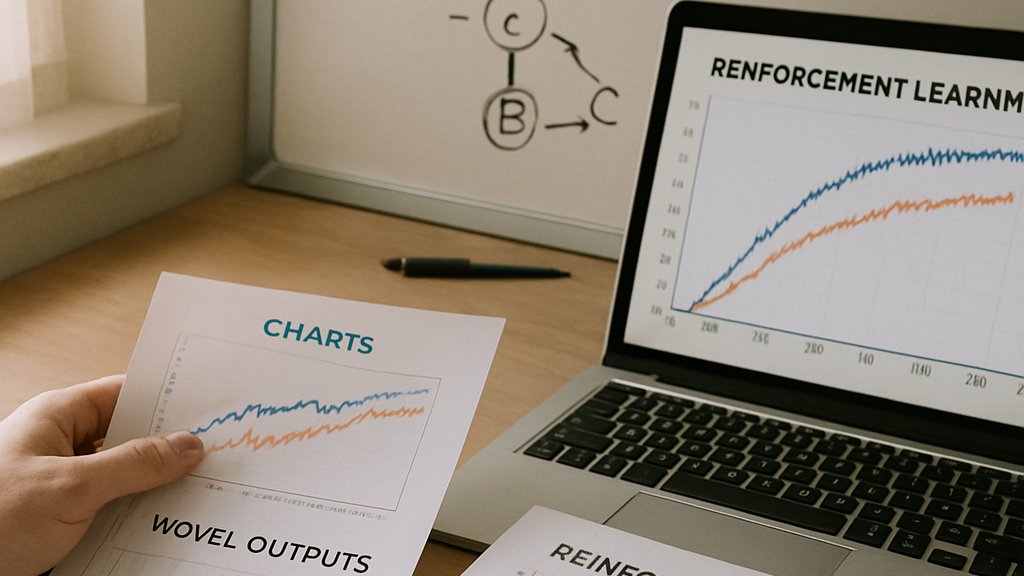
During online interaction, standard Proximal Policy Optimization continues training against task rewards. However, each policy update receives a soft KL penalty against the learned prior. Therefore, the agent explores productively while still adapting to fresh data. This elegant integration keeps Online Reinforcement Learning algorithms unchanged except for the added regularizer. In contrast, methods that force the language model to output direct motor commands often struggle with instability. These design choices create a flexible bridge between language knowledge and continuous control. Consequently, experimental gains appear across varied benchmarks, as the next section details.
Experimental Results In Focus
Indeed, empirical evidence underpins LaGO's claims. Researchers tested the framework on CLEVR-Robot and Meta-World tasks covering discrete and continuous domains. Moreover, evaluations used 1.5 million and 20 million environment steps respectively, reflecting realistic training budgets. Average reward on CLEVR-Robot jumped from 0.076 to 0.122 while success doubled to 27.2%. Similarly, Meta-World scores rose from 0.840 to 1.161, with success moving from 2.7% to 15.2%.
- CLEVR-Robot: Online Reinforcement Learning baseline reward 0.076, LaGO 0.122
- Meta-World: Online Reinforcement Learning baseline success 2.7%, LaGO 15.2%
In contrast, replacing Llama-2 with TinyLlama reduced gains, highlighting prior strength dependence. Therefore, companies considering deployment should budget for larger language models when accuracy matters. These quantitative outcomes validate the guidance concept. Subsequently, we examine practical benefits beyond raw numbers.
Additionally, the team ran all experiments on four NVIDIA RTX A6000 GPUs. Training consumed roughly 36 GPU-hours for CLEVR-Robot and 210 GPU-hours for Meta-World. Therefore, mid-sized research groups can replicate the study without supercomputer access. Nevertheless, production deployments might still require optimised inference pipelines to meet real-time constraints. These capacity notes contextualise the reported gains. Consequently, practitioners can better forecast resource needs for upcoming pilots.
Benefits For Practitioners Today
Practitioners value methods that integrate smoothly into existing pipelines. LaGO achieves that by keeping core Online Reinforcement Learning loops intact. Furthermore, the KL weight offers a single knob controlling how strongly the prior shapes exploration. This simplicity lowers engineering overhead compared with bespoke planning systems built from scratch.
Moreover, LaGO sidesteps notorious instabilities seen when language models drive actuators directly. Because the prior only nudges, catastrophic mis-parses rarely destroy trajectories. Consequently, safety reviewers may approve trials faster.
- Minimal code changes to PPO or SAC loops
- Compatible with diverse latent actions spaces
- Scales with larger LLM checkpoints and future planning systems upgrades
Industry observers also appreciate LaGO's compatibility with safety shields and human-in-the-loop evaluations. Because the prior operates in latent space, auditors can inspect sampled latent actions without revealing proprietary code. Consequently, security teams gain transparency while retaining intellectual property. Collectively, these benefits accelerate prototype cycles for robotics startups. Nevertheless, important caveats remain, as the next section outlines.
Current Limitations And Risks
Despite promising data, LaGO depends heavily on prior quality. Weaker language backbones hurt Online Reinforcement Learning performance, sometimes even below baseline. In contrast, scaling to 7B parameters required four RTX A6000 GPUs for days. Compute budgets therefore loom large for teams with limited hardware.
Another concern involves distributional shift. Experiments show gains shrink on tasks unlike the offline demonstrations. Moreover, hidden biases in the expert data may propagate through latent actions and yield unsafe behaviors. Therefore, rigorous validation and interpretability tools become mandatory before production. Finally, reproducibility suffers because no public code exists yet.
Researchers have petitioned the authors to release weights under a permissive license. Meanwhile, ICML organisers encourage artifact evaluation to bolster reproducibility across online RL papers. These risks urge cautious optimism. Subsequently, we shift to research implications for the wider community.
Implications For Control Research
LaGO strengthens the argument for language priors within robot learning. Researchers studying control research now have fresh benchmarks connecting model size and downstream gains. Consequently, comparative studies against other latent guidance approaches, such as CLUE, appear inevitable. Additionally, LaGO bridges online RL with broader planning systems literature that treats language models as world simulators.
Meanwhile, safety scholars can analyze how soft priors constrain exploration without hiding catastrophic trajectories. Their insights may influence upcoming regulatory frameworks around embodied AI. Therefore, collaboration between reinforcement learners and governance experts should intensify.
Beyond robotics, economists explore whether similar priors could guide reinforcement traders in financial planning systems. Early simulations indicate reduced exploration loss in high-frequency markets. Therefore, cross-domain fertilisation may accelerate algorithmic breakthroughs. The method thus opens fertile ground across algorithmic theory, hardware scaling, and ethics. Next, we outline concrete resources to join this momentum.
Next Steps And Resources
Engineers eager to experiment can start by replicating the offline fine-tuning pipeline. Collect expert rollouts, then adapt open Llama-2 checkpoints using supervised loss on latent actions. Subsequently, introduce a KL term into your preferred Online Reinforcement Learning codebase. Tune the weight until reward learning and prior adherence balance.
- Measure baseline with pure online RL algorithms
- Add latent prior, record sample efficiency
- Scale model size, plot success curves
Furthermore, professionals can enhance their expertise with the AI Engineer™ certification. The program covers language models, robotics, and advanced control research techniques. Moreover, recent conference workshops like LM4Plan host tutorials and solicit replication reports. Participating early positions teams to influence evolving standards. These resources lower entry barriers and support rapid innovation. Consequently, momentum around language-guided Online Reinforcement Learning should continue accelerating.
LaGO demonstrates that language priors can significantly lift Online Reinforcement Learning across robotic domains. Moreover, its two-stage design offers a practical compromise between data efficiency and engineering simplicity. Benefits include faster convergence, safer exploration, and seamless integration with existing online RL pipelines. Nevertheless, success hinges on high-quality models, adequate compute, and rigorous validation against distributional shift. Therefore, teams should start small, measure gains, then scale language capacity deliberately. Consequently, professionals should explore the AI Engineer™ credential. Join LM4Plan workshops to exchange results and shape the next wave of language-guided control research.
Disclaimer: Some content may be AI-generated or assisted and is provided ‘as is’ for informational purposes only, without warranties of accuracy or completeness, and does not imply endorsement or affiliation.


