

AI CERTS
2 hours ago
Mantis Pushes Dual Arm Robotics Beyond Fences
Fenceless Robot Safety Breakthrough
The single-arm MR-1 already ships with 47 embedded safety functions. Furthermore, SGS Fimko Oy certified the robot to ISO 10218-1 and ISO 13849-1. These marks allow operation without hard guarding. In contrast, many industrial robots still hide behind steel fencing. Mantis extends that architecture to two coordinated arms. Therefore, the prototype maintains dynamic speed-and-separation monitoring while managing higher combined payloads.
Academic literature supports this direction. Modern standards emphasize power-and-force limiting and adaptive zones. Consequently, fenceless designs reduce footprint and integration cost. Nevertheless, risk assessment grows more complex when extra joints enter the equation. These factors underscore the importance of certified control layers.
Key takeaway: Mantis doubled capability while preserving certified safety. However, application-level testing will determine ultimate acceptance.
Dual Arm Design Advantages
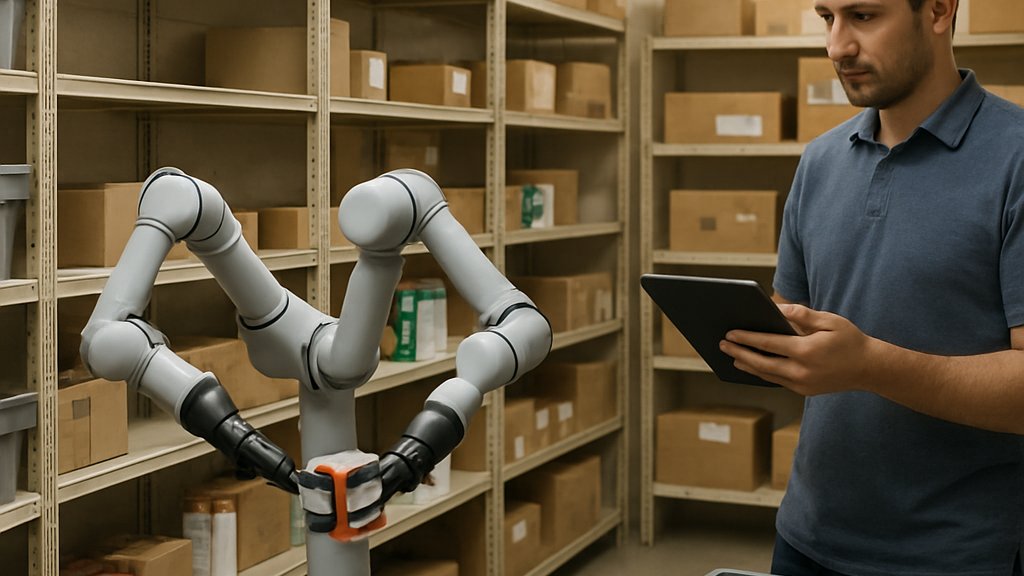
Engineers value synchronized limbs for complex bin-picking and fixture-less assembly. Meanwhile, Dual Arm Robotics achieves tasks that demand simultaneous grip and placement. The Mantis prototype mirrors human bimanual motions through coordinated path planning. Additionally, the arms share perception data from a unified sensor suite, boosting precision.
Performance numbers remain preliminary, yet executives target 0.35-second cycles per arm. Moreover, maximum linear speed of 10.6 m/s matches the single-arm unit. Consequently, throughput could scale almost linearly across many SKUs. Integrators also cited a modest weight increase to roughly 80 kg, still portable by mobile bases.
Benefits summary:
- Two 5 kg payload arms operate within 900 mm reach each.
- Shared physical AI core enables real-time collision avoidance.
- No external fencing, reducing cell footprint by up to 40%.
- Template-based programming through Mantis Studio shortens deployment days.
Key takeaway: Dual manipulators unlock richer motions and higher throughput. Consequently, sites with high-mix demands gain flexibility.
Robot Safety Certification Impact
Certification drives purchasing decisions in regulated industries. Therefore, extending ISO compliance to Dual Arm Robotics carries strategic weight. Mantis confirmed plans to submit the twin-arm configuration for separate SGS audits. Furthermore, the company claims Performance Level d for both cooperative arms.
Gerry Vannuffelen, CEO of Mantis, framed safety as the true scaling bottleneck. Moreover, he argued that intelligence without certification holds little commercial value. Consequently, many observers called the fenceless dual-arm plan a watershed moment if audits succeed.
Professionals can deepen understanding through the AI Robotics certification. The program covers ISO 10218 updates, risk assessment, and sensor fusion best practices.
Key takeaway: Verified safety labels shorten integration cycles. However, auditors must scrutinize every joint and firmware revision.
Market Adoption Outlook
The collaborative robot market exceeded USD 3 billion last year. Additionally, analysts project double-digit CAGR into the next decade. Warehouse automation remains a primary driver. Consequently, faster bin kitting solutions attract retailers chasing same-day delivery.
Collaborative Robot Market Numbers
Grand View Research expects USD 8 billion by 2030. Meanwhile, DataIntelo places kitting robots near USD 5 billion by 2028. Moreover, midsize manufacturers seek flexible alternatives to fixed tooling.
Mantis positions Dual Arm Robotics to capture these segments. Furthermore, retail robotics demands safe, small-footprint systems beside staff. Therefore, a cage-free dual-arm skews favorably toward back-room fulfillment micro-hubs.
Key takeaway: Market appetite exists for agile, certified solutions. However, pricing and proven ROI will dictate pacing into mainstream operations.
Integration And Use Cases
Early pilot partners target high-mix kit building and packaging. Additionally, electronics assemblers appreciate synchronized screw-driving while an opposite arm holds parts. Warehouse automation teams cite reduced conveyor handoffs.
Warehouse Kitting Scenarios Now
Two arms pick from opposite bins simultaneously. Consequently, order consolidation accelerates without extra shuttle systems. Furthermore, physical AI maintains safe distances from walking associates.
Retail Store Deployment Trends
Backroom fulfillment micro-centers need quick item handling. Therefore, dual-arm cells can fit within existing aisles. Moreover, retail robotics success depends on silent, safe operation around staff.
Outside commerce, industrial robots in metal fabrication envisage dual-arm grinding and inspection in one station. Additionally, life-sciences labs explore delicate liquid handling with mirrored pipettes.
Key takeaway: Versatile applications span warehouse automation, retail robotics, and classic industrial robots niches. Consequently, software templates must evolve to support domain specifics.
Implementation Challenges Ahead
Despite promise, hurdles remain. Firstly, dual-arm coordination multiplies control complexity. Nevertheless, Mantis claims its STAR safety core scales linearly. Secondly, fenceless certification covers only the robot. Therefore, integrators must still assess each work-cell.
In contrast to single arms, collision models now involve inter-arm contacts. Moreover, maintaining 0.03 mm repeatability across both units demands rigid calibration. Meanwhile, academic voices urge biofidelic impact testing to validate force limits.
Cost also weighs heavily. Consequently, buyers will compare dual-arm price against two separate cobots. Furthermore, ROI hinges on cycle-time gains and floor-space savings.
Key takeaway:
Technical and economic factors could slow rollout. However, continued standards evolution and certification education may ease integration pains.
These sections illustrated why excitement around Dual Arm Robotics runs high. Meanwhile, practical deployments will reveal the true performance envelope.
Overall, Mantis advances a bold vision blending physical AI, certified safety, and dual-arm versatility. Nevertheless, the coming certification audits and pilot data will shape industry confidence.
Consequently, engineers and operations leaders should monitor results and upskill through recognized programs.
Explore the linked certification, follow emerging benchmarks, and evaluate pilot opportunities to stay ahead.
Disclaimer: Some content may be AI-generated or assisted and is provided ‘as is’ for informational purposes only, without warranties of accuracy or completeness, and does not imply endorsement or affiliation.


