

AI CERTS
1 hour ago
LLM Performance Engineering: DeepSeek R1 Leads Coding Benchmarks
Independent meta-analyses confirm robust code quality while noting mixed open-domain knowledge coverage. Nevertheless, allegations of unauthorized distillation dog the release. Therefore, stakeholders need a clear, balanced view of where results shine, where risks lurk, and how to act. This article provides that map.
DeepSeek R1 Breakthrough Story
The developer released R1 in late 2024 as an open-weight alternative to closed giants. Furthermore, the team adopted an RL-first curriculum that rewarded chain-of-thought reasoning before any heavy supervision. In contrast, many rivals still lean on vast supervised sets first. Observers hailed the approach as a practical case study in LLM Performance Engineering. Consequently, early benchmark snapshots already placed the model near the top of HumanEval charts.
The follow-up release, R1-0528, tightened JSON compliance and reduced hallucinations. However, controversy erupted when OpenAI suggested the company might have distilled its proprietary models. Nevertheless, the firm pointed to its public research logs. These events pushed the breakthrough story beyond engineering forums into mainstream policy debates.
R1’s launch demonstrates how strategic training design can upend expectations. Yet numbers matter more than hype, so we now examine them.
Key Benchmark Numbers Explained
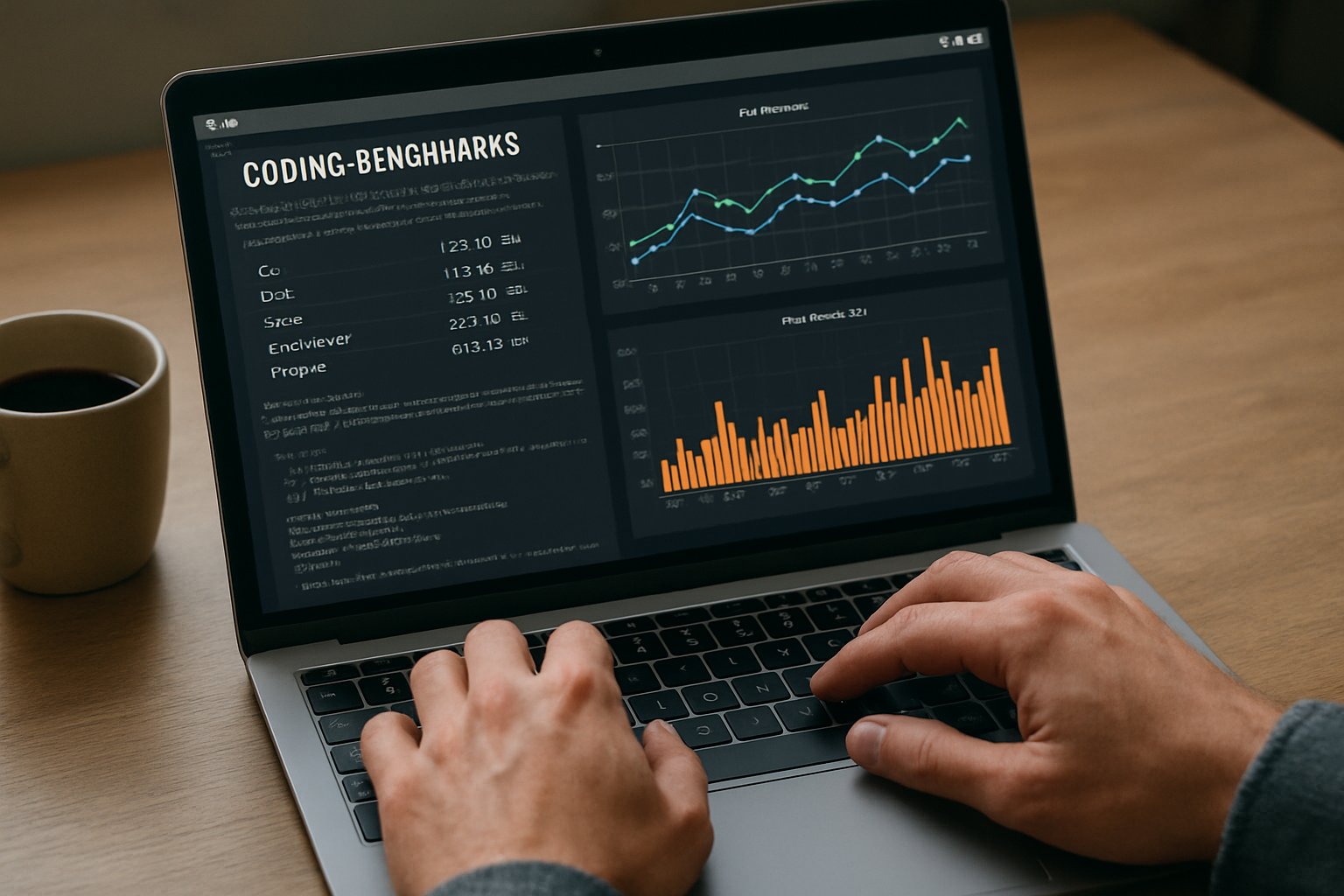
Benchmarks remain the currency of credibility in coding research. Moreover, reproducible scores frame commercial discussions around LLM Performance Engineering. Independent reviewers compiled the most cited figures into a compact dashboard.
- Codeforces Elo: 2,029 (≈96.3rd percentile human).
- HumanEval aggregate accuracy: ~80.2% pass@1.
- SWE-bench verification: ~49.2% on SWE-Verified.
- MMLU reasoning: 90.8% overall.
- AIME math challenge: 79.8% pass@1.
Additionally, NVIDIA reported a 45 percent jump when running the R1 model on Blackwell GB300 GPUs during MLPerf inference trials. Consequently, vendors now showcase the model when demonstrating hardware efficiency gains.
Major Code Benchmark Highlights
LiveCodeBench captured real-world pull requests. In contrast, Codeforces challenges reward algorithmic creativity. Consequently, R1 held near-human rankings in both scenarios, reinforcing the narrative of accessible elite coding support. Rigorous LLM Performance Engineering validation ensures fairness across tasks.
These metrics confirm strong, consistent results across diverse tasks. However, leaders must weigh them against looming compliance risks covered next.
Controversies And Compliance Risks
No open model escapes scrutiny today. Nevertheless, allegations facing DeepSeek carry unusual legal weight. This dispute also shapes LLM Performance Engineering policy agendas worldwide. OpenAI and Anthropic publicly suggested R1 training involved unauthorized distillation of closed outputs. Therefore, regulators across Washington and Brussels requested clarifications.
The firm counters that its reinforcement paths relied on original, licensed data. Furthermore, the company released partial audit logs but stopped short of full provenance disclosure. Consequently, uncertainty lingers over intellectual property exposure.
The compliance cloud could influence enterprise adoption decisions. Meanwhile, economic factors also shape the conversation, as the next section shows.
Economic And Market Impact
DeepSeek claims it built the entire model family for $5.6 million. Moreover, aggressive public API pricing undercuts dominant platforms by double-digit margins. For procurement teams practising LLM Performance Engineering, cost curves suddenly look negotiable.
NVIDIA amplified the narrative by pairing discount hardware bundles with R1 inference showings. Subsequently, several Asian telecoms piloted the model in edge routing projects, citing hardware efficiency and coding assistance gains for their LLM Performance Engineering dashboards.
Lower capital requirements democratize advanced tooling. However, security professionals now ask whether savings outweigh potential vulnerabilities highlighted next.
Security And Safety Concerns
Independent researchers from TechRadar prompted R1 with adversarial coding tasks. Consequently, the model sometimes returned insecure code that mishandled input sanitation. In contrast, it refused certain political prompts, indicating uneven guardrails.
Enterprises therefore mandate additional static analysis layers before merging generated snippets. Additionally, secure LLM Performance Engineering demands certified expertise. Professionals can enhance their expertise with the AI Engineer certification.
Robust governance processes can mitigate many risks. Nevertheless, LLM Performance Engineering success still hinges on future capability upgrades, explored below.
Future Roadmap And Guidance
DeepSeek plans more distilled variants and transparent benchmark artefacts. Furthermore, the company promises a data-provenance white paper later this year. Stakeholders practising LLM Performance Engineering should prepare reproducible test harnesses now.
Experts also advise diversifying model portfolios. Consequently, teams should benchmark at least two models per workflow and track security regressions continuously. Meanwhile, MLPerf organisers will publish refreshed coding suites, offering another comparison layer.
Careful planning balances performance aspirations with compliance realities. Therefore, decision makers can harness open innovation without inviting avoidable risk.
The ambitious experiment reframed open-source ambition. Moreover, the model showed that agile reinforcement strategies can rival closed systems on programming tasks. Nevertheless, unresolved distillation questions and security gaps require vigilant oversight. LLM Performance Engineering practitioners should track emerging audit data, reproduce critical benchmarks, and harden deployment pipelines. Additionally, verifying economic claims against real hardware bills prevents budget misalignment. Consequently, forward-looking teams combine disciplined testing with continuous red-teaming. For deeper skills, pursue the AI Engineer certification and stay ahead of rapidly shifting best practices.


