

AI CERTS
1 hour ago
Labor Union AI Partnerships Reshape U.S. Tech Hub Construction
Others, meanwhile, urge lawmakers to slow rollouts until robust worker safeguards exist. Consequently, a fragmented labor landscape is influencing political fights over permits, incentives, and regulation. This article unpacks the numbers, key players, and future stakes. Industry professionals will find actionable insights on Construction demand, workforce planning, and policy trends. Moreover, we highlight certifications that allow HR teams to manage emerging union-tech collaborations effectively. Read on to understand why Labor Union AI dialogues could redefine American industrial strategy.
Unions Shift Toward Tech
March 2026 delivered a headline few analysts predicted. OpenAI and North America’s Building Trades Unions announced a multi-year buildout pact. The deal centered on Project Labor Agreements for dozens of data centers nationwide. Subsequently, Microsoft followed with a similar curriculum promise for apprenticeship classes. Moreover, both companies offered cash for new training labs and safety modules.
Why did tech CEOs embrace hard-hat partners? Altman admitted his firm must secure 10 gigawatts of compute before 2030. Therefore, he needs 20 percent more qualified Trades people than exist today. Union halls offered an on-tap pipeline that private recruiters could not match quickly.
Union leaders saw leverage. Consequently, they negotiated Community Benefits Agreements that lock in local hiring and diversity goals. PLAs further guarantee predictable wages, safety clauses, and dispute resolution. Construction hours have climbed, with NABTU reporting record apprentice enrollment during 2025.
Partnership momentum shows unions can gain real ground by aligning with emerging sectors. However, disagreements inside the house of labor are growing, as the next section explains.
Driving Data Center Projects
Financiers pledged roughly $121 billion for U.S. data center Construction in 2025, according to S&P Global. Wood Mackenzie tracked a 241-gigawatt pipeline, much of it in rural counties across the South. Pew Research found 67 percent of upcoming facilities land outside metropolitan cores. Consequently, union locals in Iowa, Georgia, and Ohio report surging membership applications.
Labor Union AI collaborations matter here because permitting boards increasingly ask about workforce plans. Developers armed with signed PLAs often clear hearings faster than nonunion rivals. Moreover, Tech Hub consortia backed by unions gain priority under Commerce grant criteria. EDA has already distributed $504 million across twelve regional hubs for implementation.
- Average Phase-2 Tech Hub award: $22–48 million per region
- 38% Americans live within five miles of current data centers
- OpenAI committed $1.5 million for apprenticeship support
These figures reveal unprecedented scale and speed in digital infrastructure spending. Nevertheless, not all unions applaud the surge, as the following debate section illustrates.
Split Within Labor Movement
AFL-CIO president Liz Shuler has warned that unchecked algorithms could automate white-collar Jobs overnight. Similarly, UAW chief Shawn Fain supported temporary moratoria on certain AI deployments. Their stance clashes with building Trades councils counting on Construction packages for growth. In contrast, the Pennsylvania Building and Construction Trades Council lobbied hard for faster approvals.
The divide surfaces during city hearings. One speaker may demand new guardrails, while another touts apprenticeship slots for veterans. Consequently, policymakers juggle competing talking points within the same labor coalition.
Labor Union AI tension complicates contract bargaining with tech employers. Negotiators must balance immediate Jobs gains against long-term job security and data privacy.
The split underscores that no monolithic labor voice exists on AI infrastructure. Therefore, training partnerships have become a critical bridge, explored next.
Workforce Training Pact Details
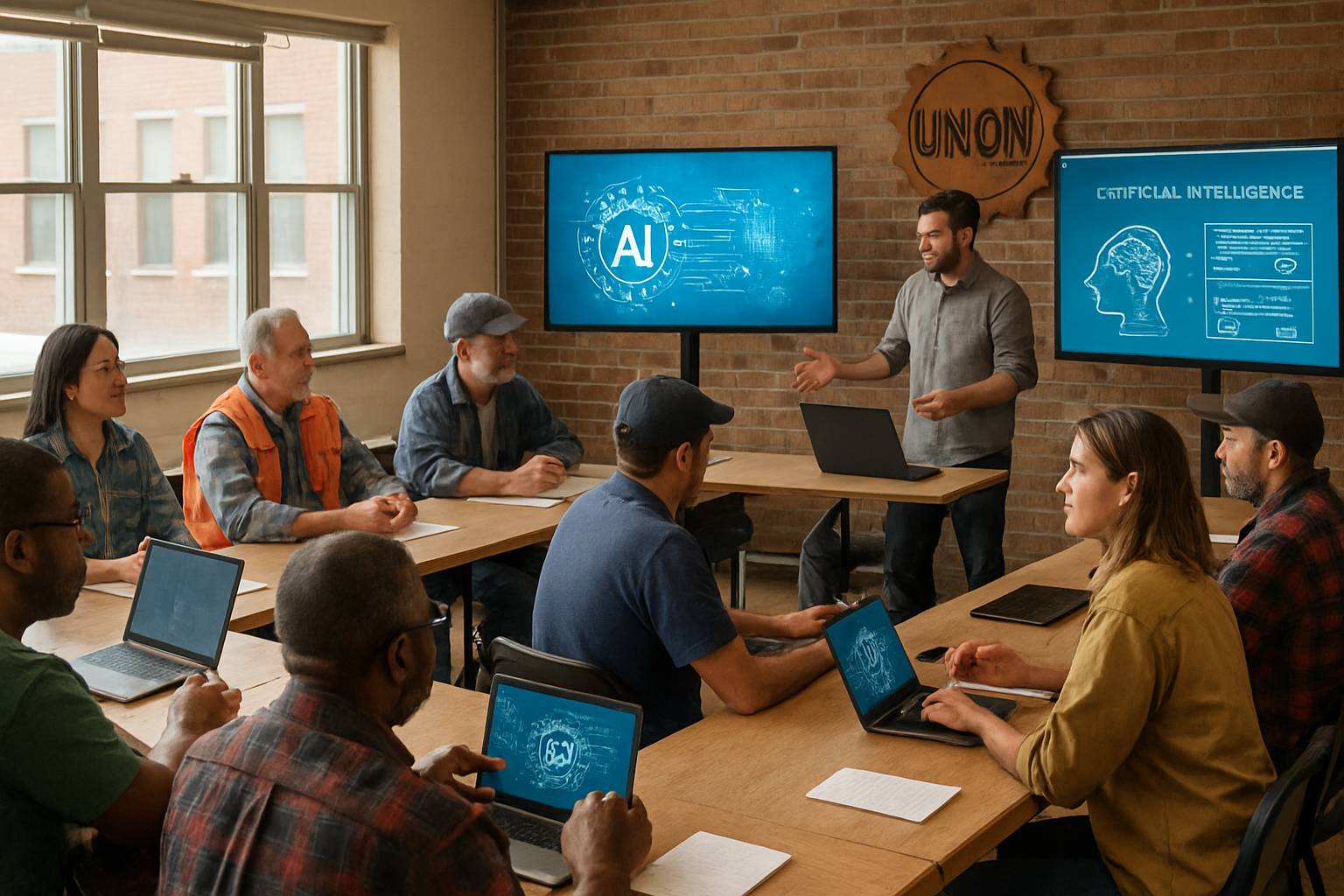
Microsoft and NABTU launched an AI literacy curriculum for 300 instructors in April 2026. Modules cover safety, data stewardship, and jobsite problem solving using handheld diagnostics. Additionally, OpenAI pledged equipment grants and virtual simulations for apprentice cohorts.
Professionals can enhance their expertise with the AI Human Resources™ certification. The course aligns HR teams with Labor Union AI frameworks emerging in CBAs. Moreover, certified managers gain vocabulary to negotiate algorithmic oversight clauses.
NABTU research director Tom Kriger says early feedback is promising. Completion rates hit 92 percent in initial pilots, outperforming legacy e-learning modules. Meanwhile, union halls report more diverse applicant pools after digital outreach campaigns.
Training pacts translate rhetoric into measurable skills pipelines. However, policy incentives still steer overall capital flows, examined in the next section.
Policy And Funding Landscape
The CHIPS Act Tech Hubs program pairs research universities, startups, and unions within regional consortia. EDA guidelines explicitly score proposals on quality Jobs and inclusive hiring metrics. Consequently, many applicants embed Labor Union AI language to win evaluation points.
Federal loan guarantees for high-voltage lines further drive Construction employment near data clusters. States also sweeten deals through tax abatements conditioned on PLA adoption. In contrast, several city councils have introduced environmental impact fees targeting water usage.
- Colorado proposes 1% fee on megawatt hours above baseline
- California bill mandates human review before algorithmic layoffs
- Illinois seeks annual transparency reports from AI operators
Policy carrots and sticks shape whether projects break ground or stall for years. Subsequently, community negotiations gain urgency, profiled below.
Emerging Community Benefit Deals
Community Benefits Agreements guarantee specific perks for neighbors living near massive builds. Somernova’s recent pact included apprenticeship scholarships, minority business targets, and air-quality monitoring funds. Similarly, OpenAI negotiated water-recycling commitments in one Midwestern township.
Labor Union AI advocates argue CBAs legitimize social license for rapid deployment. Nevertheless, critics fear developers use cash promises to sidestep deeper environmental review. Trades leaders counter that without these deals, Jobs would migrate overseas with the servers.
Benefit deals can create win-win scenarios when transparency exists. Future outcomes remain uncertain, leading to the final risk outlook.
Future Outlook And Risks
Analysts predict data center power demand could triple by 2030 under current roadmaps. Therefore, workforce shortages may intensify unless training outpaces retirement rates. OpenAI projects a 20 percent labor gap, while NABTU forecasts steady membership growth.
Labor Union AI cooperation will likely expand, yet regulatory headwinds could slow Construction timelines. Moreover, partisan shifts after the 2026 midterms may alter Tech Hub appropriations. Investors will watch grid policy, water pricing, and community sentiment closely.
Professionals preparing for this turbulence should upskill quickly. Consequently, enrolling in accredited programs strengthens credibility during CBA or PLA negotiations. Trades veterans and HR strategists alike can showcase value through Labor Union AI literacy. Nevertheless, sustained dialogue among unions, tech firms, and regulators remains the decisive success factor.
In sum, the race to build AI infrastructure is rewriting traditional labor alliances. Partnerships between builders and code writers create new Jobs today while igniting governance debates. Labor Union AI frameworks give unions a seat at the design table instead of the picket line. However, unresolved questions around energy, water, and automated management demand vigilant oversight. Therefore, continuous training, transparent CBAs, and evidence-based policy will determine whether promises become lasting prosperity. Explore the linked certification to position your organization at the forefront of ethical AI talent strategy.
Disclaimer: Some content may be AI-generated or assisted and is provided ‘as is’ for informational purposes only, without warranties of accuracy or completeness, and does not imply endorsement or affiliation.


