

AI CERTS
1 hour ago
FORT, NVIDIA Halos Unite for Next-Gen Robot Safety Systems
These moves promise a reference path toward verifiable physical AI safety across diverse machines. Moreover, the partnership aligns functional safety, AI governance, and cybersecurity under one auditable umbrella. Industry leaders cite scalability, data rigor, and accelerated compliance as core benefits. Nevertheless, critics warn that dependence on a single vendor stack could raise long-term costs. This article unpacks the technology, the numbers, and the open questions professionals must track.
Market Demands Rapid Growth
Consequently, industrial robotics deployments climbed despite macro headwinds, topping 20% compound growth last year. Warehouses, agriculture, and mining now demand near-continuous machine uptime with minimal incidents. However, regulators increasingly scrutinize AI controllers that interact with human workers. Global guidelines like ISO 13849 and IEC 61508 set failure probabilities around one in ten million hours. Therefore, builders pursue Robot Safety Systems that embed provable fail-safe channels from day one.
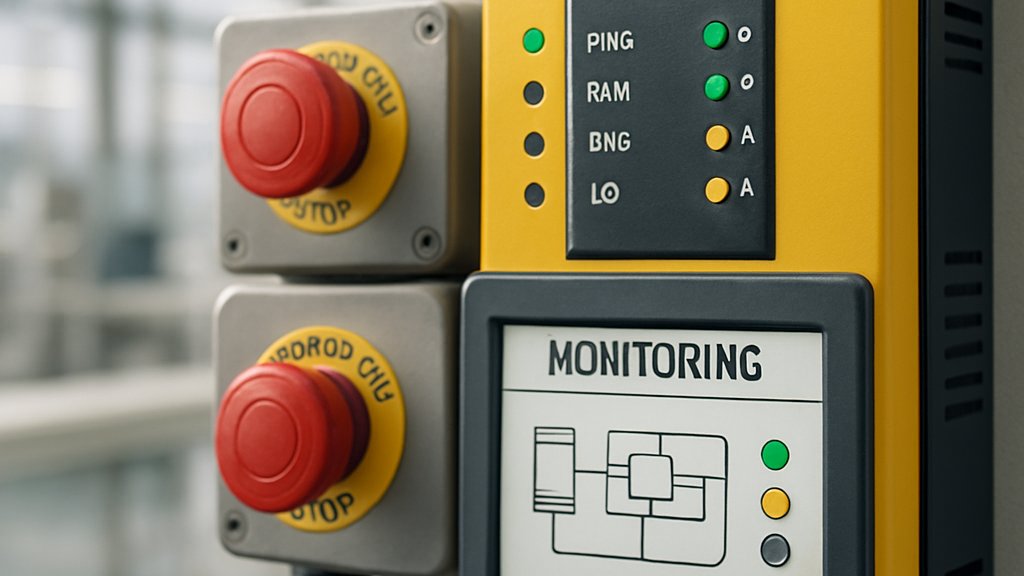
FORT claims more than 20,000 safety units already manage e-stops and fleet messages worldwide. Furthermore, 600 customers span autonomous forklifts, last-mile bots, and heavy equipment. Investors view those numbers as early validation of the business case. Nevertheless, scaling from radio e-stops to AI-driven perception demands deeper assurance tools. Halos appears positioned to fill that gap through standardized inspection workflows.
Demand pressure underlines why Robot Safety Systems certification has become a sales differentiator. Consequently, understanding the Halos framework is essential.
Halos Safety Framework Explained
NVIDIA Halos emerged last year as a full-stack safety architecture for Physical AI. In contrast, traditional functional safety standards rarely address data drift or model uncertainty. Halos therefore combines ISO 26262, SOTIF, and AI lifecycle risk controls. Moreover, the Halos Safety Evaluation Framework maps requirements to datasets, simulations, KPIs, and governance evidence. Targets include demonstrating certain Level-4 failures at fewer than one per 20,000 operational hours.
Such metrics demand enormous data volumes. Therefore, Halos promotes open datasets offering 1,700+ driving hours and Omniverse simulation loops. Additionally, the accredited AI Systems Inspection Lab supplies independent auditors and test artifacts. Industrial robotics teams can inherit these artifacts without duplicating test benches. Riccardo Mariani calls the approach holistic, spanning platform, algorithmic, and ecosystem layers.
These mechanisms create a repeatable template for Robot Safety Systems certification. However, success depends on partners like FORT integrating control hardware and proving conformance. That integration story comes next.
FORT Partnership Key Details
FORT Robotics joined the Inspection Lab during NVIDIA GTC 2026. Subsequently, the company embedded its Nano Safety Controller Pro inside Advantech’s MIC-735 edge system. The combined package leverages NVIDIA IGX Thor silicon for up to 2,070 FP4 TOPS inference. Meanwhile, the FORT controller offers SIL-rated stop functions, encrypted radio, and failsafe GPIO. Consequently, machine builders receive a drop-in Robot Safety Systems module already aligned with Halos inspection criteria.
Samuel Reeves states the collaboration will standardize how the industry evaluates AI safety evidence. Additionally, CTO Nathan Bivans expects the platform to set a new benchmark for safe autonomy. Professionals can enhance their expertise with the AI Security Level 2 certification. That credential aligns with Halos principles on threat modeling and automation security.
These announcements mark an inflection where control hardware, compute, and certification converge. Therefore, hardware synergy deserves closer examination.
Edge Hardware Synergy Deepens
Advantech designed MIC-735 for harsh industrial robotics environments and a decade-long lifecycle. Moreover, IGX Thor integrates deterministic networking, time-synchronized IO, and real-time virtualization. These features complement FORT’s fail-safe radio stack, enabling low-latency emergency stops. In contrast, cloud controllers introduce unpredictable round-trip delays unacceptable for moving machinery.
Consequently, on-premise inference paired with local Robot Safety Systems delivers sub-millisecond reaction times. FORT states test benches achieved performance within Halos SEF thresholds for category three functions. Additionally, the hardware ships with built-in security module TPM 2.0 and cryptographic boot chains.
Edge convergence strengthens physical AI safety while preserving deterministic latency. However, benefits come with ecosystem trade-offs addressed next.
Benefits And Emerging Concerns
Deployers cite several benefits from the Halos-FORT integration.
- Faster certification cycles through pre-validated Robot Safety Systems control and compute stacks.
- Auditable data pipelines satisfying functional and automation security regulators.
- Reduced integration risk for industrial robotics startups lacking safety expertise.
- Access to scalable simulation and open datasets for physical AI safety analysis.
Moreover, unified governance documents simplify cross-market submissions. Nevertheless, analysts flag potential drawbacks. Firstly, deep vendor lock-in could limit bargaining power on compute pricing. Secondly, SEF statistical demands may exceed startup budgets for data collection. In contrast, independent certification labs maintain broader hardware neutrality. Consequently, buyers must weigh speed against flexibility when selecting Robot Safety Systems.
The cost-benefit calculus varies by application, risk profile, and regional regulation. Subsequently, organizations should define measurable next steps.
Next Practical Steps Forward
Enterprises piloting autonomous loaders or cobots can start with a small proof program. Furthermore, requesting Halos Inspection Lab reports will clarify conformance status and residual gaps. Stakeholders should benchmark incident targets against their internal Robot Safety Systems metrics. Meanwhile, independent audits by TÜV or UL can validate claims beyond vendor documentation.
Developers must instrument logs, counters, and secure update channels from the outset. Additionally, cross-disciplinary training in functional, AI, and automation security accelerates deployment maturity. Companies pursuing advanced Robot Safety Systems roles may pursue the earlier mentioned certification. Consequently, internal knowledge matches external assurance artifacts.
These actions prepare teams for a rapidly standardizing safety landscape. The closing section recaps major insights.
Robot Safety Systems are becoming the cornerstone of trustworthy automation. FORT’s alignment with NVIDIA Halos illustrates how control hardware and inspection workflows can converge. Moreover, Advantech’s IGX Thor platform shows that edge compute can match stringent industrial robotics demands. The partnership promises faster, auditable physical AI safety validation while improving automation security baselines.
Nevertheless, companies must guard against ecosystem lock-in and remain data-driven about real-world performance. Therefore, leaders should demand transparent metrics, diversified suppliers, and accredited skills. Pursue iterative pilots, collect evidence, and refine governance with every model release. Explore cutting-edge training and certification to stay ahead in the safe autonomy race.
Disclaimer: Some content may be AI-generated or assisted and is provided ‘as is’ for informational purposes only, without warranties of accuracy or completeness, and does not imply endorsement or affiliation.


