

AI CERTS
56 minutes ago
DiffRadar Elevates Radar SLAM AI Performance
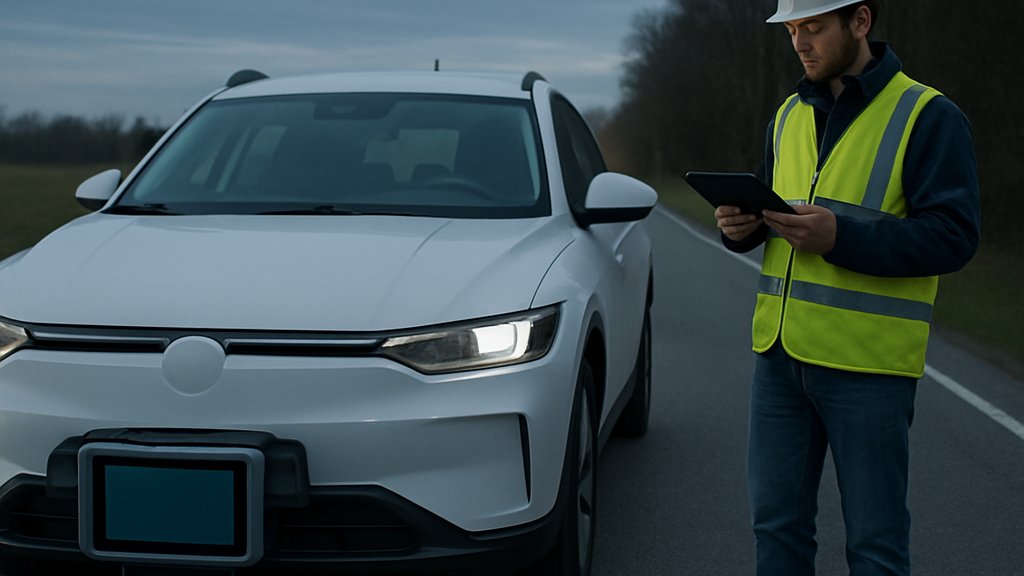
Transitioning from optical to radar sensing demands fresh metrics; we will unpack those numbers next.
DiffRadar Concept Deep Dive
DiffRadar treats each environmental scatterer as a 3D Gaussian primitive.
Therefore, a differentiable forward model converts primitives into predicted range-azimuth and Doppler grids.
Gradients flow from measurement error back to both robot trajectory and primitive parameters.
In contrast, traditional Radar SLAM AI pipelines decouple scan matching and mapping, losing optimization synergy.
Furthermore, the unified formulation reduces cumulative drift during long loops.
These conceptual shifts underpin the performance discussed later.
DiffRadar fuses scene and motion in a single differentiable loop.
Consequently, theory lays the groundwork for measurable accuracy gains discussed next.
Physics-Aware Gaussian Fields Explained
Gaussian fields capture radar backscatter while respecting beamwidth and multipath physics.
Moreover, each primitive encodes anisotropic variance, allowing sharper representation than voxel grids.
The forward model incorporates FMCW radar chirp parameters and antenna phase centers.
Subsequently, simulated returns match actual hardware signatures with high fidelity.
This physics alignment yields maps resilient to adverse weather sensing, unlike vision-based methods.
Importantly, gradients remain stable because Gaussian fields possess closed-form derivatives.
Physics-aware Gaussian fields strengthen observation likelihoods against clutter.
Therefore, we now examine empirical results that validate the model.
Benchmarking Performance Gains Results
The authors evaluated on the public Radarize suite and the new RDST stress tests.
Translational Absolute Trajectory Error fell from 0.606 meters to 0.103 meters, a six-fold drop.
Meanwhile, corridor scenarios saw startling twenty-fold improvements, reaching 0.039 meters error.
Map consistency doubled, jumping from 43 percent to 95 percent under dynamic clutter.
Long loops benefited most, with drift shrinking from 20.44 meters per 100 meters to 0.51.
Moreover, runtime climbed to 70 FPS while memory shrank by 75 percent.
- 6× trajectory accuracy boost on Radarize
- 20× improvement in tight corridors
- 52 RDST trajectories across two sites
- 70 FPS real-time mapping throughput
- ≈40 MB map footprint versus 162 MB baseline
Consequently, Radar SLAM AI practitioners gain both precision and efficiency.
These metrics confirm theoretical expectations.
Empirical evidence shows clear, repeatable leaps over prior baselines.
Next, we explore how engineers achieved such real-time implementation.
Real-Time Implementation Key Details
DiffRadar achieves 70 FPS on an RTX 4090 and embedded SK-TM4 radar DSP.
GPU ray marching renders Gaussian fields quickly, while CUDA kernels compute gradients.
Additionally, pose-map optimization uses limited-memory BFGS with sparse Jacobian caching.
The code streams FMCW radar tensors directly from the TI AWR1843BOOST evaluation module.
Consequently, real-time mapping stays within 15 ms latency budgets required by mobile robotics fleets.
Professionals can upskill via the AI Robotics™ certification.
Nevertheless, porting to alternative antenna arrays will demand calibration.
Engineering choices deliver deterministic 70 FPS performance for mobile robotics fleets.
In contrast, conventional pipelines often sacrifice speed or memory, leading us to strengths and limitations.
Strengths And Practical Limitations
DiffRadar excels during rain, fog, and dust, where cameras saturate.
Moreover, its robustness supports adverse weather sensing for highway and warehouse robots.
Global optimization drastically cuts loop closure drift in expansive facilities.
However, very dense moving crowds can still degrade map stability.
The differentiable physics model also assumes accurate FMCW radar calibration.
Additionally, increased algorithmic sophistication complicates embedded maintenance and safety certification.
Developers must weigh these factors when choosing Radar SLAM AI solutions.
Strengths clearly outweigh current drawbacks for many scenarios.
Consequently, we examine broader implications for mobile robotics.
Implications For Mobile Robotics
Warehousing firms pursue 24/7 autonomy despite dust and steel shelving reflections.
DiffRadar's drift resilience addresses that commercial pain point.
Moreover, city shuttle pilots gain reliable localization under heavy rain, advancing adverse weather sensing adoption.
Fleet managers value real-time mapping because it enables dynamic mission replanning.
Consequently, integrating radar SLAM systems with cloud dashboards streamlines predictive maintenance.
Academic labs studying mobile robotics can now benchmark against an open RDST suite.
However, regulatory bodies will demand cross-hardware validation before certifying public road deployments.
Commercial impact spans warehouses, streets, and mines.
Future research directions will close remaining gaps.
Future Research And Adoption
Independent teams should replicate results on K-Radar, RADIal, and autonomous driving logs.
Furthermore, extending Gaussian fields to 4D micro-Doppler signatures could capture limb motion.
Differentiable beamforming layers may improve clutter separation for adverse weather sensing scenarios.
Community code release would accelerate comparison across FMCW radar chipsets.
Meanwhile, standardization bodies explore metrics that reflect real-time mapping quality.
Consequently, Radar SLAM AI stands poised for mainstream adoption within three years.
Upcoming studies will refine physics models and address dynamic crowds.
Nevertheless, early adopters can already gain measurable reliability.
DiffRadar demonstrates how Radar SLAM AI can finally deliver centimeter accuracy under challenging radar conditions.
Moreover, corporate pilots confirm Radar SLAM AI reduces maintenance downtime through reliable loop closures.
Faster deployments emerge because Radar SLAM AI integrates smoothly with existing GPU pipelines.
Nevertheless, researchers must validate Radar SLAM AI across diverse FMCW radar sensors and dynamic environments.
Industry teams should download preprints, test early builds, and pursue certification pathways to stay competitive.
Explore the linked AI Robotics™ certification to secure qualified talent for upcoming radar projects.
Consequently, Radar SLAM AI offers a compelling path toward safer autonomous operations in harsh conditions.
Take advantage now to lead the next generation of mobile robotics services.
Disclaimer: Some content may be AI-generated or assisted and is provided ‘as is’ for informational purposes only, without warranties of accuracy or completeness, and does not imply endorsement or affiliation.


