

AI CERTS
5 hours ago
Data Center Resistance Shapes Project Tango Delay
Many participants fear the massive project could strain local aquifers, roads, and classrooms. Others welcome potential tax revenue and tech jobs. Meanwhile, county commissioners continue receiving hundreds of emails each week. The upcoming July 15 session now looms as a pivotal moment for Florida’s fast-growing infrastructure debate. This article unpacks the delay, the competing claims, and the broader policy currents shaping the final decision.
Hearing Delay Details Shared
County records show law firm Carlton Fields sent the postponement request on April 10. Consequently, staff granted the change without a commission vote. The new date is July 15 at 9:30 a.m. inside the Governmental Center. County Mayor Sara Baxter told WPTV the delay allows deeper review and public input. Moreover, she said additional studies on noise and traffic are already underway. The December 2025 meeting had attracted more than 400 residents, forcing an earlier pause. Subsequently, commissioners voted 7-0 to move the final zoning decision to April 2026. That vote is the one now shifted to midsummer.
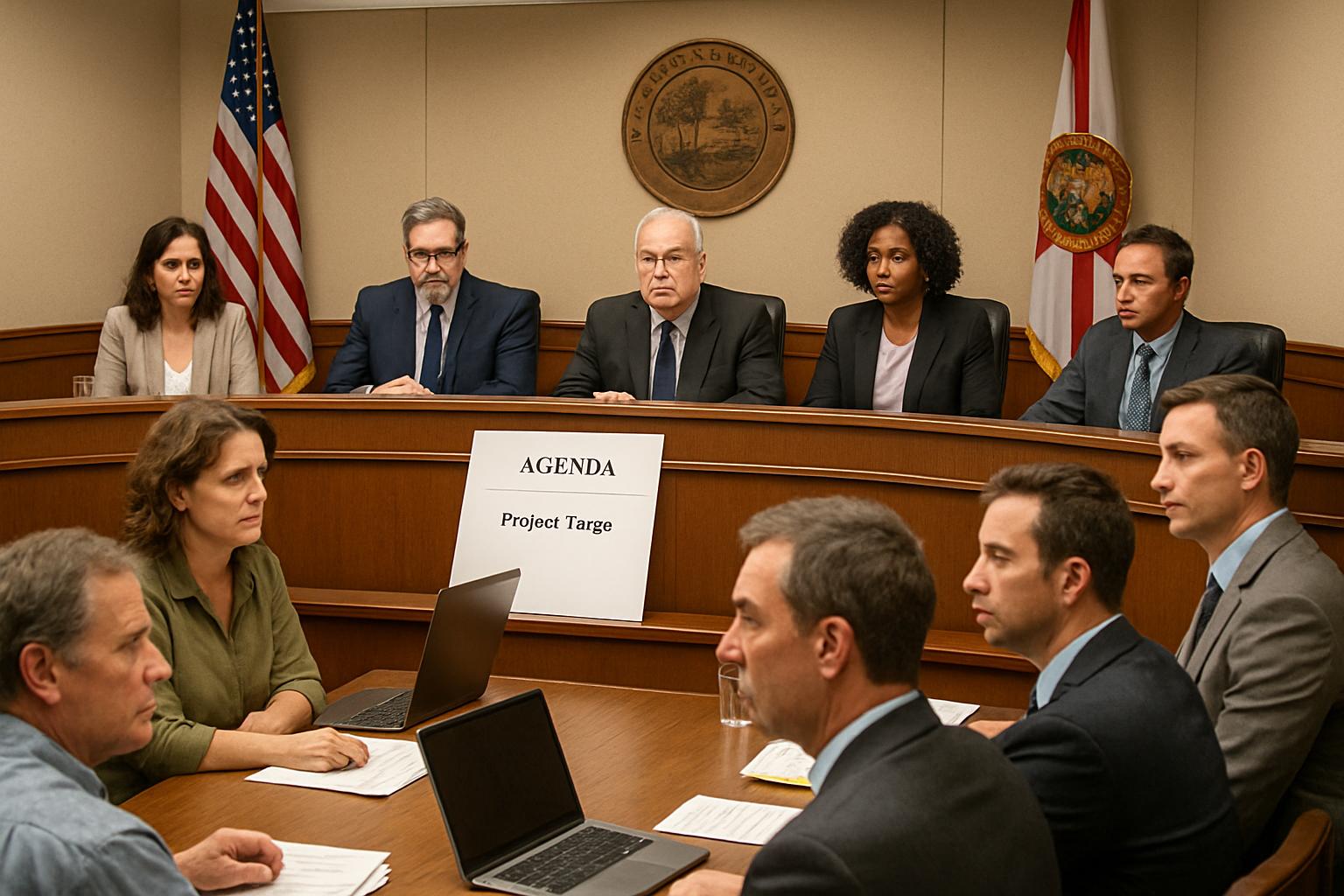
Developers claim the altered schedule helps them refine site plans. They are relocating buildings farther from homes and Binks Forest Elementary. Additionally, spokesperson Ernie Cox revealed that square footage may drop below 1.1 million. However, critics call the move a stalling tactic aimed at diffusing political pressure. Arden resident Ben Brown argued that no extra time is needed to see the land-use mismatch. Media coverage credits Data Center Resistance for keeping the postponement in headlines.
These timeline twists underscore the high stakes circling Project Tango. In contrast, community passion only strengthens as the hearing approaches.
Data Center Resistance Debate
Neighborhood listservs now read like engineering forums. Data Center Resistance organizers share maps, decibel charts, and water spreadsheets each night. Moreover, social media groups exchange strategy notes about testimony limits and Sunshine Law procedures. The coalition includes Arden homeowners, equestrian farm operators, and local Parent-Teacher groups. Nevertheless, supporters emphasize the project’s potential for modern digital infrastructure, citing expanded cloud demand.
Community workshops reveal diverging narratives. Proponents stress that hyperscale facilities rarely emit visible smoke and house few on-site staff. Conversely, environmental advocates counter that backup generators can release diesel particulates during testing. They also warn that heavy transformer hum can travel across canals. Furthermore, the group Earthjustice insists the county must publish independent cooling analyses before any vote.
Passion on both sides fuels an unusually technical public debate. Therefore, attention has shifted toward measurable impacts rather than slogans.
Key Technical Concerns Examined
Technical questions now dominate commission inboxes. Chief among them are power demand, water sourcing, and low-frequency noise. Developers have not disclosed anticipated megawatt load. Consequently, local utility Florida Power & Light has yet to outline grid upgrades. Independent analysts note that comparable AI centers can exceed 100 megawatts. Environmental engineers warn that water withdrawals, though modest on paper, could stress dry-season canals.
- Site footprint stands near 202 acres within Palm Beach County.
- Original floor request totaled 1.8 million square feet; new concept shows about 1.032 million.
- Developers predict potable demand of 5,000 gallons daily via closed-loop cooling.
- Noise models suggest levels below 50 decibels at property boundaries.
Water And Noise Metrics
Water use assumptions remain controversial. In contrast, other U.S. hyperscale campuses reportedly consume hundreds of thousands of gallons daily. Therefore, Palm Beach residents question the 5,000-gallon claim. Additionally, county staff already ordered a vibration study to validate acoustical data. Developers state that all chillers and generators will sit inside insulated enclosures. Nevertheless, opposition groups have hired independent engineers to replicate the models. These consultants coordinate with Data Center Resistance volunteers to crowd-source sensor placements.
Technical clarity could either calm or escalate concerns. Subsequently, attention is drifting toward broader policy ramifications.
Broader Policy Context Unfolds
Florida lawmakers are drafting bills that demand more transparency in data-center siting. Moreover, the proposals would end code-name protections and mandate early disclosure of utility loads. Consequently, counties might soon receive clearer forecasting tools. Commissioner Maria Sachs argues the state must set standards before approving projects of this scale. For Data Center Resistance advocates, proposed legislation represents validation of their transparency demands.
Meanwhile, national debates over AI energy footprints grow louder. Inside Climate News reported hyperscale campuses pushing local grids to the limit. Therefore, Palm Beach officials watch neighbouring counties for precedents. Professionals seeking to navigate such regulatory shifts can bolster credentials through the AI Policy Maker™ certification.
Policy changes could redefine future projects across Florida. However, economics still play a decisive role for many residents.
Local Economic Stakes Considered
Economic development officials estimate hundreds of construction jobs and millions in property taxes. Additionally, developers highlight potential partnerships with local colleges for workforce training. In contrast, critics note that operational staffing may remain minimal once servers begin humming.
Job And Tax Impact
County staff project long-term employment of roughly 50 high-skill positions. That figure disappoints some union leaders who hoped for warehouse-scale hiring. Nevertheless, Data Center Resistance members concede that even limited payroll can help fund schools if assessments are fair. Moreover, they want revenue guarantees tied to performance benchmarks.
Economic forecasts reveal both promise and uncertainty. Consequently, July’s vote must weigh fiscal upside against possible hidden costs.
Critical Next Steps Ahead
County planners will release a fresh staff report at least two weeks before the hearing. Furthermore, that packet should include updated site plans, environmental assessments, and traffic counts. Data Center Resistance volunteers plan to dissect every appendix within hours of publication.
Developers must also file revised noise models and verify water calculations with the utilities department. Meanwhile, Earthjustice attorneys prepare detailed rebuttals referencing national benchmarks. Additionally, Palm Beach State College will host a neutral forum in late June.
Observers suggest three focal questions for July. Will the developer disclose peak megawatts? Can independent engineers replicate the 5,000-gallon figure? Finally, does the county possess legal grounds to relocate or scale the campus?
The answers could set statewide precedent for high-density AI infrastructure. Therefore, Data Center Resistance considers the upcoming summer a make-or-break phase.
Project Tango’s fate now hinges on data, diplomacy, and deadlines. July’s hearing promises the most detailed public record yet. Nevertheless, uncertainty remains until independent experts verify power, water, and noise models. Data Center Resistance will continue scrutinizing every disclosure while developers polish their economic pitch. Moreover, policymakers statewide will watch the outcome when shaping new zoning statutes and environmental safeguards. Professionals seeking deeper insight into AI infrastructure governance can strengthen résumés through the AI Policy Maker™ certification. Act now to stay ahead of emerging compliance challenges.


