

AI CERTS
2 months ago
Compute Hoarding Crisis: Idle GPUs Expose Expensive Cloud Waste
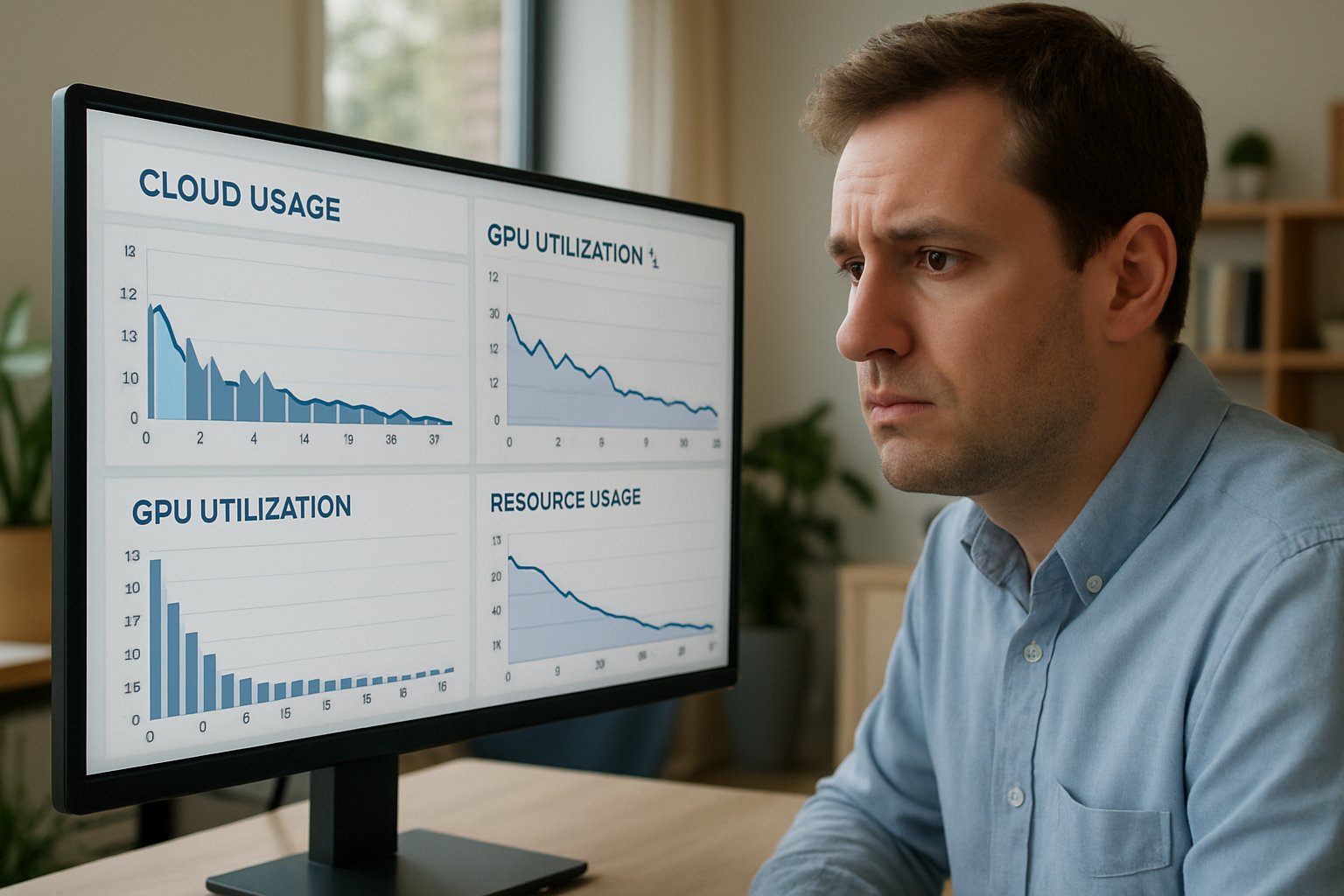
These signals intensify pressure to eliminate idle GPUs and reclaim precious engineering cycles.
However, fear of scarcity fuels FOMO overbuy behaviors that reinforce the Compute Hoarding Crisis.
Industry stakeholders now debate token economics, scheduling bottlenecks, and cultural resistance to dynamic provisioning.
This article unpacks fresh data, explores root causes, and outlines actionable remediation strategies.
Readers will learn how to turn waste into savings without sacrificing performance or compliance.
Therefore, organizations can navigate the Compute Hoarding Crisis and future-proof AI deployments.
GPU Waste Snapshot Today
The vendor collected telemetry from tens of thousands of clusters across AWS, Azure, and GCP.
Moreover, the dataset revealed GPU utilization averaging only five percent, leaving 95% capacity untapped.
Consequently, companies maintain enormous pools of idle GPUs that generate no immediate value.
The report notes one optimized fleet sustaining forty-nine percent, proving higher ceilings are practical.
Furthermore, CPU and memory utilization fell to eight and twenty percent respectively, confirming systemic overprovisioning.
In contrast, fewer than two percent of accelerators ran on Spot instances during 2025.
Therefore, most organizations still rely on expensive on-demand rates despite documented savings opportunities.
These figures crystallize the Compute Hoarding Crisis in stark financial terms.
- Average GPU utilization: 5%
- Unused capacity: 95% capacity across fleets
- CPU utilization: 8%; Memory: 20%
- Spot GPU adoption: <2%
- Price hike: 15% on AWS H200 blocks
Collectively, these numbers expose a huge waste reservoir.
However, understanding the drivers is essential before prescribing solutions.
Let us examine why teams keep provisioning far beyond live demand.
Drivers Of Compute Hoarding
Scarcity narratives began with early LLM training booms, triggering widespread FOMO overbuy across enterprises.
Additionally, procurement cycles often exceed hardware release cadences, encouraging cautious buffer allocations.
Meanwhile, service level agreements mandate low latency, so teams keep idle GPUs online for burst absorption.
Consequently, the Compute Hoarding Crisis persists even when monitoring dashboards show single-digit usage.
Fragmented scheduling also wastes capacity.
Jobs requiring contiguous H200s may wait while isolated slices sit dark, pushing effective utilization lower.
Moreover, storage throughput bottlenecks starve accelerators, compounding inefficiency.
In contrast, one Cast AI customer solved I/O throttling first and doubled throughput without new hardware.
Technical and cultural factors intertwine to deepen waste.
Therefore, attention is shifting toward new economics that reward delivered tokens, not idle hours.
The next section explores that debate.
Cost Metrics Debate Intensifies
NVIDIA now champions cost per token as the definitive efficiency gauge.
Moreover, partners like CoreWeave echo that framing to court enterprise inference workloads.
Nevertheless, some analysts warn the metric masks infrastructure cost variances across clouds and software stacks.
Cast AI counters by focusing on raw utilization, arguing that unused silicon remains pure waste.
Consequently, finance leaders struggle to reconcile token goals with the unfolding Compute Hoarding Crisis.
In contrast, engineering leaders lean into granular telemetry to expose every idle GPUs minute.
Therefore, agreement on a blended metric remains elusive.
Yet, the debate itself accelerates demand for optimization tooling.
Consensus or not, boards want savings immediately.
Next, we examine the toolkits designed to deliver that relief.
Emerging Optimization Toolkits Rise
Cast AI leads with a DRA-aware autoscaler that simulates thousands of instance permutations before provisioning.
Additionally, the platform supports fractional GPUs, MIG partitioning, and time-slicing for bursty inference.
Consequently, clusters can jump from five percent to double-digit utilization without code changes.
Spot-aware provisioning then sweeps for discounted hardware while respecting interruption budgets.
Partners integrate similar logic into open-source schedulers like Kueue and the NVIDIA GPU Operator.
Moreover, emerging capacity exchanges advertise fractional H200 slices, lowering entry thresholds.
Professionals can enhance their expertise with the AI Data Robotics™ certification.
That curriculum covers dynamic scaling principles crucial for taming the Compute Hoarding Crisis.
These tools turn utilization into a controllable variable.
However, human behavior still shapes final outcomes.
We therefore shift to cultural obstacles.
Cultural Barriers And Risks
Risk-averse engineers remember every painful OOM incident.
Consequently, they pad requests, driving infrastructure cost higher than necessary.
Furthermore, leadership often rewards uptime, not efficiency, reinforcing hoarding incentives.
In contrast, rightsizing must appear boringly reliable before teams trust automation.
Recent case studies show incident counts actually fell after aggressive tuning.
Nevertheless, change programs started with clearly defined rollback plans and executive sponsorship.
Therefore, culture evolves when savings do not jeopardize service levels.
These lessons inform practical steps to defeat the Compute Hoarding Crisis.
Actionable Steps For Teams
Start with a seven-day telemetry capture to quantify idle GPUs and confirm real baselines.
Subsequently, activate DRA so schedulers can target smallest viable instance types.
Moreover, pilot fractional GPUs on non-critical inference traffic to build confidence.
Finally, evaluate Spot adoption in low-latency tolerant pipelines to trim infrastructure cost.
- Define token or utilization KPI per workload
- Set automated rightsizing thresholds at 70% of historical peaks
- Schedule weekly reviews of 95% capacity gaps
- Reward teams when Compute Hoarding Crisis metrics improve
These concrete moves convert analysis into measurable savings.
Consequently, organizations progress from awareness to resolution.
We close with final reflections.
Conclusion And Next Moves
The Compute Hoarding Crisis persists because financial signals, tooling gaps, and culture intertwined unchecked.
However, fresh telemetry and maturing Kubernetes features now illuminate a pragmatic escape route.
Cast AI exemplifies how dynamic allocation, fractional GPUs, and Spot logic reclaim stranded value.
Moreover, aligning metrics with delivered tokens keeps optimization aligned with product outcomes.
Nevertheless, success hinges on changing FOMO overbuy mindsets that once equated buffers with safety.
Therefore, leaders should launch data-driven pilots, celebrate early wins, and scale rightsizing programs quickly.
Explore the linked certification to deepen skills and drive the next utilization breakthrough.
Disclaimer: Some content may be AI-generated or assisted and is provided ‘as is’ for informational purposes only, without warranties of accuracy or completeness, and does not imply endorsement or affiliation.


