

AI CERTS
1 week ago
China AI Strategy: Beijing’s 7% R&D Growth Pledge Explained
Moreover, record 2025 R&D statistics give the campaign early momentum. Officials highlighted expanding basic research, strategic projects, and fiscal incentives. Meanwhile, analysts probed whether higher inputs will narrow the technology gap with advanced economies. In contrast, multilateral institutions cautioned about quality, productivity, and fiscal efficiency. This article dissects the pledge, funding mechanisms, sector priorities, and international ramifications. It also maps practical metrics for tracking delivery over the next decade. Finally, readers gain guidance on upskilling amid fast evolving innovation agendas.
Pledge Sets Ambitious Pace
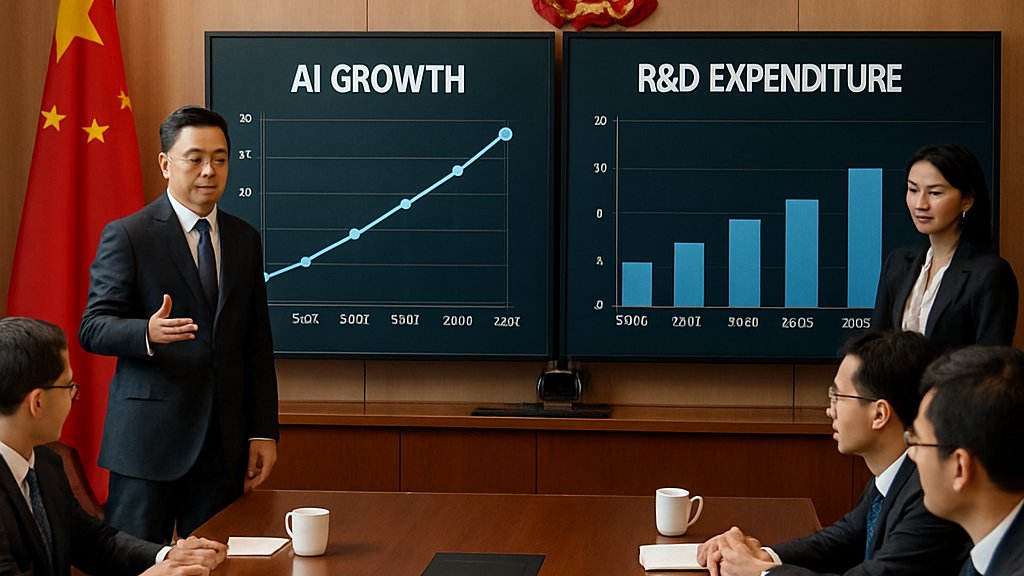
Beijing embedded the 7% target in the 2026 Government Work Report delivered on 5 March. Furthermore, the pledge spans the entire Five-year plan horizon covering 2026 through 2030. Officials described the figure as a floor, not a ceiling, for annual societal R&D growth. Therefore, compound growth could lift total spending far above today’s 3.9 trillion yuan baseline. Nature calculated that each percentage point now equals billions of additional yuan every year. Consequently, the China AI Strategy gains a substantial financial backbone.
Nevertheless, the government avoided separate numeric targets for basic research intensity. Instead, ministers promised “original innovation” without quantifying specific outcomes. This section shows the ambition behind the headline number. However, funding architecture determines whether ambition converts into impact.
Funding Mix And Scale
Enterprises financed 77.7% of China’s R&D in 2024, according to National Bureau of Statistics data. Moreover, central fiscal allocations for science and technology may reach 1.3 trillion yuan during 2026 alone. The Ministry of Finance will layer tax credits, direct grants, and project funds onto corporate budgets. Additionally, local governments must co-finance national laboratories and demonstration zones.
Key financial levers include:
- Super deduction tax credits for eligible R&D expenses.
- Matching grants for chips, AI, and fusion megaprojects.
- Sovereign funds injecting equity into deep-tech startups.
- Preferential loans from state banks for scale-up factories.
The China AI Strategy will rely on this blended finance model to sustain compound growth. Consequently, public and private money combine to elevate absolute outlays faster than the headline 7%. Experts argue that such leveraging aligns with the broader Five-year plan emphasis on market orientation. Multi-channel financing diversifies risk and magnifies capacity. In contrast, over-targeting sectors may distort allocation efficiency; the next section examines priorities.
Key Sectors In Focus
Government communiqués spotlighted semiconductors, embodied AI, biomanufacturing, batteries, and brain-computer interfaces. Moreover, three international science hubs will anchor collaborative research in these domains. Officials branded the hubs as flagship vehicles for closing the technology gap. Consequently, each hub will house national labs with enterprise participation. Experts note that semiconductor self-reliance sits at the heart of the China AI Strategy. Meanwhile, AI model training requires advanced chips, aligning hardware and algorithm priorities.
Biomanufacturing and fusion also feature due to supply-chain resiliency concerns. Additionally, the plan assigns funding for quantum and low-altitude economy pilots. Sector selection targets key choke points in global value chains. Nevertheless, quantity alone cannot guarantee world-class innovation, a tension explored next.
Quality Versus Quantity Debate
IMF economists argue that input growth has not matched productivity outcomes so far. Moreover, patent citation quality still lags leading innovative economies. Therefore, the Five-year plan urges better evaluation and peer review of major projects. Additionally, ministries plan to raise the basic-research share above 8% of total R&D. Critics warn that without governance reforms, the China AI Strategy may overproduce low-value patents. Experts believe higher basic research could bridge the technology gap over time.
Nevertheless, crowding out private exploratory work remains a risk. ITIF notes that wage-adjusted corporate spending already rivals United States peers. Consequently, managerial capacity and incentive structures may become decisive factors. Balancing scale with quality defines sustainable leadership. Meanwhile, regional and corporate actors translate national goals into lab realities, examined next.
Corporate And Regional Roles
Huawei, CATL, and SMIC together invested tens of billions in R&D during 2025. Moreover, provincial governments offer matching funds to anchor projects within local clusters. Consequently, regional competition accelerates deployment of testing fields and pilot fabrication lines. Universities partner with enterprises via new national laboratories and open collaboration platforms. Such structures align with the China AI Strategy push for enterprise-university-institute ecosystems.
Additionally, firms can broaden internal talent pipelines through formal upskilling programs. Professionals may deepen expertise via the AI for Everyone™ certification. Regional alignment channels capital and skills toward target sectors. However, uneven fiscal strength could widen gaps between coastal and inland provinces, a risk reviewed globally next.
Global Response And Risks
International partners monitor the pledge for supply-chain signals. Meanwhile, some governments tighten export controls on advanced lithography and AI chips. In contrast, others pursue joint research with Chinese institutes to share costs. Export controls specifically target nodes vital for the China AI Strategy, including extreme ultraviolet lithography. Consequently, policy fragmentation could slow global innovation while raising compliance burdens. IMF warns that heavy subsidies may trigger retaliatory measures, widening the technology gap further.
Moreover, macro headwinds such as property downturns could constrain corporate cash for R&D. External reactions thus shape project viability and timelines. Therefore, investors should track diplomatic signals alongside domestic metrics, as outlined in the following indicators.
Metrics To Watch Closely
Several indicators help executives assess progress beyond headline spending. Firstly, monitor annual NBS R&D intensity updates every February. Secondly, review patent citations and journal impact factors for quality signals. Thirdly, follow award lists for national key laboratories and megaproject milestones. The China AI Strategy also targets an 8% basic research share within total spending.
Critical datapoints include:
- Basic research share relative to total R&D.
- Enterprise contribution percentage within yearly spending.
- Commercial revenue from newly launched deep-tech products.
- International co-authorship rates in peer-reviewed journals.
Moreover, compare China AI Strategy outcomes against peer regions to spot divergence early. Such vigilance allows boards to adjust capital allocations rapidly. Consistent metrics translate policy rhetoric into actionable intelligence. Consequently, stakeholders can position for opportunities as the Five-year plan unfolds.
China’s 7% R&D pledge marks the largest incremental science budget worldwide. Moreover, the commitment integrates funding levers, sector priorities, and corporate partnerships. Consequently, the China AI Strategy gains durable momentum backed by both state and market resources. Nevertheless, success hinges on closing the technology gap through higher quality outputs, not numbers alone.
Balanced evaluation frameworks and transparent data will be vital. Meanwhile, global reactions could accelerate or constrain specific projects. Executives should monitor the metrics highlighted above and cultivate versatile talent. Therefore, pursue continuous learning, such as the AI for Everyone™ certification, to stay competitive. Act now to convert policy signals into strategic advantage over the coming decade.
Disclaimer: Some content may be AI-generated or assisted and is provided ‘as is’ for informational purposes only, without warranties of accuracy or completeness, and does not imply endorsement or affiliation.


