

AI CERTS
1 hour ago
AI Storage Infrastructure Evolves With Gen5 Flash
Consequently, architects and procurement teams will grasp why density, standards, and ecosystem play equal roles. Meanwhile, we will spotlight the 122TB DapuStor R6060 drive, its roadmap, and the collaborations bringing system-level value. Expect actionable guidance backed by independent benchmarks and analyst commentary. Ultimately, you will see how next-generation enterprise storage stacks can align with AI business priorities. In contrast, traditional SATA arrays now struggle to feed GPUs without bottlenecks. Therefore, choosing components that anticipate tomorrow's workloads has never been more critical.
Market Forces Accelerate Adoption
Grand View Research estimates data-center flash revenue hit thirty billion dollars during 2025. Moreover, analysts forecast mid-twenties percent compound growth through 2030 as AI models swell. Consequently, capacity tiers push closer to accelerators to minimize idle GPU minutes. AI Storage Infrastructure becomes strategic, not optional, for cloud builders and on-prem innovators. In contrast, tape libraries cannot answer random reads within acceptable service-level targets. Therefore, hyperscalers eye ultradense NVMe SSD solutions that deliver flash latency at near-disk dollars-per-terabyte.
Computex announcements reinforced that trend, featuring multiple 200-plus-terabyte E3.L devices from at least five vendors. Nevertheless, density alone fails when firmware and host software ignore write amplification. Thus, buyers now evaluate standards adoption, partner ecosystem maturity, and real endurance telemetry. These dynamics set the scene for our closer look at the vendor’s newest offerings.
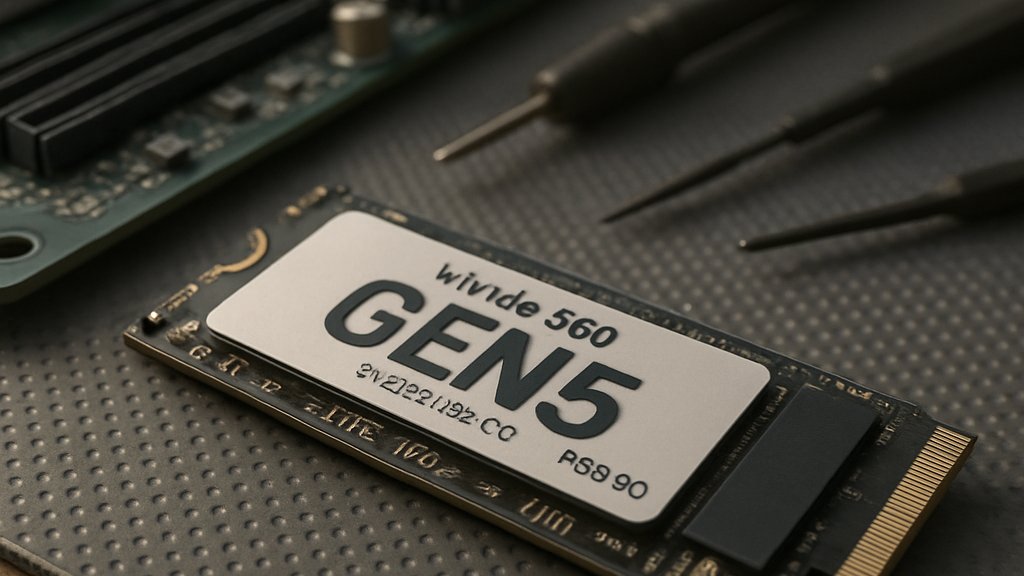
Rising AI demand mandates flash density, low latency, and intelligent data placement. However, product execution matters, leading us to DapuStor Gen5 Capacity Leap.
DapuStor Gen5 Capacity Leap
DapuStor entered the Gen5 arena with the R6060 family during late 2025. Furthermore, the vendor shipped 15 TB to 122 TB U.2 units and previewed a 245 TB E3.L SKU. Sequential reads peak near 14 GBps, while random workloads cross two million IOPS on midrange capacities. The R6060 is an NVMe SSD built on a proprietary controller and Micron QLC NAND. Therefore, the model strengthens AI Storage Infrastructure by collapsing rack sprawl into fewer slots. Consequently, the drive targets read-heavy AI data lakes and key-value caches that flood inference farms.
Key R6060 Performance Metrics
- Up to 14 GB/s sequential read, 4 GB/s sequential write
- Capacities: 15.36 TB, 30.72 TB, 61.44 TB, 122.88 TB, roadmap 245 TB
- Endurance: 0.6 DWPD, MTBF 2.5 million hours, five-year warranty
StorageReview’s May 2026 hands-on noted stable latency under mixed 70-30 read-write loads. Moreover, reviewers praised firmware-level wear mitigation that kept QLC viable for enterprise storage scenarios. In contrast, earlier QLC generations struggled beyond small-file benchmarks. Computex demonstrations placed eight R6060 E3.L drives behind an ATTO PCIe switch, saturating 200 GBps of rack bandwidth. These numbers prove the capacity leap pairs with real throughput, not marketing gloss. DapuStor now delivers density and speed that align with AI pipeline expectations. Next, we examine the NVMe Core Tech Foundations enabling that progress.
NVMe Core Tech Foundations
NVMe 2.0 expands beyond basic queues, introducing directives like FDP that hand placement logic to hosts. Consequently, write amplification drops because systems signal object temperature before persisting data. Flexible placement particularly benefits QLC, whose four-bit cells tire quickly under random writes. Furthermore, PCIe Gen5 doubles lane bandwidth, allowing fewer controllers to feed AI accelerators at scale. The result is an NVMe SSD pool that rivals HBM scratchpads for key-value cache retrieval. In contrast, Gen4 devices would require twice the slot count to match throughput.
Meanwhile, fabric protocols such as NVMe-oF break locality barriers by exposing remote drives with microsecond overhead. ATTO’s switch demo proved 96 pooled R6060s could share disaggregated bandwidth across heterogeneous compute islands. Therefore, AI Storage Infrastructure becomes a scalable fabric layer, not an island behind each host. These technical pillars underpin upcoming ecosystem collaborations. Standards reduce integration friction and elevate flash utilization. Accordingly, ecosystem partnerships rapidly expand around these foundations.
Ecosystem Partnerships Rapidly Expand
The vendor amplified reach by aligning with DDN, Western Digital, Advantech, and Inventec throughout 2025-2026. Moreover, ATTO leveraged its PCIe switch to pool drives across multiple inference clusters. Consequently, integrators achieved 200 GBps rack throughput without overhauling server motherboards. Western Digital provided complementary HDD tiers, creating a flash-to-disk hierarchy under one management plane. Additionally, DDN’s Infinia software exposed NVMe-over-Fabric namespaces as S3 objects for data scientists. These collaborations echo previous microprocessor ecosystems where reference designs accelerated market maturity.
Partners also displayed live kv-cache offload, reducing GPU memory consumption by fifty percent. Therefore, AI Storage Infrastructure solutions now ship as complete racks, not loose components. Partnership momentum underscores that specification compliance must pair with system integration. Ecosystem breadth shortens deployment cycles and derisks procurement decisions. Nevertheless, engineers must reconcile density tradeoffs before mass rollout.
Balancing Flash Density Tradeoffs
Quad-level cell flash packs four bits per transistor, cutting cost yet sacrificing native endurance. However, firmware tricks alone cannot save drives from sustained write storms. StorageReview measured roughly 0.6 DWPD on the 122 TB sample, acceptable for read-heavy analytics. In contrast, transactional logging workloads might exhaust that budget inside three years. Therefore, architects assign QLC devices to cold feature stores, vector databases, and model snapshots. The vendor mitigates risk using FDP, larger SLC caches, and background health telemetry.
Furthermore, enterprise storage teams can throttle burst ingestion through controller QoS settings. A concise checklist helps evaluators balance benefits and limits. Density slashes cost while AI Storage Infrastructure demands workload awareness. Subsequently, we turn to deployment best practice guidance.
Deployment Best Practice Guide
Successful rollouts start with a phased qualification in a non-production inference cluster. First, validate BIOS support for E3.L form factors and Gen5 signal integrity. Moreover, confirm firmware exposes FDP and that orchestration platforms understand placement directives. Next, model data temperature to separate write-intensive features from read-heavy artifacts. Consequently, NVMe SSD arrays avoid excessive garbage collection and latency spikes. Many teams adopt a tiered namespace approach, pinning hot shards on TLC before migrating to QLC. Additionally, enterprise storage monitoring must track cumulative writes against warranty thresholds. Below is an abbreviated deployment checklist synthesizing reviewer and partner advice.
- Check server backplane voltage and airflow for 25 W E3.L drives
- Enable NVMe-oF discovery automation for rapid node replacement
- Audit data retention policies to exploit low $/TB flash
Therefore, teams minimize surprises during scaling sprints. Rigorous planning converts headline specs into sustainable production value. Finally, we consolidate insights and recommend next steps.
AI disruptions demand resilient, scalable, and efficient AI Storage Infrastructure across every data center tier. Our review showed how Gen5 hardware, open standards, and partner fabrics craft an AI Storage Infrastructure. Moreover, careful workload placement and NVMe-oF pooling sustain the AI Storage Infrastructure through future node refreshes. Enterprise storage leaders that follow the checklist can transform GPU utilization and total cost curves.
Computex buzz proved the race is on, but disciplined engineering will determine victors. Professionals can enhance expertise through the AI Network Security™ certification and sharpen competitive advantage. Act now to benchmark your workloads and start building the next-generation AI Storage Infrastructure today.
Disclaimer: Some content may be AI-generated or assisted and is provided ‘as is’ for informational purposes only, without warranties of accuracy or completeness, and does not imply endorsement or affiliation.


