

AI CERTS
4 months ago
Industrial Hardware Sees 10M-Cycle Vision Cable Breakthrough
The latest entrants come from OKI, 3M, Northwire, and Zhaolong. Each claims camera cables that survive relentless bending, sliding, and torsion. The development positions Industrial Hardware for higher uptime and lower maintenance. Meanwhile, analysts expect the global Machine Vision market to surpass USD 20 billion by 2025. High Flex connectivity therefore becomes a strategic differentiator.
Industrial Hardware Demand Surge
Global factories are adding more cameras per line every quarter. Furthermore, market researchers at Grand View Research peg 2024 Machine Vision revenue near USD 22 billion. In contrast, legacy wiring fails within months on six-axis robots, forcing costly shutdowns. Consequently, buyers now specify Cables tested for ten million cycles or better. Vendors answer with coax, USB3, and Ethernet assemblies engineered for Durability and EMI immunity.
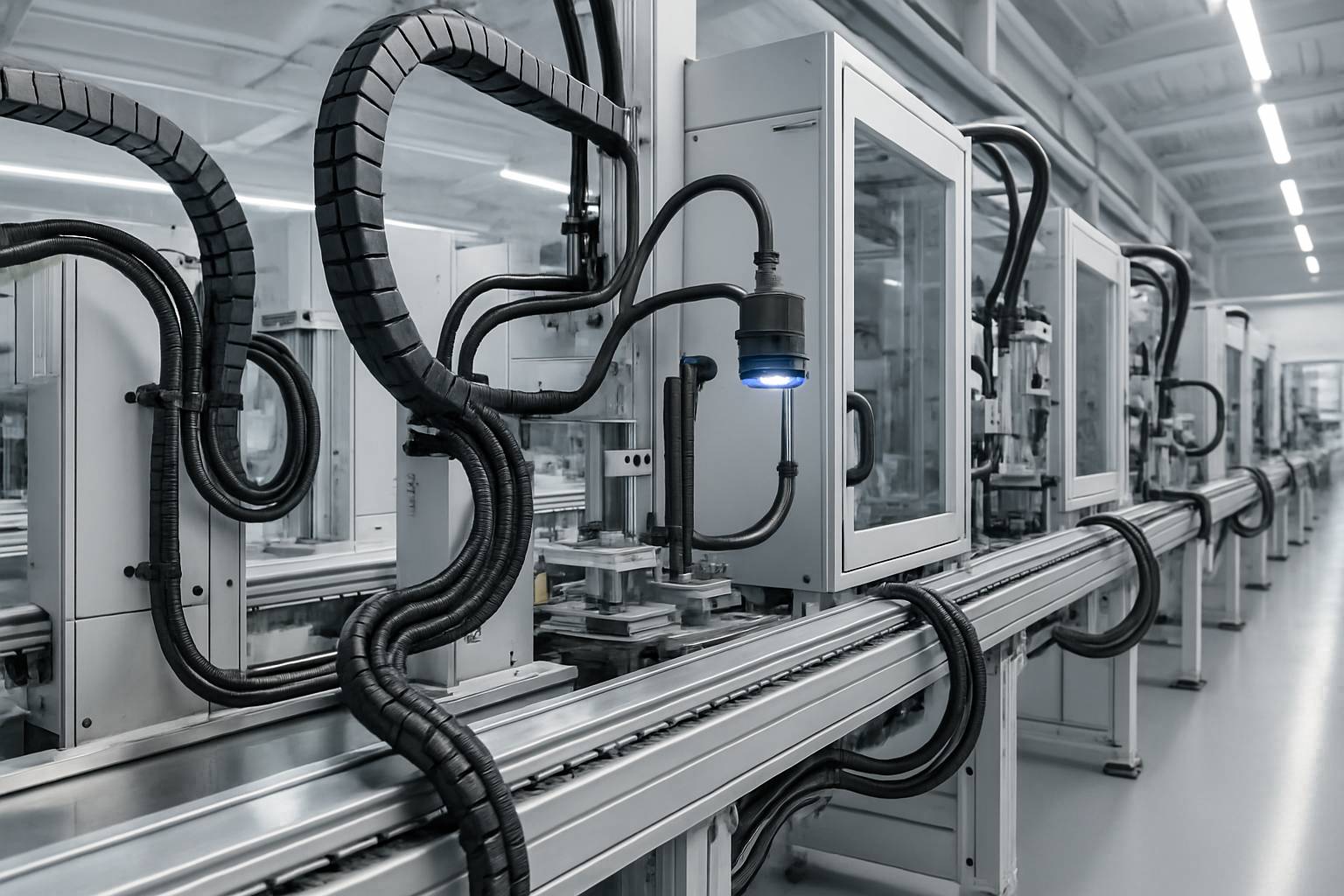
These figures show surging demand for motion-rated connectors. However, the race also reflects broader Industrial Hardware modernization. Consequently, vendors who deliver reliable, High Flex interconnects will capture new Robotics projects.
The trend is clear: uptime now drives cable selection. Therefore, we next examine how suppliers push flex life boundaries.
Flex Life Race Intensifies
OKI launched its High-Durability CoaXPress 2.0 cable family in March 2024. Moreover, the release states ten million sliding cycles at a 50 mm radius. Such advances reshape Industrial Hardware specifications for moving cameras. Bending and twisting figures reach 300 000 cycles under stricter geometries. Meanwhile, 3M promotes USB3 assemblies certified for 100 million cycles on its premium grade.
Northwire, Zhaolong, and several niche firms echo similar milestones, though test rigs differ. Consequently, spec sheets now include drag-chain, tick-tock, and torsion numbers. Buyers must read the small print because one vendor’s cycle may equal another’s failure.
Competitive pressure keeps flex counts climbing yearly. Nevertheless, understanding test diversity is essential before trusting any headline figure. The next section unpacks those protocols.
Testing Methods Still Diverge
Laboratories simulate motion through three dominant setups for Industrial Hardware cabling. Firstly, drag-chain benches slide Cables along carriers to mirror gantry travel. Secondly, tick-tock machines bend samples over fixed radii. Thirdly, torsion rigs twist conductors ±180 degrees around their axis.
Additionally, temperature, tension, and lubricants alter results dramatically. For example, Northwire’s 12 million tick-tock score compares favourably with 3M’s drag-chain data, yet conditions differ. Therefore, engineers should request full reports or independent laboratory confirmation.
Standardization remains elusive, leaving room for marketing spin. Consequently, interface choice also matters, which CoaXPress 2.0 illustrates well.
CoaXPress Drives Bandwidth
CoaXPress 2.0 pushes 12.5 Gbps per coax lane using Micro-BNC connectors. Furthermore, aggregated four-lane links reach 50 Gbps, supporting 8K cameras. High Flex coax must maintain 75 Ω impedance while enduring constant motion.
Mike Cyros of Euresys notes that reliable cabling unlocks the interface’s potential on fast Robots. Therefore, OKI targets camera-on-robot applications where backflips, arcs, and plunges stress every millimetre of dielectric in Industrial Hardware environments.
The standard exemplifies how speed amplifies mechanical risk. Consequently, benefits and tradeoffs deserve balanced discussion.
Benefits And Key Tradeoffs
Extended-life assemblies promise fewer line stops, trimmed spare inventory, and safer cable routing. Moreover, upgraded jackets offer oil, chemical, and weld-spatter resistance critical to Robotics environments. The shift already influences Industrial Hardware budgets for 2025.
Key advantages highlighted by vendors include:
- Durability verified to 10 million cycles during drag-chain testing.
- Support for Machine Vision interfaces beyond 10 Gbps.
- Ingress protection ratings reaching IP67 and higher.
- Lower total cost through reduced changeovers.
Nevertheless, drawbacks persist. Premium units cost several times commodity harnesses. In contrast, added stiffness can complicate routing through tight joints. Connectors also remain failure hotspots, even when cable conductors survive.
Professionals can enhance their expertise with the AI + Robotics™ certification. The credential deepens knowledge of materials, signal integrity, and predictive maintenance. Therefore, engineers can justify investments to skeptical finance teams.
Balancing these pros and cons requires structured evaluation. Subsequently, a concise procurement checklist proves valuable.
Procurement Checklist For Engineers
Start by defining motion profile, bend radius, and duty cycle for each route. Moreover, compare vendor test parameters with those real numbers.
Essential questions include:
- What lab method generated the cycle claim?
- Does impedance stay within tolerance over life?
- Are connectors rated equal to cable life?
- Is replacement time factored into ROI?
Additionally, verify warranties, supply-chain stability, and certification availability. The growing Industrial Hardware ecosystem offers multiple qualified suppliers, yet global shortages can still delay projects.
A disciplined checklist prevents costly surprises. Hence, final recommendations follow.
Conclusion And Next Steps
Ten-million-cycle claims mark a pivotal moment for Machine Vision infrastructure. Furthermore, engineers now deploy cameras on agile Robotics cells with fewer service calls. However, numbers vary with test geometry, so independent validation remains vital. High Flex Cables with proven Durability still justify premiums when downtime carries six-figure penalties. Therefore, teams should scrutinize data, run pilot tests, and align designs with real motion profiles. Finally, enhance personal expertise through respected certifications and stay ready for the next bandwidth leap. Consequently, early adopters gain measurable uptime advantages and stronger cost justification.


