

AI CERTS
3 hours ago
OpenAI’s AI Smart Speaker Targets Companion Market
Consequently, rivals from Amazon to Apple are recalibrating forecasts. Meanwhile, investors weigh legal challenges now emerging from Apple's trade-secrets suit. This article unpacks the market data, technical architecture, supply risks, and strategic implications. Readers will gain actionable insights before OpenAI formally unveils the product. Therefore, early understanding supports better roadmap alignment for partners and competitors. In contrast, waiting risks missed design cycles.
Global Market Context Today
Grand View Research pegs smart-speaker revenue at $15.8 billion for 2025. Moreover, the firm expects $48.6 billion by 2033, representing 15.1% compound growth. Bloomberg Intelligence projects conversational and computer-vision hardware hitting $60 billion by 2032. Consequently, investors treat voice hardware as a renewed battleground. Existing ecosystems remain entrenched, yet differentiation grows harder. Analysts predict that a truly screenless speaker commanding context could lift profit pools.
- 2026 global revenue forecast: $18.1 billion
- 2033 global revenue forecast: $48.6 billion
- Projected CAGR 2026-2033: 15.1%
- Bloomberg computer-vision hardware: $60 billion by 2032
- Reported OpenAI speaker price: $200-$300
In contrast, average retail pricing still squeezes margins for mainstream speakers. Therefore, companies chase premium differentiation through privacy, design, and integrated services. OpenAI bets that language prowess and mobility can unlock new willingness to pay. Nevertheless, success requires trust alongside novelty. The numbers reveal a growing yet unforgiving market. Subsequently, device design choices become strategic levers.
Key Device Design Details
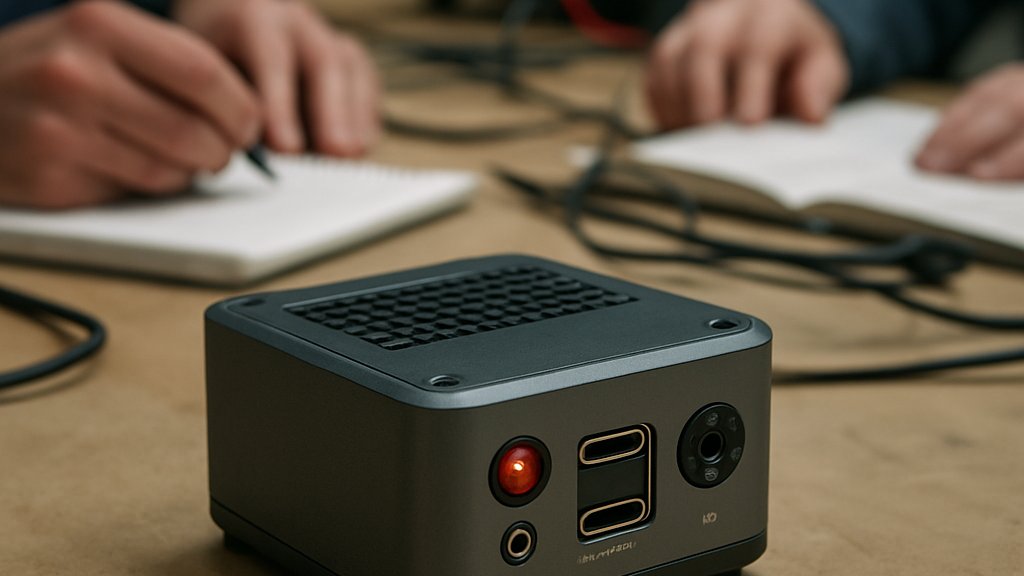
Leaked CAD renders show a palm-sized cylinder mounted on a magnetic base. However, the top hemisphere can tilt, allowing the camera to track a speaker. Micro-radar and ambient light sensors improve scene understanding without a traditional display. Therefore, users engage through voice, gesture, and subtle movement cues. OpenAI engineers describe the product internally as a lovable companion device for the kitchen, desk, and bedside. Moreover, the firm positions the unit as a fully screenless speaker that can relocate between rooms on battery power. Jony Ive’s industrial team emphasizes sustainable materials and soft textures that reduce perceived surveillance.
Consequently, OpenAI device ergonomics differ sharply from puck-shaped smart hubs. Meanwhile, voice coils support stereo playback loud enough for midsize rooms. Early prototypes reportedly weigh under 500 grams, easing portability. Such mobility underlines the AI Smart Speaker promise of following conversations naturally. These design decisions showcase differentiated interaction. In contrast, rivals still rely on static bedside placement. Hardware aesthetics and movement may convert curiosity into repeat engagement. Subsequently, silicon choices become the next differentiator.
Custom Silicon Performance Edge
OpenAI and Broadcom unveiled Jalapeño, a custom inference accelerator tuned for large language models. Richard Ho claims early silicon already outruns general GPUs on power per token. Furthermore, latency drops enable smoother back-and-forth dialogue, critical for a reactive AI Smart Speaker. The chip ties into a broader hardware strategy that spans datacenters and on-device intelligence. Greg Brockman states the world is becoming compute-powered; consequently, vertical control lowers cost per query. Cloud inference still handles heavy fine-tuning, yet edge silicon manages frequent interactive tasks.
Additionally, on-device processing could reassure privacy-sensitive buyers. However, placing Jalapeño inside every OpenAI device raises bill of materials pressure. Management weighs split inference paths that combine local embeddings with cloud reasoning. Nevertheless, early tests reportedly achieve 50-millisecond round-trip answers under lab Wi-Fi. These performance gains could justify the $200 price floor. Subsequently, legal hurdles enter the spotlight. Custom silicon provides ambition and risk in equal measure. Therefore, litigation outcomes deserve close scrutiny.
Mounting Legal Clouds Ahead
Apple filed a federal complaint on July 10, alleging trade-secret theft linked to former employees. In contrast, OpenAI denies wrongdoing and vows vigorous defense. The suit seeks injunctions that could block supplier collaboration for any OpenAI device. Furthermore, Apple aims to freeze key talent recruitment within emergent hardware teams. Legal experts expect months of discovery, yet preliminary orders could land sooner. Consequently, component contracts might stall, extending the program schedule.
Nevertheless, OpenAI's RFP outlines alternate suppliers to mitigate single-party exposure. Meanwhile, Foxconn and Celestica remain silent on contingency production. Any temporary restraining order could push the AI Smart Speaker launch beyond 2027. These uncertainties intensify financing costs. Subsequently, manufacturing plans demand extra buffers. The courtroom will shape timelines as much as engineering. Therefore, operations teams are revising worst-case scenarios.
Critical Manufacturing Roadmap Risks
OpenAI issued an RFP in January seeking U.S. assembly for consumer devices, robotics, and datacenters. Broad proposals closed in June, with vendor selection set for March 2027. However, domestic fabrication remains costlier than Asian alternatives. Consequently, management weighs a hybrid model using Foxconn’s Vietnam lines for initial ramp. Additionally, U.S. final assembly could satisfy political stakeholders and shorten shipping cycles. The hardware strategy also demands tight integration between Jalapeño packaging and acoustic enclosures. Screenless speaker ergonomics complicate waterproofing during automated lines.
Moreover, lithium-ion supply remains volatile amid electric-vehicle demand. Any slip risks missing holiday shelves and ceding mindshare. Nevertheless, OpenAI device prototypes are already with two contract EMS partners for design for manufacturability. These supply complexities heighten capital requirements. Subsequently, competitive positioning deserves assessment. Material sourcing and line readiness dictate launch realism. Therefore, market dynamics must be weighed against capacity locks.
Shifting Competitive Market Outlook
Amazon, Google, Apple, Sonos, and Samsung all maintain distinct voice ecosystems. Yet, none pair conversational power with mobility and multimodal context like the proposed AI Smart Speaker. Moreover, incumbent assistants lack current-generation reasoning equal to GPT-5 class models. Consequently, differentiation may hinge on proactive suggestions rather than reactive queries. Market observers view the OpenAI device as a wedge that could capture premium households first. In contrast, Amazon focuses on bundling Prime content and cheaper Echo variants. Google counters with deeper smart-home integrations.
Additionally, Apple leverages HomePod spatial audio and tight privacy marketing. Still, Apple’s legal gambit indicates genuine concern. For startups, the push confirms renewed investor enthusiasm for consumer AI experiences. Nevertheless, distribution remains expensive without ecosystem subsidies. These competitive signals underscore the importance of bold roadmaps. Subsequently, strategic next steps merit discussion.
Next Steps For Leaders
Product managers and solution architects should begin prototype integration planning now. However, secure supply and alternative silicon partners remain prudent hedges. Teams targeting consumer AI experiences must deepen multimodal design expertise. Moreover, privacy frameworks should precede sensor deployment decisions. Professionals can enhance their expertise with the AI Product Manager™ certification. The credential covers roadmap building, hardware strategy alignment, and cross-functional governance. In contrast, designing a trustworthy companion device requires rigorous data-handling policies.
Consequently, graduates can speak confidently with silicon partners, contract manufacturers, and security auditors. Meanwhile, senior leaders should monitor legal filings weekly to adjust capital allocations. The AI Smart Speaker timeline could slip, yet ecosystem stakes justify early experimentation. Nevertheless, delaying engagement risks product gaps once the category matures. Leaders who invest now secure first-mover insight. Therefore, action today positions teams for tomorrow’s launches.
OpenAI’s forthcoming AI Smart Speaker crystallizes a broader pivot toward experiential hardware. Moreover, the screenless speaker format alongside camera mobility promises richer context. Consequently, this companion device could elevate expectations for proactive household assistance. However, litigation, supply volatility, and on-device costs still shadow timelines. Investors will watch Apple’s case carefully while benchmarking Jalapeño yields.
Meanwhile, rivals iterate existing speakers, hoping to blunt the AI Smart Speaker impact. For enterprise builders, early experiments in consumer AI interfaces remain vital. Professionals should refine hardware strategy assumptions and secure second-source suppliers now. Ultimately, those who act decisively can shape the next interface decade.
Disclaimer: Some content may be AI-generated or assisted and is provided ‘as is’ for informational purposes only, without warranties of accuracy or completeness, and does not imply endorsement or affiliation.


