

AI CERTS
2 hours ago
GenVid2Robot: Generative Robot Actions Reach Real Manipulators
This article dissects the paper, compares rivals, and outlines practical steps for engineers. Readers will spot benefits, limitations, and certification paths for sharpening skills. Throughout, we reference Generative Robot Actions as the emerging paradigm bridging visuals and machines. In contrast, earlier systems relied on curated human videos and manual clipping. GenVid2Robot instead embraces open-ended video generation to widen task imagination. Therefore, verification becomes critical, because raw frames often hide impossible bends or teleporting objects.
Market Context Now Emerges
Global investment in embodied AI rocketed during the last year. Furthermore, advances in video generation now supply richer synthetic demonstrations than static datasets. NovaFlow and Gen2Act exemplify the trend, yet both struggle with geometric consistency in practice.
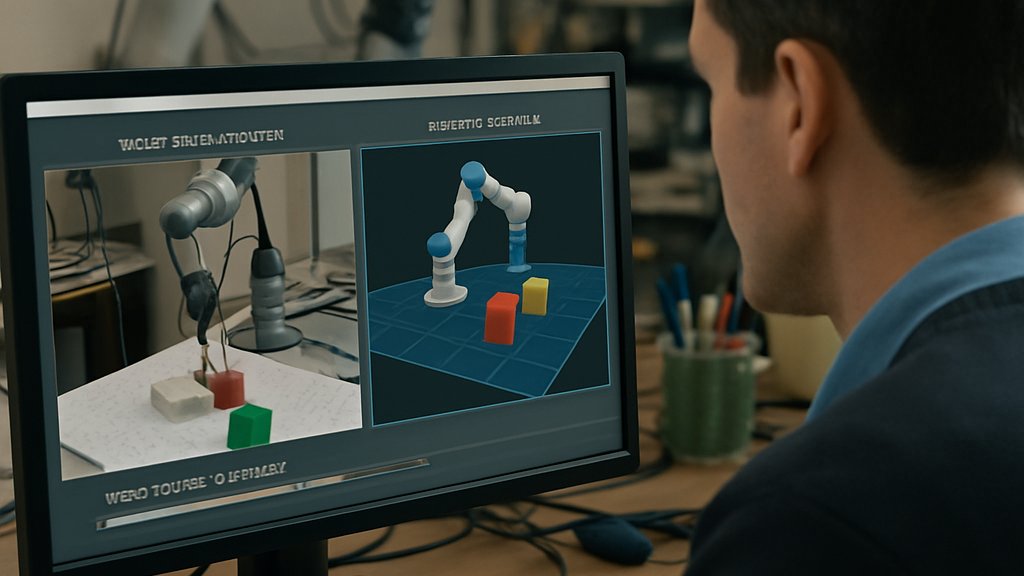
In contrast, GenVid2Robot positions the rigid filter as a decisive differentiator. Consequently, advocates claim safer action transfer from pixels to grippers. Analysts expect Generative Robot Actions to reduce dataset collection costs across logistics, retail, and research.
Moreover, regulatory bodies stress accountability for autonomous robot manipulation at scale. Rigid tests create auditable evidence chains, aligning with upcoming ISO revisions. Therefore, early adopters may gain compliance advantages.
GenVid2Robot surfaces within a busy, investment-rich embodied AI landscape. However, technical design choices define its real competitiveness, which the next section unpacks.
Pipeline Design Fully Explained
The pipeline starts with text prompts feeding a cloud video generation model. Subsequently, a vision-language model grounds task anchors within each frame. CoTracker then provides dense flow, while PnP with RANSAC checks for sparse SE(3) agreement.
If the rigid test passes, the motion hypothesis proceeds to grasp selection. Mask-constrained anygrasp produces candidate grasps and computes a tool center point. Moreover, grasp-conditioned motion induction yields a provisional trajectory.
Inverse kinematics filtering ensures each waypoint respects joint limits and avoids self-collision. Consequently, the system exports a ROS plan for execution on the RM75 arm. These steps operationalize Generative Robot Actions without manual teleoperation.
- Cloud video generation: 185.5 seconds
- VLM grounding: 224.8 seconds
- CoTracker flow: 7.41 seconds
- PnP/RANSAC: 0.204 seconds
- AnyGrasp planning: 2.1 seconds
- IK checks: 0.5 seconds
Clearly, runtime is dominated by the first two cloud stages. Therefore, localizing generation models remains a pressing optimization avenue before full production rollout.
This design highlights where geometry, perception, and control intersect. Next, we examine how the rigid test boosts reliability.
Rigid Test Key Benefits
SE(3) consistency rejects videos exhibiting impossible deformations or perspective drift. Moreover, it shields the manipulator from hallucinated penetrations that plague naive action transfer. GenVid2Robot authors note an 86.3% overall success across 80 real trials.
Per-task gains over an unfiltered baseline appear striking. Pouring improved from 75% to 90%, while sweeping rose from 60% to 80%. Consequently, geometric consistency emerges as a measurable lever, not academic ornament.
Furthermore, the filter imposes negligible latency at 0.204 seconds per candidate. Therefore, designers can keep safety without sacrificing throughput once generation delays shrink.
Rigid testing materially enhances success rates and preserves speed. However, experiments reveal remaining challenges addressed in the following performance review.
Experimental Results In Focus
The team evaluated four household tasks on the RM75 manipulator. Additionally, each task received 20 trials to ensure statistical weight. Generative Robot Actions achieved 90% success for pouring and lifting, 85% for tool delivery, and 80% for sweeping.
Workspace limit violations caused 70% of the observed failures. In contrast, grasp slippage and depth noise accounted for the remainder. Moreover, geometric consistency could not detect reachability issues, underscoring complementary needs.
The authors recommend workspace-aware trajectory optimization and tactile feedback for next iterations. Consequently, integrating force sensors may close the loop during robot manipulation.
- Pros: No robot demonstrations required, clearer auditing, transferable across tasks.
- Cons: High cloud latency, partial safety guarantees, dependency on RGB-D quality.
Performance metrics validate the concept yet expose environment-dependent pitfalls. Subsequently, we compare GenVid2Robot with related projects to contextualize these numbers.
Comparative Related Works Landscape
NovaFlow leverages dense actionable flow extracted from video generation outputs. Gen2Act trains end-to-end policies from synthetic clips for embodied AI tasks. Nevertheless, both methods lack explicit geometric consistency checks.
Vid2Robot instead relies on human demonstration videos, limiting creative task coverage. Consequently, Generative Robot Actions offer broader motion diversity with similar hardware prerequisites.
GenVid2Robot fills a gap between policy learning and uncontrolled imagination. However, adoption also depends on enterprise considerations, explored next.
Practical Adoption Pathways Ahead
Enterprise robotics teams worry about deployment latency and cloud costs. Moreover, privacy concerns arise when sending factory images to remote video generation servers. Edge-based diffusion models promise relief within two years.
Meanwhile, skill shortages hamper smooth pilots. Professionals can enhance their expertise with the AI Video Architect™ certification. Such programs cover action transfer principles and responsible robot manipulation workflows.
Furthermore, continuing education aligns staff with fresh embodied AI best practices. Consequently, organizations shorten their learning curves and mitigate safety risks.
Adoption requires technical speedups and skilled personnel. Therefore, we close with a forward-looking outlook.
Limitations And Future Outlook
Current latency blocks real-time adaptation, limiting interactive teaching situations. Additionally, geometric consistency cannot detect distant obstacles or future self-collisions.
Researchers plan to incorporate online regrasping, tactile feedback, and depth error compensation. Moreover, combining Generative Robot Actions with reinforcement learning could refine trajectories during execution. In contrast, policy learning alone still demands expensive simulators.
Subsequently, open sourcing code and datasets will spur replication and benchmarking. Community scrutiny should accelerate convergence toward dependable embodied AI manipulation systems.
Future work targets speed, reachability, and open evaluation. Consequently, continuous collaboration will decide how quickly factories trust autonomous arms.
GenVid2Robot presents a compelling bridge between generative imagination and physical execution. The study proves that Generative Robot Actions can outperform unfettered baselines by embedding geometric checks. Moreover, enterprises eye reduced programming overhead and quicker task onboarding. However, cloud latency and workspace reachability still restrict Generative Robot Actions in demanding cycles.
Consequently, investing in local diffusion models, tactile sensing, and staff upskilling becomes vital. Professionals should monitor releases, replicate findings, and deploy pilot cells embracing Generative Robot Actions with caution. Take action today by reviewing certifications and collaborating with peers shaping tomorrow’s adaptive factories.
Disclaimer: Some content may be AI-generated or assisted and is provided ‘as is’ for informational purposes only, without warranties of accuracy or completeness, and does not imply endorsement or affiliation.


