

AI CERTS
2 hours ago
Robot Rearrangement Learning Transforms Home Coordination
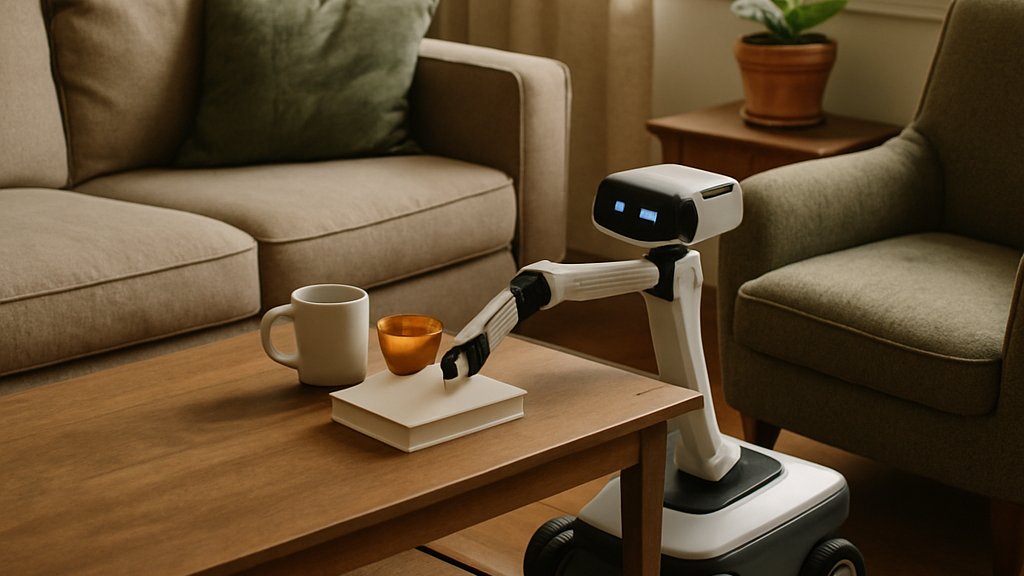
Consequently, robots can infer what to do next by scoring several sampled action chunks in real time.
This article unpacks the method, experimental evidence, advantages, and open questions for technical stakeholders.
Additionally, readers will find guidance on upskilling to exploit the coming wave of household robotics.
Market Need For Flexibility
Traditional mobile manipulation pipelines rely on rigid state machines or fully supervised end-to-end imitation.
Consequently, developers spend months segmenting data and hand-tuning transitions between navigation, pick, and place.
Growing apartment diversity and aging populations intensify pressure for adaptable assistive platforms.
Meanwhile, cloud labor shortages and privacy concerns limit remote teleoperation as a fallback.
Stakeholders therefore demand learning strategies that generalize across unseen room layouts and object sets.
Robot Rearrangement Learning directly targets this gap by letting robots rearrange without curated skill boundaries.
In contrast, earlier skill-library solutions falter when unmodeled disturbances break the predefined sequence.
Markets need versatile, label-free autonomy to unlock reliable service deployment.
With that requirement framed, the next section details how implicit behavior coordination works under the hood.
Implicit Behavior Coordination Explained
The Bonn team frames each short demonstration as a context–action chunk without any skill tag.
Subsequently, a conditional flow-matching transformer learns to denoise Gaussian noise into feasible action sequences.
Because training uses mixed unlabeled demonstrations, the policy naturally expresses multiple latent behavior modes.
However, sampling only one candidate often misses subtle affordances.
Therefore, the authors generate several candidates per step and score them with a learned Q critic.
The critic propagates sparse success rewards backward using an uncertainty-weighted aggregation scheme called in-sample planning.
This pipeline yields implicit coordination without ever enumerating discrete skills or providing an oracle plan.
Consequently, robots decide whether to keep navigating, pick, or place based solely on estimated value.
Flow matching produces diverse proposals, while Robot Rearrangement Learning frameworks choose the highest-value option.
Armed with these mechanics, we can evaluate real performance across simulated and physical arenas.
Flow Matching Policy Details
Each action chunk spans two seconds of end-effector velocity and gripper commands.
Moreover, chunk boundaries overlap, enabling the critic to blend reward information across trajectories.
Training required 6,400 successful samples per behavior mode, collected through expert teleoperation in Habitat.
Nevertheless, the model scales to extra behaviors without retraining earlier modes.
Such scalability aligns with embodied learning goals that favor rich repertoires over brittle pipelines.
Such diversity nurtures effective subtask learning across navigation, manipulation, and door-opening maneuvers.
Collectively, these ingredients form the backbone of Robot Rearrangement Learning in practice.
These design choices ground the empirical gains reported next.
Experimental Insights And Results
Quantitative ablations confirm the importance of both multi-candidate sampling and uncertainty-aware scoring.
When the critic was removed, success on Nav-Open-Pick-Nav-Place dropped to 61.5 percent.
Meanwhile, random candidate selection barely helped, while uncertainty weighting boosted success to 68.5 percent.
Moreover, adding extra unlabeled behaviors did not hurt performance on simpler tasks.
The Nav-Place scenario reached 89.3 percent with the full repertoire, equaling the task-specific agent.
Longer horizons proved tougher for every baseline.
Nevertheless, implicit coordination retained 32 percent success at five targets, dwarfing the 0.5 percent of monolithic imitation.
- Unlabeled dataset size: 6,400 chunks per behavior mode
- Critic upgrade raised success to 68.5% on Nav-Open-Pick-Nav-Place
- Robot Rearrangement Learning kept 32% success across five targets
Such evidence underscores why Robot Rearrangement Learning attracts growing industrial interest.
Consequently, the method scales better along both behavior breadth and temporal depth.
Numbers suggest implicit value-guided stitching offers tangible robustness gains.
Yet metrics alone never reveal full deployment readiness, so benefits and caveats follow next.
Advantages Over Prior Methods
First, the approach removes expensive annotation of skill start and end points.
Additionally, the same flow model can propose recoveries when unexpected obstacles arise.
This property reduces downtime in dynamic household robotics environments.
Second, implicit selection handles partial observability without an external planner.
Therefore, perception errors at one step need not derail the entire chain.
Third, mixing wider repertoires satisfies embodied learning advocates who want evergreen libraries.
- Label-free data collection lowers engineering costs.
- Generative sampling offers intrinsic redundancy against failures.
- Unified policy simplifies deployment across robot fleets.
Together, these gains push Robot Rearrangement Learning toward practical household assistance.
However, unresolved limitations still temper immediate real-world scaling, as discussed next.
Remaining Gaps And Risks
Despite Robot Rearrangement Learning progress, training still expects dense coverage within the subtask learning space.
In sparse regimes, reward propagation through in-sample planning may collapse.
Furthermore, full physical evaluation remains limited to a tabletop UR3e demonstration.
Target position inference also required critic retraining when real objects moved.
Consequently, maintenance overhead persists until more adaptive critics emerge.
Another concern involves safety during generative exploration near humans.
Regulators will likely demand conservative assurance cases before approving embodied learning systems for eldercare.
Nevertheless, transparent value functions could support formal verification in future studies.
Current gaps center on data diversity, real-world transfer, and safety certification.
Addressing these issues will influence research roadmaps and workforce preparation, reviewed in the next section.
Upskilling The Robotics Workforce
Engineers embracing Robot Rearrangement Learning need fluency in generative modeling, uncertainty estimation, and physical evaluation workflows.
Therefore, many professionals are pursuing micro-credentials focused on data-driven manipulation.
Professionals can enhance their expertise with the AI Robotics Specialist™ certification.
Moreover, curricula now include subtask learning principles and best practices for gathering unlabeled demonstrations safely.
Workshops also emphasize household robotics benchmarking with Habitat to accelerate reproducibility.
Consequently, teams gain shared evaluation language before prototyping on hardware.
Mentors recommend tracking ten key metrics, from coverage density to critic calibration error.
In contrast, earlier curricula often ignored open-loop failure analysis.
Broader skill sets will remain vital as these rearrangement frameworks progress toward consumer deployments.
Upskilling now secures future employability and research impact.
Next, the conclusion distills strategic lessons for executives and engineers alike.
Conclusion And Next Steps
Robot Rearrangement Learning shifts focus from hand-coded skill trees to data-driven composition.
Through flow matching and value critics, candidates integrate implicitly, outperforming prior labeled pipelines.
Moreover, scaling experiments show resilience along task length and repertoire breadth.
Nevertheless, real-world validation and safety assurances remain active frontiers.
Stakeholders can prepare by investing in data infrastructure, simulation, and certified talent.
Take decisive action today and secure a competitive edge in next-generation household robotics.
Furthermore, monitoring forthcoming code releases will accelerate reproducibility across labs and startups.
Visit the certification link above to start mastering Robot Rearrangement Learning skills demanded by tomorrow's autonomous rearrangers.
Disclaimer: Some content may be AI-generated or assisted and is provided ‘as is’ for informational purposes only, without warranties of accuracy or completeness, and does not imply endorsement or affiliation.


