

AI CERTS
2 hours ago
Video Reasoning AI Powers CineCap’s Cinematography Captions
Moreover, the authors released open code, checkpoints, and a focused benchmark to foster transparent evaluation. Industry analysts now assess how this technique may change editing workflows, creative tooling, and content search. Meanwhile, investors watch performance metrics that surpass existing baselines by significant margins. The following analysis explains CineCap’s architecture, training strategy, results, and implications for enterprise adoption. It also flags potential risks and suggests next steps for verification and scaling.
CineCap Research Breakthrough Details
CineCap focuses on cinematographic captioning rather than generic scene description. Therefore, it detects camera motion, angle, composition, depth of field, and subject orientation. The system links each attribute to explicit spatio-temporal anchors inside the clip. Consequently, reviewers can trace every claim back to visual evidence at precise timestamps.
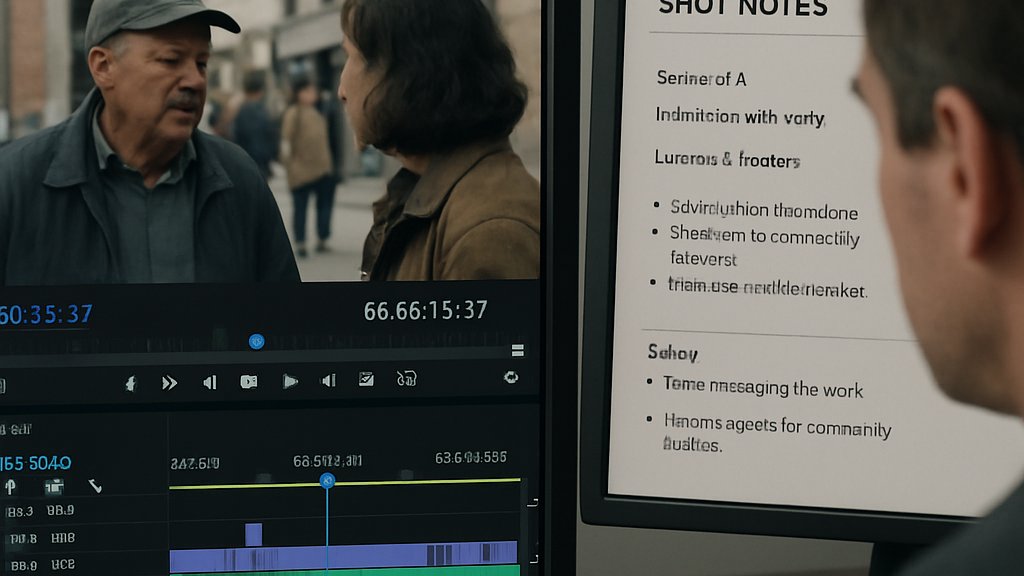
Atomic chain-of-thought supervision decomposes captions into small evidence steps. In contrast, previous pipelines trained end-to-end without revealing intermediate logic. This disclosure aligns with industry demands for transparent Video Reasoning AI. Additionally, the explicit format supports downstream analytics and dataset auditing.
CineCap introduces traceable captions grounded in verifiable anchors. However, understanding its reasoning pipeline requires deeper inspection, which the next section provides.
Structured Reasoning Design Approach
Structured reasoning drives CineCap’s novelty. The pipeline first samples frames and detects objects with a vision encoder. Subsequently, it constructs graph nodes linking objects to motion trajectories across time. This graph becomes an explicit knowledge canvas for caption generation.
Next, a Qwen3-VL backbone processes visual tokens alongside prompts describing desired cinematography aspects. Meanwhile, atomic chain-of-thought labels supervise the model to output micro reasons before the final sentence. Therefore, each caption includes a concise explanation of angle or movement backed by anchor references. The design echoes recent calls for faithful multimodal models that reveal inner logic.
Structured reasoning supplies transparency and control during caption generation. The forthcoming training discussion shows how supervision and reinforcement refine that structure.
Training Strategy Deep Insights
CineCap trains in two phases. First, supervised fine-tuning runs on roughly 80,000 synthetic and human captions for two epochs. Furthermore, it initializes language quality before reinforcement begins. Second, Group Relative Policy Optimization fine-tunes on 2,000 curated samples.
An LLM-as-judge scores candidate captions for accuracy, coverage, and fluency. Subsequently, reward signals update the policy across eight rollouts per sample. Therefore, the model learns to balance completeness with brevity. Reported metrics show substantial gains.
The two-phase recipe couples data efficiency with reward engineering. Consequently, the resulting Video Reasoning AI beats comparators, as the next results section illustrates.
Benchmark Results Performance Overview
Evaluation occurs on the bespoke CineCap Bench dataset. Each clip lasts under 40 seconds and receives a multi-aspect cinematographic caption. Metrics span five filmmaking facets, including shot size and camera motion. Additionally, human judges annotate correctness and description richness.
Key performance highlights include:
- Video Reasoning AI model size: 8B parameters
- CineCap Bench: 472 annotated pairs
- Absolute F1 gain: 32.41 percent over baseline
- Open weights and data under MIT license
CineCap-GRPO outperforms strong proprietary models like Gemini-1.5 and Claude-Opus on every facet. Moreover, the open model surpasses other multimodal models by double-digit F1 margins. The largest gains emerge in depth-of-field detection, previously a weak point for caption generation. Nevertheless, absolute scores still hover below 70 on complex sequences.
CineCap currently leads quantitative charts across targeted metrics. However, broader testing will verify robustness, guiding the discussion on applications.
Practical Industry Use Cases
Studios can index archives by camera technique for rapid retrieval. Consequently, editors locate all dolly-in shots within seconds. Advertising teams can match brand guidelines with consistent cinematography patterns automatically. Moreover, training datasets for controllable video generation pipelines gain richer annotations.
Streaming platforms could surface immersive previews that emphasize stylistic elements alongside plot. Therefore, viewers receive nuanced recommendations tailored to creative preferences. Game engines may also script dynamic cameras by reading CineCap captions as instruction tokens. Additionally, accessibility tools can narrate cinematic intent for low-vision audiences.
Professionals can validate skills through the AI Video Creator™ certification. Such credentials align with emerging Video Reasoning AI workflows in post-production. Furthermore, product managers gain vocabulary for integrating structured reasoning APIs into asset management. These scenarios indicate near-term commercial traction.
Adoption spans editing, streaming, gaming, and accessibility domains. In contrast, limitations still warrant caution, as the following section explores.
Risks And Current Limitations
Reliance on LLM-as-judge introduces evaluation bias. Studies report hallucinations when language models assess their peers. Therefore, human verification remains crucial before deploying captions in critical workflows. Moreover, the CineCap dataset is small, risking overfitting to specific filming styles.
Dataset licensing also deserves scrutiny, because clip sources influence downstream usage rights. Consequently, enterprises must run legal checks before bulk adoption. False positives may mislabel subject motion as camera motion, harming search accuracy. Nevertheless, structured reasoning makes such errors more transparent than opaque embeddings.
Compute requirements present another hurdle. Inference on 40-second clips needs powerful GPUs and specialized preprocessing libraries. Meanwhile, smaller studios may lack that infrastructure. Cloud APIs could mitigate the barrier but raise privacy questions.
These issues underline the importance of staged rollouts and robust audits. Subsequently, research attention shifts toward future enhancements.
Future Research Directions Ahead
Larger multi-annotator benchmarks will confirm generalization across genres and motion complexity. Furthermore, integrating physics-aware multimodal models could provide deeper grounding signals. Improved anchor extraction algorithms may scale dataset creation tenfold. Consequently, caption generation could cover long-form content like sports or documentaries.
Researchers also plan human preference studies to compare Video Reasoning AI with professional editors. Moreover, collaboration with film schools can refine the ontology of cinematography attributes. Reinforcement learning techniques beyond GRPO may stabilise training on longer clips. In contrast, explainability tools might visualize reasoning graphs for classroom demonstrations.
Upcoming community priorities include:
- Expand Video Reasoning AI benchmarks across genres
- Develop low-compute inference pipelines
- Create unbiased human evaluation protocols
Open challenges create opportunities for startups offering specialized evaluation, hosting, and fine-tuning services. Therefore, stakeholders should monitor repositories, preprint updates, and emerging standards. Community engagement will shape responsible innovation in this domain. Meanwhile, certifications help professionals stay ahead of rapid tooling shifts.
Roadmaps highlight scalability, evaluation, and pedagogy as next milestones. Ultimately, sustained collaboration will mature the ecosystem for creative industries.
CineCap pushes Video Reasoning AI toward genuine cinematographic literacy. Its transparent method, combined with reinforcement rewards, outperforms heavyweight multimodal models on a focused benchmark. However, limited data, evaluator bias, and compute costs temper immediate deployment. Video Reasoning AI talent remains scarce yet highly valued across media workflows. Nevertheless, early use cases in editing and accessibility show compelling value. Professionals can leverage the cited certification to capitalise on emerging roles. Consequently, test the code, verify outputs, and share findings to propel the ecosystem forward.
Disclaimer: Some content may be AI-generated or assisted and is provided ‘as is’ for informational purposes only, without warranties of accuracy or completeness, and does not imply endorsement or affiliation.


