

AI CERTS
2 hours ago
Mistral Workflows: Agentic Orchestration Reaches Enterprise Scale
Moreover, it maps the launch to wider Infrastructure investments and sovereignty debates. Readers will gain a grounded view of durability enhancements, customer scale claims, and remaining gaps. Meanwhile, certified professionals can assess new opportunities to sharpen career trajectories. Finally, actionable next steps highlight training like the provided AI Engineer credential. Throughout, transition phrases ensure concise yet connected prose for hurried readers.
European Cloud Market Context
Europe has pursued digital sovereignty for years. However, few indigenous vendors operated Infrastructure at hyperscale until recently. Mistral’s €11.7 billion valuation demonstrates robust investor confidence in continental talent. Bloomberg further reported $830 million debt financing for a Paris-area GPU campus.
Consequently, thousands of Nvidia GB300 units will power low-latency inference close to customers. Analysts note that 44 MW capacity ranks among Europe’s largest dedicated AI facilities. Such proximity reduces data transfer costs and improves Efficiency for regulated sectors. In contrast, enterprises relying on foreign clouds face lingering residency questions.
France Travail and La Banque Postale already highlight sovereignty as a decisive factor during vendor selection. These examples frame Workflows within a broader geopolitical competition. Therefore, European boards now monitor Agentic Orchestration strategies as closely as model accuracy metrics. Sovereign Infrastructure investments amplify Mistral’s appeal for privacy-sensitive industries.
Subsequently, the market context sets the stage for a technical deep dive.
Agentic Orchestration Demystified Now
Workflows targets the persistent gap between proof-of-concept bots and revenue-critical automation. Instead of brittle script chains, it offers durable process graphs called workflows. At the heart lies Agentic Orchestration, coordinating multiple models, connectors, and human approvals.
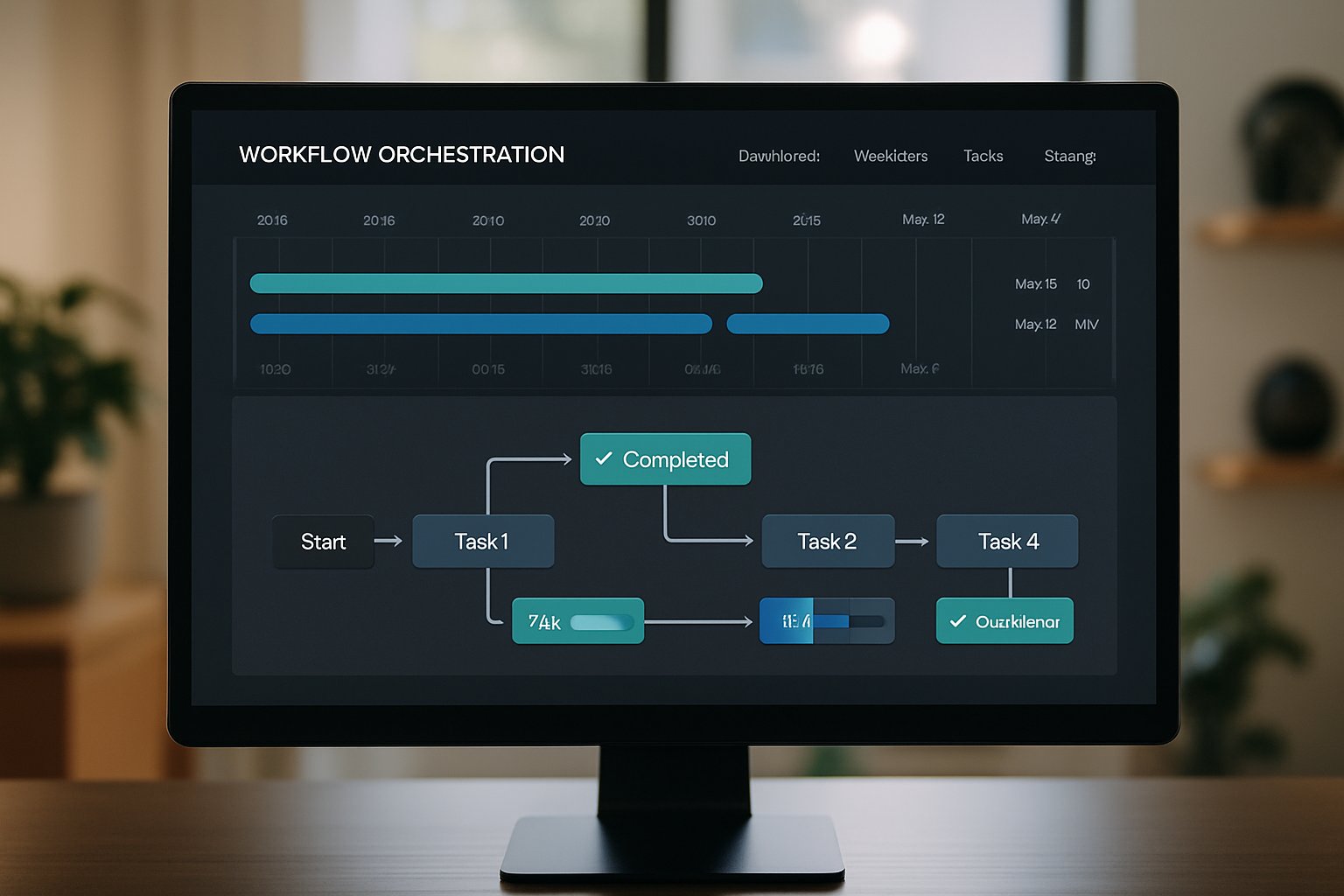
Furthermore, each step records inputs, outputs, and retry history for audit compliance. Human-in-the-loop pauses stop execution without consuming compute, thereby lowering carbon footprint. Observability panels within Studio visualize branching paths and latency hot spots. Studio also autogenerates sequence diagrams that simplify architecture reviews with non-technical stakeholders.
Consequently, governance committees receive clearer evidence when approving sensitive automation. Elisa Salamanca described the system as the missing Infrastructure that converts experiments into stable products. Nevertheless, critics reminded InfoQ that orchestration cannot fix half-right agent actions automatically. Teams must still design rollbacks, guardrails, and domain policies.
- ASML, ABANCA, and CMA-CGM are early adopters running cargo, KYC, and support workflows.
- Press reports claim “millions of daily executions,” though exact telemetry remains undisclosed.
- Mistral offers a Python SDK v3.0 plus demo templates inside Studio.
- Python SDK offers wait_for_input() to pause tasks indefinitely without cost.
Together, these features illustrate the promise of Agentic Orchestration at industrial scale. However, understanding the underlying engine clarifies durability guarantees.
Temporal Engine Underpinning Workflows
Temporal supplies the core state machine ensuring exactly-once execution semantics. Mistral extended the engine with streaming APIs, payload offloading, multi-tenancy, and granular telemetry. Additionally, encryption keeps plaintext payloads inside customer networks.
Workers connect outbound through firewalls, leaving control plane traffic entirely managed by Mistral. Therefore, crash recovery becomes automatic because Temporal replays commands until success. Such resilience aligns with financial regulators that mandate auditable histories. Developers appreciate that workflow code remains ordinary Python rather than a proprietary DSL.
Additionally, the SDK surfaces typed stubs that enable static analysis and early error detection. Such tooling reduces regression risk during frequent model updates. In contrast, many serverless chains lose state during network partitions.
Observability And Efficiency Gains
OpenTelemetry traces feed dashboards measuring tail latency and resource Efficiency. Moreover, developers annotate spans to highlight expensive model invocations. Consequently, teams can right-size GPU pools and improve Infrastructure spending.
InfoQ commentators welcomed these insights yet warned about lingering GPU scheduling complexity. These engine enhancements thus raise visibility without eliminating every tuning duty. Robust execution history and fine-grained metrics underpin sustainable Efficiency gains. Subsequently, attention shifts to deployment architecture choices.
Hybrid Deployment Architecture Advantages
Workflows follows a hybrid model separating control and data planes. Customers install workers via Helm or containers inside existing Kubernetes clusters. Meanwhile, Mistral hosts orchestration state and the Studio interface.
Sensitive data never leaves the customer perimeter, satisfying European Banking Authority guidelines. Moreover, enterprises avoid managing orchestration clusters themselves, reducing operational toil. Durable pauses permit week-long human approvals without hogging compute budgets.
Therefore, legal sign-offs integrate seamlessly into Agentic Orchestration flows. Such design balances sovereignty, cost, and deployment speed for regulated industries. Real deployments show sub-second message overhead between worker pods and the hosted orchestrator. However, VPN misconfiguration can still add latency surprises during peak season loads.
Nevertheless, hybrid models introduce networking dependencies and potential latency spikes when connectors call cloud APIs. The architecture delivers privacy benefits while outsourcing high-availability concerns. Consequently, stakeholders must still evaluate network design before scaling further.
Operational Risks And Challenges
No orchestration layer eliminates every production hazard. Prashanth Velidandi cautioned that GPU Efficiency hinges on scheduler quality, not only workflow graphs. In contrast, partially correct agent actions can damage records before rollbacks execute.
Moreover, cost governance remains difficult because large language models spike consumption unpredictably. Temporal retries protect against crashes yet may inflate bills if guardrails misfire. Therefore, monitoring budgets alongside observability metrics becomes mandatory.
Security teams also demand role-based access control, secrets rotation, and compliance attestations. Mistral ships RBAC today, but external audits are still pending. Nevertheless, early customers report productivity gains overshadowing these concerns.
Some finance teams impose strict cost caps, automatically pausing workflows when budgets exhaust. Meanwhile, auditors demand immutable logs that map every automated decision to underlying data inputs. Risk awareness encourages disciplined design around Agentic Orchestration pipelines. Subsequently, organizations formulate structured adoption roadmaps.
Strategic Adoption Roadmap Steps
Successful rollouts usually begin with a narrow, revenue-linked use case. For example, CMA-CGM automated cargo release validations in weeks using Workflows templates. Additionally, teams should pilot observability dashboards from day one.
Next, integrate cost alerts tied to GPU Efficiency thresholds. Iterative rollouts allow feedback loops, preventing uncontrolled sprawl across business units. After metrics stabilize, expand Agentic Orchestration into adjacent processes like KYC or refund handling.
Professionals can deepen skills via the AI Engineer certification referenced by Mistral. Moreover, certification prepares developers to contribute resilient workflows and security reviews. Finally, executive sponsors should document measurable benefits before pursuing enterprise-wide migrations.
Quarterly reviews should benchmark success metrics against original hypotheses for transparency. Roadmaps anchored in metrics accelerate sustainable adoption of Agentic Orchestration. Consequently, the market momentum described earlier appears poised to compound.
Conclusion And Next Steps
Mistral Workflows enters a crowded field yet brings unique sovereignty and durability traits. European Infrastructure investments further differentiate the offering for privacy-conscious industries. However, mastering Agentic Orchestration still requires disciplined design, observability, and cost governance.
Engine extensions, hybrid deployment, and Efficiency tooling address many pain points. Nevertheless, teams must validate scale claims and prepare rollback strategies. By following the roadmap outlined above, organizations can de-risk production launches swiftly.
Interested professionals should pursue continuous learning, including the linked AI Engineer certification. Furthermore, peer benchmarks show governance maturity accelerates once shared patterns exist. Take action now and transform experimental agents into revenue-grade systems with structured automation.
Disclaimer: Some content may be AI-generated or assisted and is provided ‘as is’ for informational purposes only, without warranties of accuracy or completeness, and does not imply endorsement or affiliation.


