

AI CERTS
2 months ago
Grok 4.3 Shows Multimodal AI Models Gaining Native Video Skills
This article distills the core specifications, pricing quirks, and emerging competitive context. Furthermore, it highlights early tester feedback on latency, clip limits, and document exports. Professionals evaluating frontier systems will also find certification paths to build verified expertise. Therefore, expect actionable insights grounded in reported facts rather than unchecked hype. Let us unpack Grok 4.3’s video breakthrough and its broader enterprise implications.
Silent Beta Rollout Details
xAI inserted Grok 4.3 into iOS, Android, and web clients on 17 April. Meanwhile, only the SuperGrok Heavy tier, priced at $300 monthly, could activate the model. Testers immediately compared the release against other Multimodal AI Models already in production. Other subscribers saw the name but received access-denied messages when selecting it. Moreover, no official blog, benchmark chart, or model card accompanied the launch.
Elon Musk later clarified on X that the active checkpoint holds roughly 500 billion parameters. He added that a one-trillion-parameter version remains in training and will follow in days.
In sum, rollout speed outpaced documentation. Consequently, analysts must piece together facts from community sightings before moving deeper.
Native Video Capability Explained
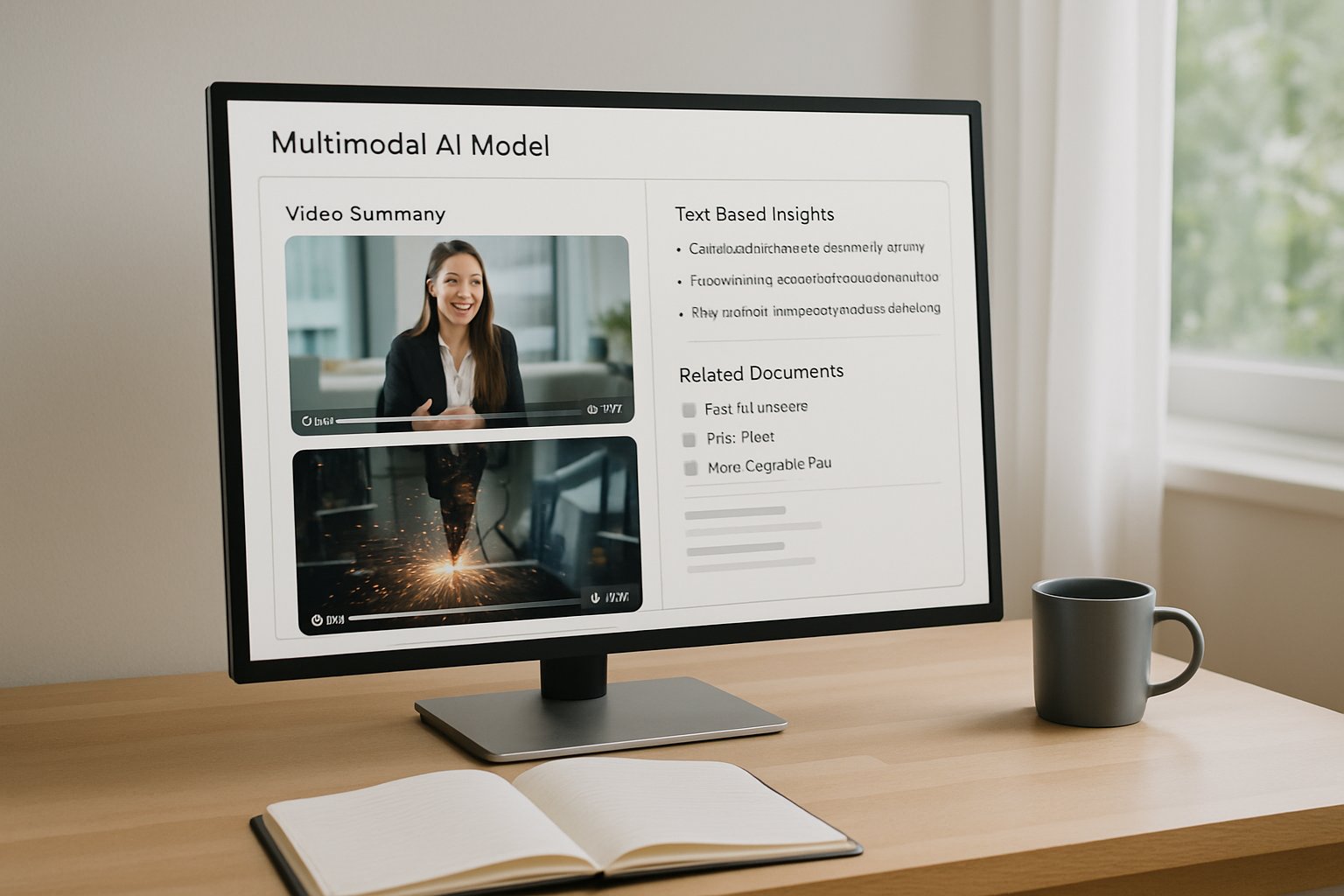
Native video input marks the headline addition over previous Grok builds. Instead of frame sampling, the model ingests entire clips and reasons across temporal continuity. Therefore, users can ask, “What changed between minutes twelve and thirteen?” and receive grounded answers. Early testers uploaded thirty-second meeting recordings and received concise action-item lists within seconds. However, community posts note quality drops on longer or higher-resolution files.
For Multimodal AI Models, temporal reasoning represents a longstanding benchmark. xAI claims Grok handles speech transcription, speaker segmentation, object tracking, and motion causality processing in one pass. Such unified processing compresses multi-tool workflows that previously chained transcribers, chunkers, and language models. Moreover, the feature integrates with a download button that exports summaries directly to PDF slides.
These gains illustrate why enterprises crave seamless video intelligence. Nevertheless, capability alone means little without scale, which the next section addresses.
Extended Context Window Power
Grok 4.3 retains the eye-catching two-million-token context window introduced last cycle. Consequently, analysts can drop entire film transcripts, multiple reports, and source code repositories into one chat. The model then references earlier segments without manual indexing or external vector stores. This breadth benefits Multimodal AI Models by tracking entities across hours of footage and pages. In contrast, several rival offerings still cap sessions below one million tokens.
Developers also exploit the window for chained reasoning, embedding entire policy libraries beside meeting videos. Furthermore, the long memory reduces repetitive prompt engineering and automation glue code. However, observers caution that evaluation suites for such extreme context remain scarce.
Long memory sets the stage for richer outputs. Subsequently, document generation becomes the next logical frontier.
Document Output Workflows Simplified
Grok 4.3 now offers one-click exports to PDF, PowerPoint, and spreadsheet formats. Therefore, users reviewing a training footage can spawn a slide deck without switching applications. The workflow suits compliance teams that must file structured evidence within rigid templates. Moreover, output reproducibility supports audit trails and automation hooks for downstream reporting.
- Time saved by removing manual clip transcription.
- Reduced licensing costs for separate editing software.
- Fewer errors through consistent template automation.
Multimodal AI Models that generate fully-formatted decks reduce post-analysis drudgery for consultants. Collectively, these perks highlight why document workflows matter alongside raw video analytics. Consequently, pricing considerations now rise to the foreground.
Pricing And Access Barriers
SuperGrok Heavy subscribers pay $300 each month for early access. Meanwhile, standard tiers observe the model grayed out, fueling frustration online. No API pricing table appeared at publication time, limiting corporate procurement planning. Additionally, the paywall hinders independent benchmarking, which requires volume testing.
Elon Musk’s transparency about parameter counts contrasts with the opaque cost model. Nevertheless, enterprises value predictable billing when embedding Multimodal AI Models into production pipelines. Procurement teams must triangulate anecdotal latency data before green-lighting large deployments.
Unknown costs complicate adoption timelines. Next, we examine operational and governance risks.
Risks And Unknowns Ahead
Absence of an official model card leaves safety mitigations vague. Consequently, privacy officers worry about ingesting personally identifiable information within recordings. Community testers also reported intermittent latency and occasional hallucinated frame descriptions. Moreover, Grok 4.3 currently lacks session-persistent memory, forcing manual context restatement between chats.
Regulators may scrutinize video ingestion because deepfake detection policies remain evolving. In contrast, peer vendors released whitepapers outlining misuse safeguards for similar processing engines. Therefore, xAI faces pressure to publish comprehensive governance documentation soon.
Unchecked Multimodal AI Models could inadvertently store sensitive frames, triggering compliance breaches. Risk transparency shapes trust trajectories. Accordingly, analysts monitor competitive moves to gauge market impact.
Market Impact Outlook 2026
Competitors like Anthropic, OpenAI, and Google DeepMind already market capable multimodal suites. However, none combine native video reasoning with a two-million-token window yet. That pairing grants xAI a messaging advantage despite unverified performance metrics. Vendors racing to perfect Multimodal AI Models now spotlight parameter counts as marketing shorthand. Consequently, investors interpret Grok 4.3 as a bid to own long-form media automation.
Industry consultants predict a surge in meeting analytics, sports analysis, and security forensics use cases. Moreover, professionals can enhance their expertise with the AI+ Quantum Analyst™ certification. Such credentials guarantee teams understand deployment nuances around large Multimodal AI Models.
xAI’s trajectory now depends on documented evidence and wider access. The concluding section distills strategic takeaways and next steps.
Strategic Takeaways
Grok 4.3 positions xAI at the crossroads of video intelligence and massive context reasoning. Its silent beta proved that Multimodal AI Models can unify transcription, processing, and presentation within one chat. However, opaque benchmarks, premium pricing, and safety gaps hinder immediate enterprise rollouts. Therefore, leaders should demand formal documentation while piloting limited workloads to measure latency and automation value.
Meanwhile, professionals can future-proof careers through the linked certification, securing verified expertise for forthcoming releases. Act now to explore workloads, gather empirical data, and stay ahead in the evolving multimodal arena.
Disclaimer: Some content may be AI-generated or assisted and is provided ‘as is’ for informational purposes only, without warranties of accuracy or completeness, and does not imply endorsement or affiliation.


