

AI CERTS
49 minutes ago
Australia’s AI Boom Exposes a Skills Gap Why AI Training Is Now a Business Survival Priority
AI Adoption Is Rising Faster Than Employee Readiness
Across industries, Australian businesses are integrating tools such as generative AI copilots, workflow automation platforms, predictive analytics engines, and intelligent assistants. Many leaders are chasing faster output, lower costs, and competitive advantage. Yet implementation often begins before staff understand how to prompt systems, validate outputs, manage privacy risks, or redesign workflows around AI.
This creates a dangerous scenario where technology is present, but capability is missing. AI software alone does not produce transformation. Skilled people do.
The same trend is visible globally. Businesses are buying access to AI tools quickly, but they are slower to invest in structured learning programs that help teams apply those tools strategically. In Australia, that lag is becoming visible enough to trigger public discussion around workforce capability, trust, and productivity.
Why Generative AI Needs Immediate Training Support
The most suitable technology to connect with this development is Generative AI. It is one of the fastest-growing workplace technologies because it can create content, summarize information, draft reports, automate responses, and improve internal efficiency. However, it also carries risks when used without training.
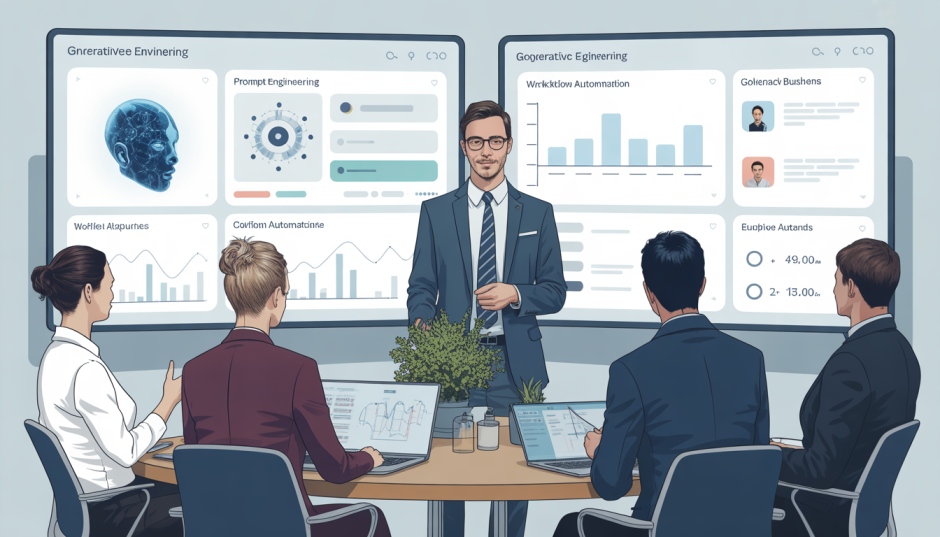
Employees who lack AI education may share confidential data into public tools, trust inaccurate outputs, generate biased content, or misuse automation in customer-facing tasks. This can damage brand trust and increase operational risk.
When employees are properly trained, generative AI becomes a force multiplier. Teams can improve writing speed, data interpretation, idea generation, research efficiency, and collaboration. The difference between risk and reward often comes down to training.
That is why organisations now need certifications in areas such as prompt engineering, AI ethics, governance, data literacy, automation strategy, and responsible AI implementation.
The Real Cost of Delayed AI Upskilling
Many companies assume they can “learn while doing.” In practice, this usually leads to fragmented adoption. Some teams become highly productive while others resist change or misuse tools. Managers struggle to measure ROI. Security teams face new risks. HR teams worry about role disruption. Leaders then blame the technology when the real issue is capability.
Australian business surveys already show that concerns around privacy, cybersecurity, governance, and skills shortages remain key barriers to scaling AI effectively.
Without training, companies often experience slower adoption, inconsistent results, employee anxiety, shadow AI usage, and poor governance.
With training, they gain confidence, measurable productivity, stronger compliance, and a culture of innovation.
Why Certification Matters More Than Casual Learning
Watching a few videos or reading tool guides is not enough for enterprise AI adoption. Businesses need structured learning pathways with measurable outcomes.
This is where professional AI certifications become valuable. Certifications help employees move from curiosity to competence. They provide frameworks, use cases, governance principles, and practical skills that organisations can apply immediately.
For executives, AI leadership certifications help with strategy and decision-making. For marketers, they improve personalization and campaign intelligence. For cybersecurity teams, they strengthen threat detection and response. For HR teams, they support talent transformation. For technical teams, they improve automation and data workflows.
In short, certification turns scattered experimentation into scalable capability.
How the AI CERTs ATP Model Helps Organisations Scale Faster
For companies, colleges, consultants, and training providers looking to meet rising AI demand, the AI CERTs Authorized Training Partner (ATP) model offers a practical growth path.
The ATP program enables partners to deliver globally aligned AI certification training with ready-made curriculum, branding support, sales enablement, and scalable learning infrastructure. Instead of building programs from scratch, organisations can launch trusted AI education faster and serve growing market demand.
This is especially relevant in markets like Australia, where businesses urgently need workforce AI readiness but may not have internal capability to develop complete learning ecosystems.
As AI adoption rises, ATP-style partnerships can help close the gap between tool usage and talent readiness.
What Australian Businesses Should Do Next
The smartest organisations will not ask whether AI is coming. They will ask whether their people are ready.
The next 12 months should focus on role-based AI training plans, governance frameworks, certification pathways, internal AI champions, and measurable learning outcomes. Businesses that invest now will outperform those still relying on trial and error.
Technology moves quickly. Workforce capability must move faster.
Conclusion
Australia’s workplace AI surge has made one reality clear: buying AI tools is easy, building AI-ready talent is harder. The companies that win in 2026 will be those that treat AI training as a strategic investment, not an optional extra. AI advantage belongs to organisations that educate as fast as they innovate.
FAQs
What is causing the AI skills gap in Australia?
Businesses are adopting AI tools rapidly, but employee training programs have not expanded at the same speed.
Why is generative AI training important?
It helps employees use AI safely, accurately, and productively while reducing privacy and quality risks.
Do small businesses need AI certification too?
Yes. Smaller teams often benefit the most because training helps them automate faster with fewer resources.
What is the ATP model by AI CERTs?
It is an Authorized Training Partner program that enables organisations to deliver AI certification programs efficiently.
Can AI training improve ROI from AI tools?
Absolutely. Skilled employees use tools better, create better outputs, and help organisations scale results faster.
Disclaimer: Some content may be AI-generated or assisted and is provided ‘as is’ for informational purposes only, without warranties of accuracy or completeness, and does not imply endorsement or affiliation.


