

AI CERTS
2 hours ago
China’s Axoft implant tests reshape AI Health Research
Axoft says it has tested in 11 patients worldwide. However, only one confirmed procedure occurred in China. Investors responded swiftly, closing a $55 million Series A round. Moreover, the firm plans several additional Trials inside Chinese hospitals before a U.S. FDA filing next year. This introduction maps the story’s commercial stakes and scientific promise. Readers will also gain context on funding, governance and ethical debates that shape modern Brain innovation.
China BCI Growth Momentum
China’s National Medical Products Administration approved its first commercial Implant for paralysis in March 2026. Therefore, many foreign start-ups see China as an attractive test bed. Nature reported dozens of active invasive Trials inside mainland hospitals. Furthermore, a bibliometric survey counted 194 BCI studies registered worldwide by late 2024, with a rising Chinese share.
Several incentives explain this momentum. In contrast to slower Western pathways, Chinese ethics committees often green-light exploratory devices within months. Additionally, local government grants offset clinical costs. Consequently, Axoft’s leaders framed Shanghai as a logical early market. The company remains silent on the unnamed partner hospital, raising transparency questions.
These regulatory tailwinds accelerate device iteration. However, rapid timelines may compress patient-safety evaluations. That tension underpins ongoing AI Health Research discussions about harmonised oversight. The sector’s future depends on resolving that friction.
Fresh Funding Fuels Expansion
Axoft’s new capital came from C.P. Group Innovation, Gaorong Ventures, Hillhouse and The Engine. Moreover, Boston Globe sources suggest total fundraising now exceeds $60 million. The cash infusion supports material scale-up, additional Medical trials and expanded engineering hiring.
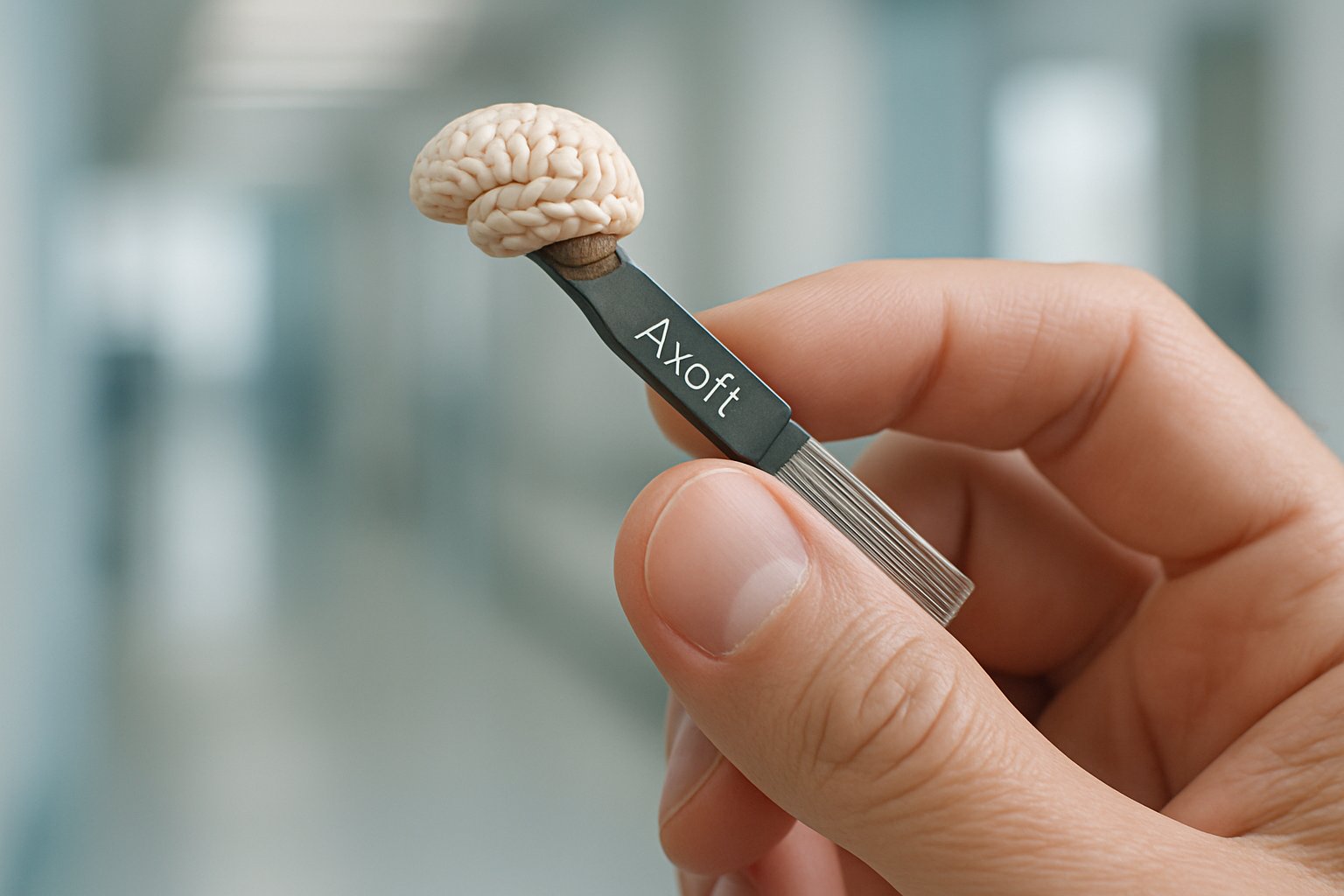
Key investors highlighted Fleuron’s mechanical profile: up to 10,000 times softer than silicon arrays. Consequently, the material may reduce glial scarring, prolonging signal quality. However, independent labs have not yet replicated those Brain tissue claims. Gaorong Ventures’ Hongbo Zhao publicly cited founder Jia Liu’s flexible-electronics research as the deal’s foundation.
Funding strength signals investor confidence. Nevertheless, robust data will ultimately decide market viability. These dynamics segue into the firm’s strategy.
Axoft Strategy In Focus
CEO Paul Le Floch outlines a phased roadmap. Initially, the company targets disorders of consciousness. The device measures cortical activity, potentially helping doctors prognosticate comatose patients. Subsequently, Axoft aims to support speech and motor restoration applications.
The approach mirrors other Implant pioneers yet emphasises softness as a unique differentiator. Furthermore, Axoft licenses Fleuron to academic groups, seeking validation beyond internal Trials. Meanwhile, the firm prepares a U.S. investigational device exemption submission. That filing will test whether China-derived intraoperative data satisfies Food and Drug Administration expectations.
Ethical Oversight Gaps
Rapid cross-border research raises governance issues. Independent ethicists warn that temporary surgeries, even minute-long, still carry infection and haemorrhage risks. Moreover, unnamed Chinese partners limit external audit possibilities. Consequently, stakeholders demand clear trial-registration numbers, consent forms and adverse-event logs.
Data sovereignty adds another layer. Neural signals represent intimate health information. Therefore, international transfers may trigger national-security reviews. Meanwhile, researchers debate long-term responsibility for explanted hardware. These unresolved concerns place Axoft at the heart of wider AI Health Research policy discussions.
Addressing oversight gaps will build patient trust. However, doing so requires coordinated action among regulators, hospitals and industry.
Clinical Evidence So Far
Axoft’s FINESSE study implanted four patients at The Panama Clinic. Each surgery yielded roughly twenty minutes of multi-layer recordings. Additionally, the Shanghai test delivered similar temporary data. No serious complications were reported publicly. Nevertheless, observers note the limited sample size.
For perspective, other leading Brain interface firms—Neuralink, Synchron, Precision Neuroscience—publicly document multi-month performance and stimulation outcomes. Consequently, analysts await Axoft’s chronic-implant reports. Moreover, peer-reviewed histology confirming reduced gliosis remains absent.
Key published numbers include:
- Up to 1,024 electrodes per probe strand
- Material softness claimed at 10,000× conventional probes
- Eleven total human exposures, one inside China
These metrics sound impressive. However, reproducible Trials must confirm lasting signal integrity. Stronger evidence will bolster commercial arguments.
Key Strategic Takeaways Ahead
Axoft’s decision illustrates a broader trend: innovators leverage diverse regulatory jurisdictions. Furthermore, substantial venture backing now follows cross-border pathways. Consequently, professional audiences should monitor several action points:
- Track Chinese registry entries for new Implant approvals.
- Compare chronic safety data across firms.
- Evaluate data-governance frameworks protecting neural records.
Professionals can deepen their defensive skill set through the AI Security Level 1™ certification. Comprehensive security knowledge will prove essential as neurodata volumes climb.
Regulatory Crossroads For BCIs
Global regulators face balancing acts. The FDA maintains rigorous feasibility demands, slowing early-stage Medical devices. In contrast, China promotes accelerated pathways for strategic sectors. Moreover, Europe’s new Artificial Intelligence Act proposes risk-classification tiers that encompass invasive BCIs.
Industry groups therefore lobby for harmonised standards. Consequently, convergent rules would reduce developer uncertainty and protect patients. Meanwhile, cybersecurity frameworks must evolve because implanted networks differ from typical hospital endpoints. AI Health Research communities are already drafting specialised threat models.
These policy shifts will define market entry windows. Prepared companies will navigate them effectively.
Axoft’s Shanghai milestone underscores fast-moving territory. Strong funding, bold strategy and regulatory diversity shape its trajectory. Nevertheless, transparent data and ethical vigilance remain non-negotiable. Continuous AI Health Research collaboration will decide whether ultra-soft Brain interfaces reach broader patient populations. Engage now, evaluate forthcoming Trials rigorously, and cultivate the expertise needed for responsible deployment.
Professionals who master compliance, security and clinical metrics will lead next-generation neurotech. Consequently, consider expanding credentials and joining specialist forums today.
Disclaimer: Some content may be AI-generated or assisted and is provided ‘as is’ for informational purposes only, without warranties of accuracy or completeness, and does not imply endorsement or affiliation.


