

AI CERTS
3 hours ago
Humanoid Robotics Trial Transforms Tokyo Airport Baggage Handling
Record inbound tourism and a chronic labor shortage push the airline toward bold automation moves. Consequently, executives call 2026 the “first year of humanoids” for ground operations. This article dissects the strategy, technology, challenges, and implications for aviation leaders. Therefore, understanding Humanoid Robotics today will help executives future-proof tomorrow’s ramp workforce.
Robots Tackle Ground Work
Haneda processes more than 60 million passengers annually, moving thousands of bags each hour. In contrast, the new robots promise steady performance without fatigue or injury risk. They stand roughly 130 centimeters tall and carry modest payloads that suit small baggage items. However, engineers will first restrict them to low-speed pushes of carts beside human supervisors. The collaborative method aligns with aviation safety doctrine and early Humanoid Robotics deployments elsewhere.
Japan Airlines hopes robots will reduce manual lifting and free staff for complex customer tasks. Moreover, managers believe consistent robot availability will buffer operations during peak travel surges. These initial duties create a baseline for measuring progress across the two-year trial experiment.
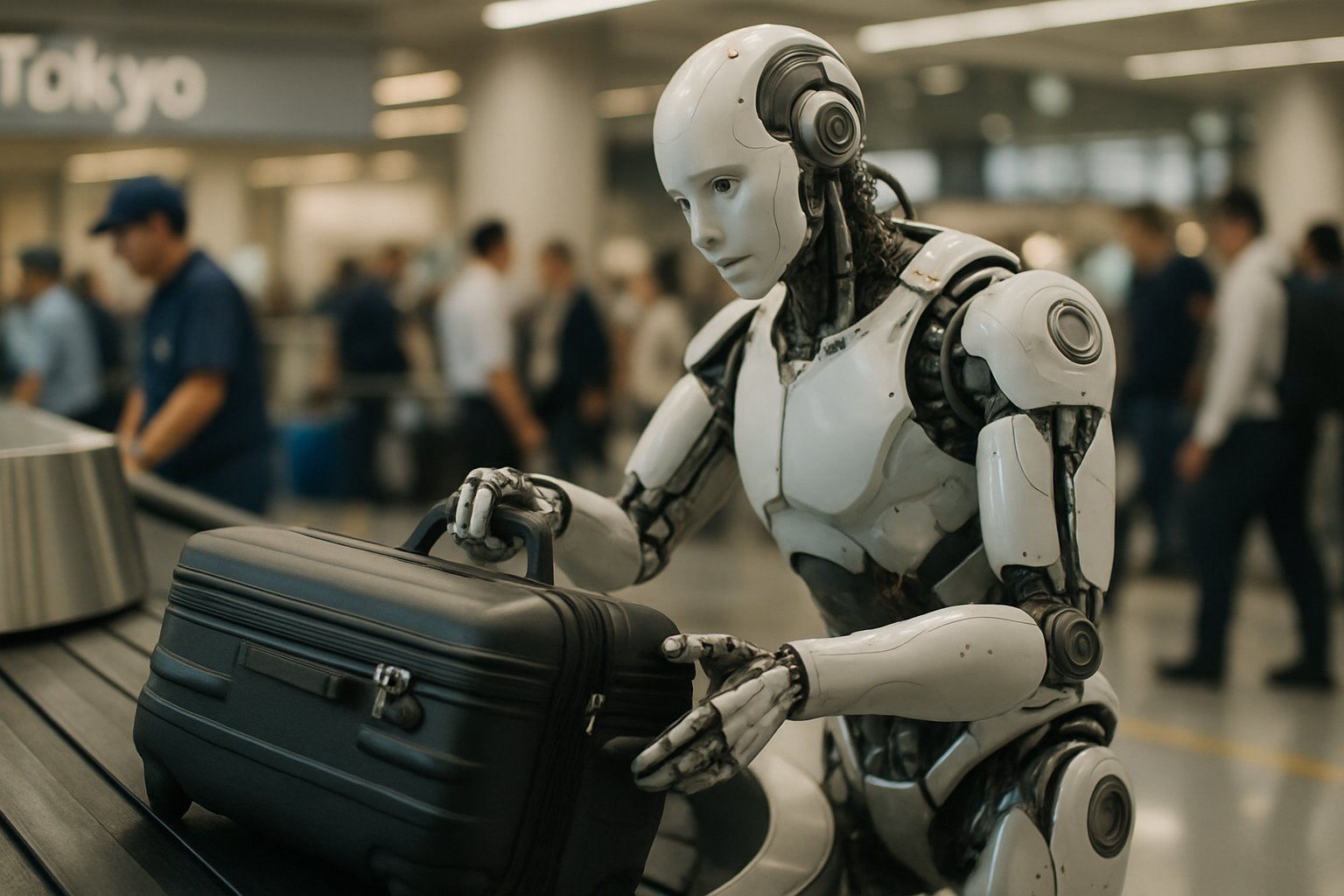
Early tasks focus on safe, low-risk cargo motions. Subsequently, more demanding activities will enter scope in later phases.
Drivers Behind New Trial
Japan faces an aging workforce and tightening immigration policies. Consequently, a critical labor shortage threatens service quality at airports nationwide. Tokyo airport feels the pressure most acutely because international arrivals are hitting fresh records. Japan Airlines therefore frames the trial experiment as a pre-emptive capacity hedge, not head-count purge. Meanwhile, corporate sustainability goals push management toward flexible automation that reuses existing infrastructure.
Humanoid Robotics forms can climb stairs and enter cabins without expensive machinery changes. Therefore, incremental capital costs stay manageable compared with full conveyor rebuilds. These forces collectively justify sustained investment through 2028.
Rising demand and shrinking labor shape JAL’s urgency. However, technology readiness ultimately dictates project pacing, as the next section explains.
Technology Under The Hood
Unitree’s G1 model headlined recent media demonstrations, though JAL has not confirmed final hardware choices. The 35-kilogram platform delivers two hours of continuous operation on a 9,000-mAh battery.
- Height: 130 cm, weight: 35 kg.
- Battery: 9,000 mAh, around two hours runtime.
- Payload: up to 5 kg per arm today.
- Recharge: quick-swap packs in under one minute.
Fast-swap packs allow quick returns to duty during intense Tokyo airport schedules. Furthermore, onboard lidar and stereo vision enable obstacle detection suitable for narrow jet bridges. However, wind gusts, puddles, and reflective surfaces still confuse perception stacks. Therefore, remote supervisors can override motions via encrypted 5G links when anomalies arise. Consequently, GMO AIR integrates multi-factor authentication and failsafe posture freezes that halt movement near aircraft. These safeguards align with emerging ISO robotics safety drafts focused on airside Humanoid Robotics. Moreover, the trial offers a live proving ground for Humanoid Robotics planners still maturing in labs.
Field data will feed algorithm refinement and battery design. Subsequently, lessons will inform the safety strategy discussed next.
Safety And Regulation Steps
Aviation safety culture leaves no room for uncontrolled experimentation. Thus, JAL divided the program into three formal verification phases. Phase one maps workflows and pinpoints hazards with conventional risk matrices. Phase two moves robots into closed hangar mock-ups for functional stress tests. Phase three exposes units to live Tokyo airport operations under tight human escort. Meanwhile, regulators from MLIT and TIAT review logs and certify incremental capability releases.
In contrast, fully autonomous apron duty remains years away pending rigorous fault-tree analyses. Nevertheless, early results will shape future guidance for all airport automation projects. Experts advise redundant brakes, emergency stop lanyards, and bright vests to signal active Humanoid Robotics units.
Layered controls reduce collision and cyber risks. Therefore, economic considerations now enter the conversation.
Human Impact And Economics
Ramp agents endure heavy lifting, awkward postures, and tight schedules. Consequently, musculoskeletal injuries drive absenteeism and high turnover. Japan Airlines positions robots as exoskeleton-free relief rather than direct replacements. Union representatives have not yet issued formal statements on the trial experiment. However, past surveys show staff support cobots that spare joints while preserving wages. Moreover, automation investments hedge against volatile exchange rates affecting foreign worker recruitment. Airlines must still budget chargers, spare batteries, and software licenses. Total cost of ownership will decide whether Humanoid Robotics scales beyond pilots.
Economics look promising yet unproven at present. Nevertheless, strategic trends signal larger deployments ahead.
Future Outlook For Airports
Industry analysts call 2026 the commercial dawn for legged machines. Therefore, lessons from this Tokyo airport deployment will ripple globally. European hubs eye similar robot projects to offset post-pandemic labor shortage effects. In contrast, U.S. regulators remain cautious about tarmac autonomy near crews. Nevertheless, rapid battery innovation may soon triple runtime and payload capacity. Humanoid Robotics will benefit from these parallel advances in sensors, compute, and materials. Longer term, airports could run mixed fleets of fixed conveyors, AGVs, and dexterous humanoids.
Global momentum appears strong despite regulatory friction. Consequently, executives require clear strategic frameworks, addressed next.
Strategic Takeaways For Leaders
Executives should begin with detailed task analyses identifying ergonomic pain points. Next, build multidisciplinary teams that include safety engineers, cyber specialists, and frontline staff. Moreover, pilot metrics must capture throughput, dwell time, error rates, and human sentiment. Data transparency fosters trust and accelerates regulator approvals. Budget planning should incorporate battery refresh cycles and software subscription escalators. In contrast, ignoring hidden costs can derail promising technology programs.
Leaders also need continuous training pipelines for both technicians and managers. Professionals can deepen expertise through targeted upskilling. They may start with the AI for Everyone™ certification. Humanoid Robotics literacy will soon rank alongside data fluency in operations roles. Consequently, early adopters can convert technical insight into defensible competitive advantage.
Structured governance, metrics, and training underpin successful adoption. Therefore, a concise recap follows below.
Japan Airlines has seeded a bold vision for airport ground work. The ongoing trial experiment showcases what carefully staged Humanoid Robotics can achieve today. Moreover, macro forces—surging tourism and chronic labor shortage—make successful automation more than a curiosity. Safety frameworks, cyber defenses, and sound economics remain decisive success factors. Consequently, leaders should monitor field data and refine their own roadmaps accordingly. Readers eager to lead similar initiatives can begin updating skills through accredited robotics courses. Explore the linked certification and stay ahead of the operational transformation curve.
Disclaimer: Some content may be AI-generated or assisted and is provided ‘as is’ for informational purposes only, without warranties of accuracy or completeness, and does not imply endorsement or affiliation.


