What Is the Best AI Certification for Non-Technical Employees?


Executive Summary
Non-technical employees face major hurdles when attempting to navigate technical training programs. By evaluating recent industry shifts, this blog breaks down the best AI credentials tailored specifically for business roles. It reveals how role-based certifications eliminate programming confusion, lower operational risks, and unlock immediate corporate innovation.
Table of Contents
- The Friction in Non-Technical Professional Upskilling
- Case Study: The 2026 Legal and Corporate Professional Inflection
- Top 10 AI Certifications for Non-Technical Employees
- Why Launching an AI Training Business Is the Ultimate Partner Opportunity
- Frequently Asked Questions (FAQs)
The Friction in Non-Technical Professional Upskilling
Many company executives make the mistake of assuming that artificial intelligence training belongs solely to the engineering department. When they realize that business teams also need these tools, they often distribute generic computer science modules. This technical over-engineering causes immediate cognitive fatigue. Non-technical staff members are forced to sit through lessons on python libraries, neural network layers, and complex coding structures. As a result, employees abandon the courses because the concepts do not connect with their daily responsibilities.
The digital landscape changed completely, proving that tool access must be paired with structured, non-technical credentials. The industry witnessed a massive geopolitical shift when the U.S. Commerce Department ordered Anthropic to restrict foreign nationals’ access to its Fable 5 and Mythos models due to access control concerns. Anthropic responded by temporarily disabling the models globally before restoring a modified version of Fable 5, which features enhanced regional screening and tighter safety classifiers.
Simultaneously, the Five Eyes intelligence alliance issued a joint warning, highlighting the sudden security, prompt injection, and operational risks linked to advanced frontier models. These global events prove that modern enterprises do not need more casual tool users. They need certified professionals who understand functional governance, regional compliance boundaries, and safe deployment without needing a degree in software engineering. For entrepreneurs, this massive education gap is a golden opportunity to become an authorized training partner and help businesses build practical, role-specific skills.
The 2026 Legal and Corporate Professional Inflection
To understand how role-based training alters professional environments, look at the comprehensive global data released in the Thomson Reuters Future of Professionals Report. This study surveyed over 1,800 compliance, risk, legal, and tax experts across 62 countries. It revealed a staggering reality: a widening execution gap is now carrying material consequences, with up to $143 billion in client revenue at risk in the United States alone due to a failure to effectively implement safe digital workflows.
Furthermore, this corporate pressure is triggering real structural transformations in public governance. For instance, the public consultation phase concluded for India’s Supreme Court draft Regulations for Use of AI in Courts. These strict guidelines establish that while automated systems can handle research, citation verification, and administrative transcription, they must preserve human primacy and never decide cases or influence judicial deliberations.
This means that frontline corporate professionals must master functional boundaries immediately. They cannot afford to spend months studying abstract computer science. They need targeted AI training programs that teach them exactly how to utilize these automated workflows safely within their explicit business lanes.
Top 10 AI Certifications for Non-Technical Employees
The following ten credentials represent the most effective role-specific learning pathways available for non-technical employees. These programs entirely skip programming code and focus on operational innovation, risk mitigation, and everyday business applications.
1. AI CERTs® Certified AI Professional (CAIP)™
This foundational program is widely regarded as an industry standard for corporate workers. It introduces the core concepts of automated data processing, machine learning workflows, and strategic prompt structures without requiring any coding knowledge. It teaches business leaders how to evaluate corporate software vendors, spot operational bottlenecks, and safely deploy automated workflows in daily office environments.
2. AI CERTs® Certified AI Manager (CAIM)™
Designed specifically for team leaders, project managers, and operations directors, this credential focuses on implementation governance. It addresses the exact problems highlighted in the Stanford Real World AI Security Conference, where researchers demonstrated that advanced tools are highly vulnerable to indirect prompt injections and data leaks. This course equips managers to build strict internal review checkpoints, manage data pipelines, and keep corporate assets safe.
3. AI CERTs® Certified AI Product Manager™
Product managers must bridge the gap between creative design and technical execution. This certification focuses heavily on user experience design, automated market analysis, and product lifecycle management. It enables non-technical product leads to structure product backlogs, design feature sets, and coordinate with technical engineering squads using precise, standardized terminology.
4. AI CERTs® Certified AI Marketer™
This pathway is designed for digital marketers, brand copywriters, and social media directors. It bypasses technical code to focus on algorithmic customer segmentation, rapid graphic prototyping, and dynamic content generation. By mapping out automated content generation safely, it allows small marketing squads to execute massive campaigns that previously required entire advertising agencies.
5. AI CERTs® Certified AI HR Specialist™
Human resource professionals handle sensitive personnel records and complex hiring criteria. This pathway focuses on automated screening compliance, payroll data security, and resume evaluation boundaries. It teaches HR leaders how to spot and eliminate algorithmic bias in hiring tools, ensuring that internal talent acquisition systems remain fair, transparent, and completely compliant with local labor laws.
6. AI CERTs® Certified AI Legal Practitioner™
In light of the India Supreme Court Draft Regulations, legal professionals must understand the limits of automated research. This credential trains corporate attorneys, paralegals, and contract managers in citation verification, secure document synthesis, and automated document review. It teaches legal professionals how to disclose tool usage transparently and prevent data leaks while managing high-stakes case files.
7. AI CERTs® Certified AI Financial Analyst™
Financial professionals require extreme precision and absolute security. This certification explores automated spreadsheet modeling, market forecasting, and predictive risk auditing. It strips away the computer science mechanics and focuses on how finance leads can use advanced analytical tools to interpret massive market datasets, optimize corporate budgets, and spot fraudulent transactions in real time.
8. AI CERTs® Certified AI Healthcare Administrator™
Healthcare environments operate under incredibly strict privacy and patient data laws. This certification trains hospital managers, administrative staff, and clinical coordinators on patient data protection boundaries, automated medical transcription safety, and billing code optimization. It provides a non-technical roadmap to lower administrative overhead without compromising patient safety or data security.
9. AI CERTs® Certified AI Operations Specialist™
This pathway targets supply chain coordinators, logistics managers, and inventory specialists. It covers automated inventory tracking, route optimization modeling, and automated vendor management. It trains operations professionals to use real-time predictive analytics to prevent shipping delays, lower warehouse storage costs, and keep enterprise logistics running smoothly.
10. AI CERTs® Certified AI Customer Success Manager™
Customer success teams are heavily affected by automated chatbots and voice assistants. This credential teaches support managers how to integrate human empathy with automated ticket routing. It shows how to use customer sentiment analysis to resolve complaints faster, design intelligent self-service portals, and prevent client churn without losing the human touch.
Why Launching an AI Training Business Is the Ultimate Partner Opportunity
Every modern enterprise is searching for a dependable way to upskill its workforce without causing widespread code fatigue among its employees. They do not want general, text-heavy tutorials; they want trusted, internationally accredited credentials. For educational institutes, enterprise consultancies, and independent training companies, this massive market demand is a highly profitable commercial opportunity.
Instead of wasting years trying to write textbooks, build testing platforms, and secure legal accreditations, you can plug directly into a pre-validated global network. By leveraging the AI CERTs Authorized Training Partner (ATP) Program, your education company gains immediate corporate trust.
Connecting with this established powerhouse allows you to offer a massive catalog of 72 specialized professional certifications, backed by an ecosystem that already supports more than 115,000 learners, 200 expert trainers, and 300 partners across 90 countries.
There is a precise partnership path optimized for your specific business goals:
- Build a high-revenue corporate training company through the Authorized Training Partner Program.
- Integrate professional career credentials into collegiate degrees via the Authorized Academic Partner Program.
- Provide large-scale, certified upskilling paths for industry groups as an Association Partner.
- Earn predictable referral commissions by participating as an Affiliate Partner.
Frequently Asked Questions (FAQs)
1. What makes non-technical AI certifications different from standard technical training?
Standard training focuses heavily on computer programming languages and mathematical modeling. Non-technical certifications completely skip the code to focus on strategic execution, prompt optimization, data protection, and real-world business applications within specific roles.
2. Why are role-based certifications necessary for compliance-heavy fields like law and healthcare?
Recent public regulations require strict human primacy and clear data protection boundaries. Role-specific certifications train employees on where automated data processing ends and mandatory human review begins, preventing severe legal and data security violations.
3. Can an independent education business successfully sell these programs to major corporations?
Yes, by partnering with an established network. Trying to sell custom, unaccredited courses to enterprise buyers is incredibly difficult. However, when you become an authorized training partner, you gain immediate access to a globally recognized blueprint that carries instant market trust.
4. How do these professional credentials help reduce employee training fatigue?
Employees experience training fatigue when the educational material feels completely detached from their actual job duties. Role-based paths keep learners engaged by focusing entirely on tools, processes, and solutions that they can apply to their daily work tasks immediately.
5. What is the quickest way to start offering global enterprise certifications?
The fastest route is to join an established global network. Choosing to become a partner allows you to deploy a pre-validated, high-quality professional training catalog to your corporate clients within a matter of weeks.
Recent Blogs
FEATURED
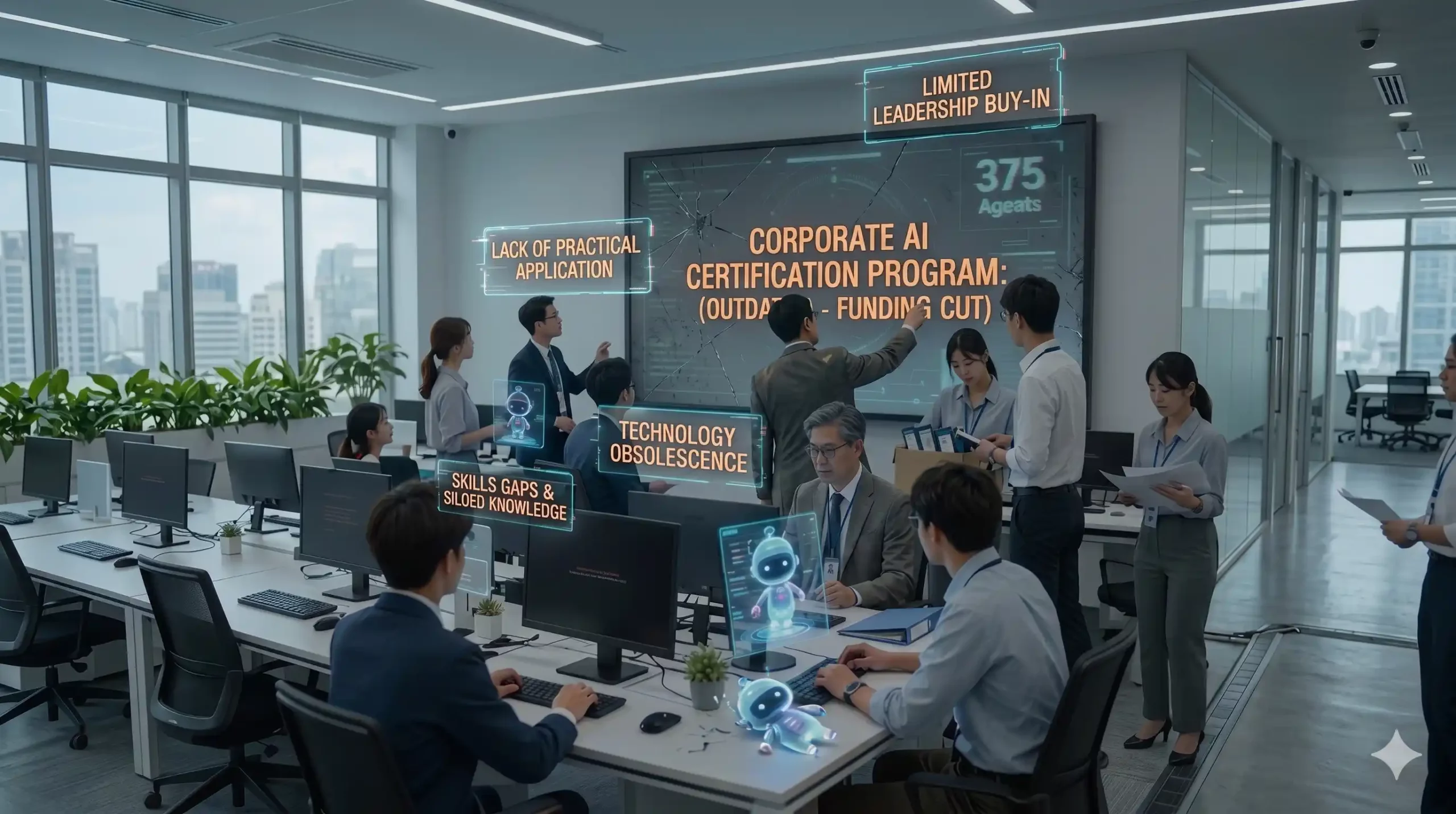
Why Do Corporate AI Certification Programs Often Fail Long Term?
June 25, 2026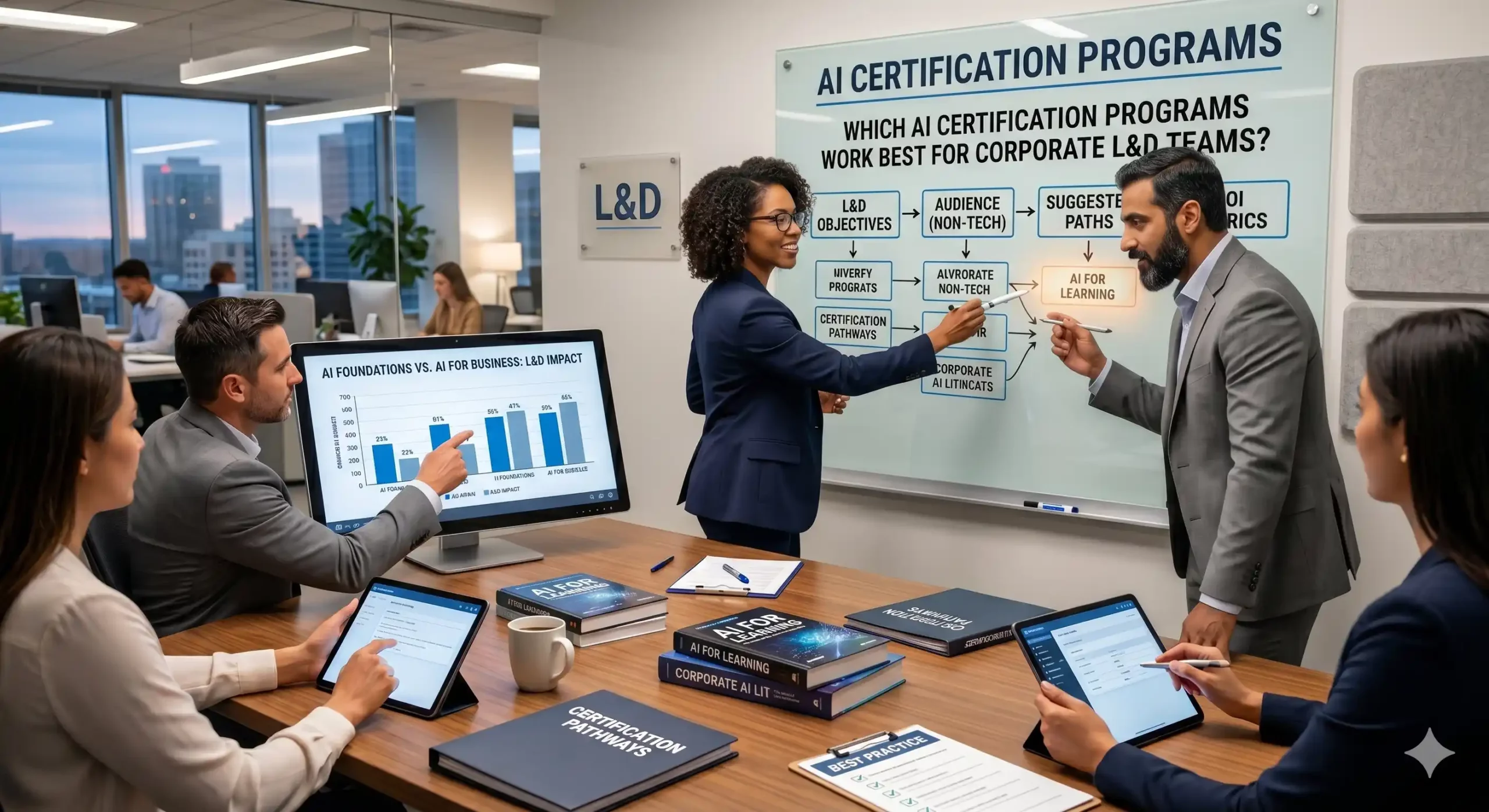
FEATURED
Which AI Certification Programs Work Best for Corporate L&D Teams?
June 25, 2026
FEATURED
What Makes It Hard to Upskill Employees with AI Certifications?
June 24, 2026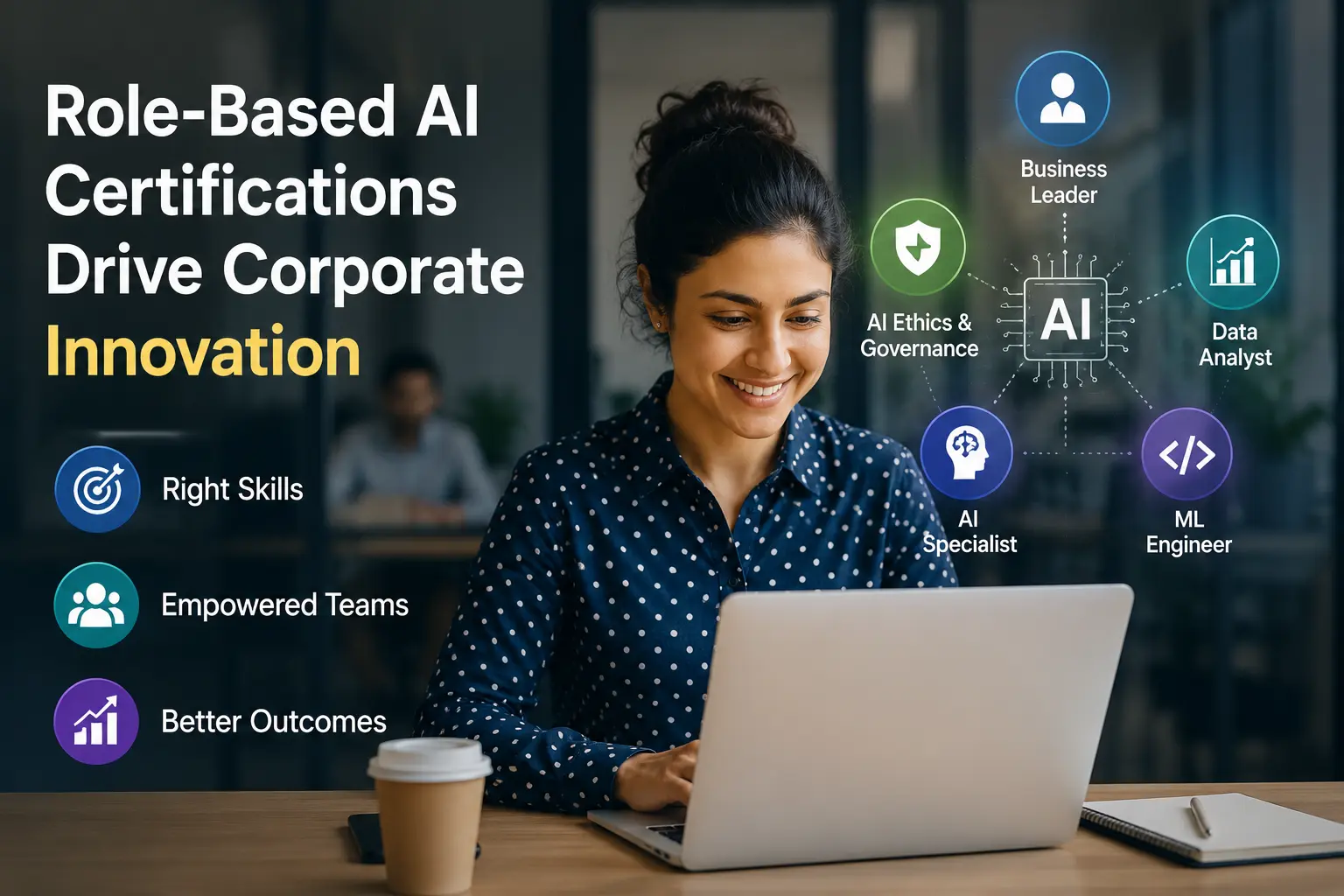
FEATURED
How Do Role-Based AI Certifications Improve Corporate Innovation Outcomes?
June 18, 2026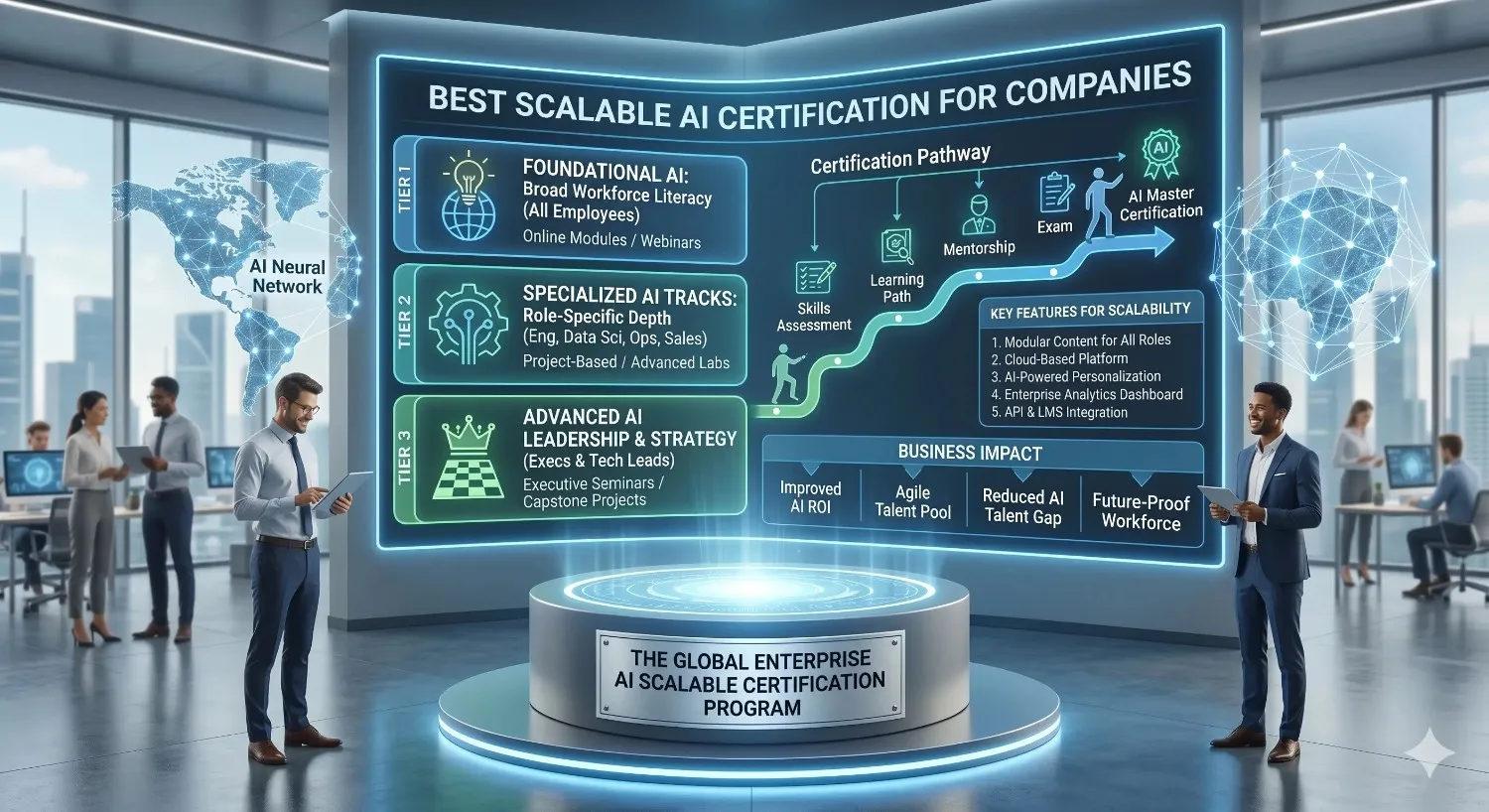
FEATURED
What is the Best Scalable AI Certification Program for Companies?
June 17, 2026